
[論文レビュー] Low Regularity Exponential-Type Integrators for Semilinear Schrödinger Equations
本稿では、半線形シュレーディンガー方程式に対する、初めての1階指数型積分法を提案する。この手法は、解が $H^{r+1}$ に属する場合に $H^r$ で収束を達成し、古典的手法と比較して正則性の追加要件を著しく低く抑えている(2階の追加正則性ではなく、1階のみ)。スキームはねじれた変数の定式化と、$φ_1$-関数による剛性項の正確な積分を用いることで、低正則性解に対しても最適収束を実現する。
We introduce low regularity exponential-type integrators for nonlinear Schrödinger equations for which first-order convergence only requires the boundedness of one additional derivative of the solution. More precisely, we will prove first-order convergence in H$^r$ for solutions in H$^r$$^+$$^1$ (r > d/2) of the derived schemes. This allows us lower regularity assumptions on the data than for instance required for classical splitting or exponential integration schemes. For one dimensional quadratic Schrödinger equations we can even prove first-order convergence without any loss of regularity. Numerical experiments underline the favorable error behavior of the newly introduced exponential-type integrators for low regularity solutions compared to classical splitting and exponential integration schemes.
研究の動機と目的
- 半線形シュレーディンガー方程式に対する古典的手法の高い正則性要件を解決すること。
- 解の正則性仮定を最小限に抑えた状態で、1階収束を維持する時間積分法を開発すること。
- 古典的手法が要請する2階の追加正則性から、わずか1階の追加正則性にまで低減すること。
- 非滑らかで低正則性の解に対して、数値実験を通じて優れた収束特性を示すこと。
- 特に低正則性領域において、指数積分法の適用範囲を拡大すること。
提案手法
- 歪みのない変数 $v(t) = e^{-it\Delta}u(t)$ にダムデールの公式を適用することで、剛性のある線形時間発展と非線形項を分離する。
- 非線形項 $\overline{u}^{2p}$ の主要な部分は、$\varphi_1(z) = (e^z - 1)/z$ で定義される $\varphi_1$-関数を用いて正確に扱い、構造的保存性と精度を維持する。
- 積分スキームは $u^{n+1} = e^{i\tau\Delta}\left[u^n - i\mu\tau (u^n)^{p+1} \varphi_1(-2i\tau\Delta)(\overline{u^n})^p\right]$ として構築され、1階収束を保証する。
- ダムデールの公式における積分を近似せず、剛性部分を正確に解くことで、局所切捨て誤差を低減する。
- $r > d/2$ の $H^r$-ノルムにおいて解析を行い、解の $H^{r+1}$-正則性のもとで収束を証明する。
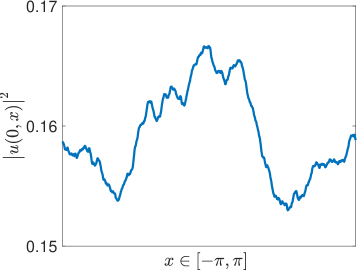
- 滑らかでない初期データと滑らかな初期データを用いた数値的検証を行い、Lie分割法、Strang分割法、古典的指数積分法と比較する。
実験結果
リサーチクエスチョン
- RQ1解空間 $H^r$ よりも1階のみ追加の正則性を要する半線形シュレーディンガー方程式に対して、1階指数積分法を構築可能か?
- RQ2提案された積分法は、低正則性解に対しても1階収束を維持できるか?特に、古典的手法が収束次数の低下を示す状況において。
- RQ3滑らかでない、または低正則性の初期データに対して、新しい積分法は古典的手法(分割法・指数積分法)と比較して、精度と収束速度で優れているか?
- RQ4非整数の指数 $p$ を持つ非線形項 $|u|^{2p}u$ に対しても、新しい積分法が最適収束を達成できるか?特に非線形項が滑らかでない場合に。
- RQ5非線形項が小さい場合(例:$\mu = 0.01$)においても、この手法は安定で収束するか?特に2次シュレーディンガー方程式のような状況で。
主な発見
- 提案された指数型積分法は、解が $H^{r+1}$ に属する場合に $H^r$ で1階収束を達成し、古典的手法が要請する2階の追加正則性ではなく、1階の追加正則性で十分である。
- 1次元の2次シュレーディンガー方程式($p=1$)において、この手法は正則性の損失なしに1階収束を達成する。
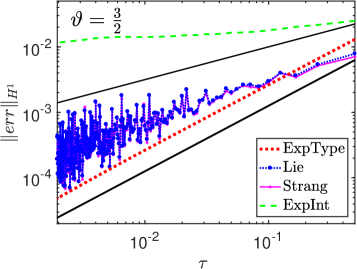
- 滑らかでない初期データを用いた数値実験では、古典的指数積分法は収束せず、Lie/Strang分割法は強力な収束次数の低下(1/2次にまで低下)を示す。
- 新しい積分法は、理論的予測通り、滑らかでない解に対しても1階収束を維持する。数値結果により確認されている。
- 非整数の指数 $p$ に対しても、この新しい積分法は $p = 1/4$ まで1階収束を維持するが、古典的手法では著しく性能が低下する。
- 小さな非線形項($\mu = 0.01$)に対しても、この新しい積分法は滑らかでないデータおよび滑らかなデータの両方に対して、高い精度と1階収束性を保ち、古典的手法を上回る。
より良い研究を、今すぐ始めましょう
論文の読解から最終レビューまで、研究時間を劇的に削減しましょう。
クレジットカード登録不要
このレビューはAIが作成し、人間の編集者が確認しました。