
[論文レビュー] MACE-OFF: Transferable Short Range Machine Learning Force Fields for Organic Molecules
MACE-OFF23は、有機分子の転送可能な局所機械学習力場で、ハイレベルな量子データで訓練され、気体・液体・結晶・生体分子全般に対して高精度・高効率で検証された。
Classical empirical force fields have dominated biomolecular simulation for over 50 years. Although widely used in drug discovery, crystal structure prediction, and biomolecular dynamics, they generally lack the accuracy and transferability required for first-principles predictive modeling. In this paper, we introduce MACE-OFF, a series of short range transferable force fields for organic molecules created using state-of-the-art machine learning technology and first-principles reference data computed with a high level of quantum mechanical theory. MACE-OFF demonstrates the remarkable capabilities of short range models by accurately predicting a wide variety of gas and condensed phase properties of molecular systems. It produces accurate, easy-to-converge dihedral torsion scans of unseen molecules, as well as reliable descriptions of molecular crystals and liquids, including quantum nuclear effects. We further demonstrate the capabilities of MACE-OFF by determining free energy surfaces in explicit solvent, as well as the folding dynamics of peptides.Finally, we simulate a fully solvated small protein, observing accurate secondary structure and vibrational spectrum. These developments enable first-principles simulations of molecular systems for the broader chemistry community at high accuracy and relatively low computational cost.
研究の動機と目的
- 有機分子を構成するH, C, N, O, F, P, S, Cl, Br, Iを含む転送可能で純粋に局所なML力場を開発する。
- SPICEデータセットを用い、def2-TZVPPD/omegaB97M-D3(BJ)などの高レベル量子データで訓練し、より大きな断片と水クラスタを補強する。
- 気体・液体・結晶・生体高分子を横断する分子内・分子間相互作用の正確な予測を示す。
- 二面角スキャン、格子定数、昇華エンタルピー、水の構造、ペプチド/タンパク質関連性質を再現するモデルの能力を示す。
- 一般的なMDエンジン(LAMMPS, OpenMM)での計算性能とスケーラビリティを評価する。
提案手法
- MACEアーキテクチャを用い、2層のメッセージパッシングと等変特徴を持つ。
- 原子周囲環境を局所カットオフ(4.5–5.0 Å)で表現し、体秩序4までの等変積基を構築する。
- 96/128/192の化学チャネルと0/1/2の等変メッセージを用いて3つのモデルサイズ(S, M, L)を訓練する。
- SPICEデータ(10元素、中性種)を大型断片と水クラスタで補強して訓練; 力のエラー > 2 eV/Åの外れ値を除去する。
- 出力関数の和としてエネルギーと力を予測する(レイヤー1:不変、レイヤー2: MLP); 力は解析的エネルギー微分から導出。
- トーションスキャン(TorsionNet-500とビアリルベンチマーク)、分子結晶(振動スペクトル、昇華エンタルピー)、水の構造/ダイナミクス(RDF、量子核効果を含む振動スペクトル)、液体相の密度・蒸気化熱を評価する。
実験結果
リサーチクエスチョン
- RQ1MACE-OFF23は有機系のエネルギー/力に化学精度を達成できるか?
- RQ2訓練データを超えた大きな断片や明示的溶媒環境に対して局所モデルはどれだけ一般化するか?
- RQ3モデルはDFTや高レベル量子参照と比較して異性体障壁・構造を正確に再現するか?
- RQ4結晶相・液相の性質、振動スペクトル・昇華エンタルルピーを説明し、水における量子核効果を扱えるか?
- RQ5MDシミュレーションにおける計算性能(速度とスケーラビリティ)は?
主な発見
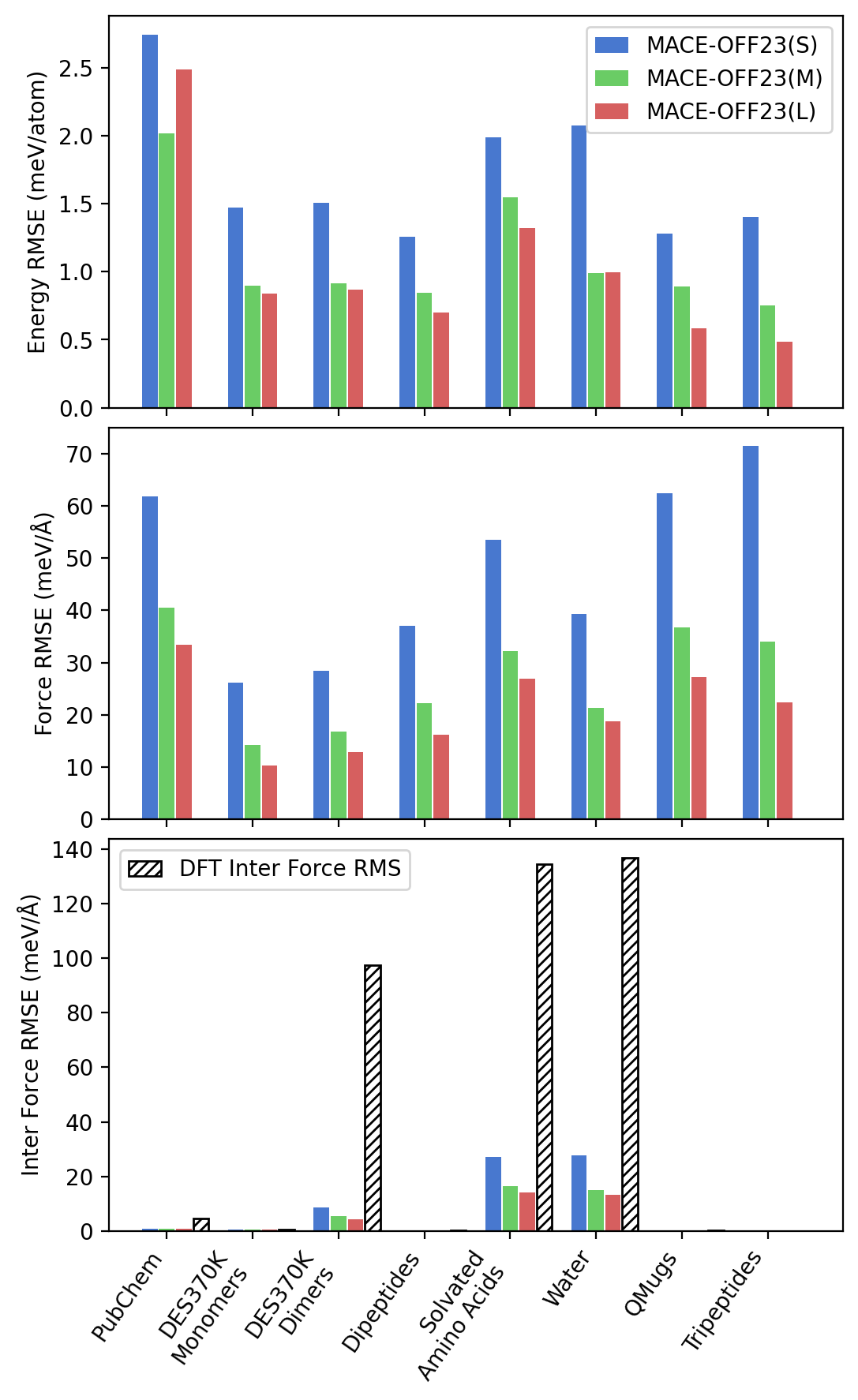
- 大規模なMACE-OFF23モデルは約0.5–1.0 meV/原子のエネルギー/力RMSEと約15–20 meV/Åの分子間力を達成し、対象有機物では化学精度を大幅に下回る。
- 分子間力エラーは約5–15 meV/Åで、総力エラーの約1.5–3倍小さく、分子内エラーは約1–2%程度。
- 二重結合の障壁高さはビアリルベンチマークで約0.3–0.5 kcal/mol、TorsionNet-500では約0.25 kcal/molの誤差で、SPICE DFTレベルで比較するとDFT参照精度に近づく。
- MACE-OFF23(S/M/L)は水のRDFをTIP3P/MB-polと同等に再現し、量子核効果(PIGS)を含めると周波数域で実験のラマ/IR特徴と一致する。
- 大規模モデルのMACE-OFF23は23結晶を跨ぐ昇華エンタルピー予測を平均誤差約1.7 kcal/molで可能にし、分散補正機能と同等。
- 液体には密度のMAEが約0.09 g/cm3 (Mモデル)程度で妥当な蒸発熱予測を示し、水/エーテル/ジブロムのケースは体系的傾向と誤差打ち消しの潜在を言及。
![Figure 2: Dihedral benchmark scans. The top panel shows torsion drive data for the TorsionNet-500 dataset, which has a wide chemical diversity (five example molecules are shown). The bottom panel focuses on the torsion angle between two aromatic rings in the biaryl torsion benchmark [ 66 ] which con](https://ar5iv.labs.arxiv.org/html/2312.15211/assets/x1.png)
より良い研究を、今すぐ始めましょう
論文設計から論文執筆まで、研究時間を劇的に削減しましょう。
クレジットカード登録不要
このレビューはAIが作成し、人間の編集者が確認しました。