
[論文レビュー] Machine Learning-based Lung and Colon Cancer Detection using Deep Feature Extraction and Ensemble Learning
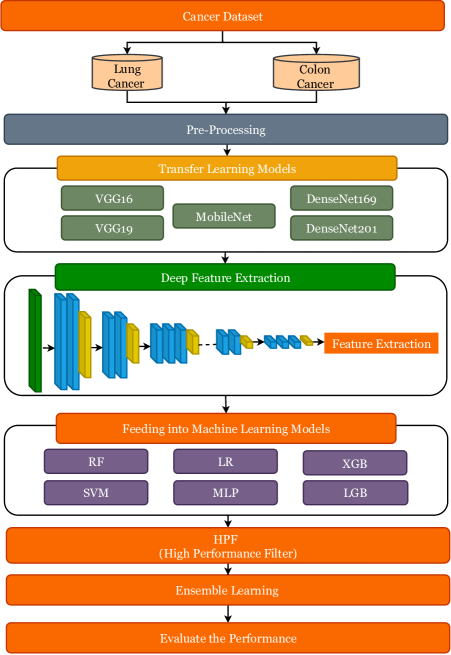
本研究では、転移学習に基づく深層特徴抽出(MobileNetを用いて)とアンサンブル学習(ソフト投票)を統合したハイブリッド機械学習フレームワークを提案し、肺がんおよび大腸がんの自動検出を実現する。LC25000ヒストパスロジー画像データセットを用いた評価において、肺がん検出で99.05%、大腸がん検出で100%、統合検出で99.30%の正確性を達成し、既存手法を上回る性能を示した。
Cancer is a fatal disease caused by a combination of genetic diseases and a variety of biochemical abnormalities. Lung and colon cancer have emerged as two of the leading causes of death and disability in humans. The histopathological detection of such malignancies is usually the most important component in determining the best course of action. Early detection of the ailment on either front considerably decreases the likelihood of mortality. Machine learning and deep learning techniques can be utilized to speed up such cancer detection, allowing researchers to study a large number of patients in a much shorter amount of time and at a lower cost. In this research work, we introduced a hybrid ensemble feature extraction model to efficiently identify lung and colon cancer. It integrates deep feature extraction and ensemble learning with high-performance filtering for cancer image datasets. The model is evaluated on histopathological (LC25000) lung and colon datasets. According to the study findings, our hybrid model can detect lung, colon, and (lung and colon) cancer with accuracy rates of 99.05%, 100%, and 99.30%, respectively. The study's findings show that our proposed strategy outperforms existing models significantly. Thus, these models could be applicable in clinics to support the doctor in the diagnosis of cancers.
研究の動機と目的
- 機械学習を用いて、肺がんおよび大腸がんの早期検出のための高精度で自動化されたシステムを開発すること。
- 深層特徴抽出とアンサンブル学習技術を組み合わせることで分類性能を向上させること。
- 複数の転移学習アーキテクチャと機械学習アルゴリズムを用いて、モデル性能を評価および最適化すること。
- 診断時間とリソース使用量を削減しながらも、がん検出の正確性を維持すること。
- 病理医が肺がんおよび大腸がんの診断を支援できる臨床応用可能なツールを提供すること。
提案手法
- ヒストパスロジー画像からの深層特徴抽出に、事前学習済みの5つの転移学習モデル(VGG16、VGG19、MobileNet、DenseNet169、DenseNet201)を採用した。
- モデルの評価の強固さと一般化性能を確保するため、10-fold交差検証を適用した。
- RF、SVM、LR、MLP、XGB、LGBのうち、最高性能を示す機械学習モデルを選別するために、高性能フィルタリング(HPF)を適用した。
- 最も優れた性能を示したモデルを統合し、アンサンブルソフト投票分類器を構築することで、予測の正確性と安定性を向上させた。
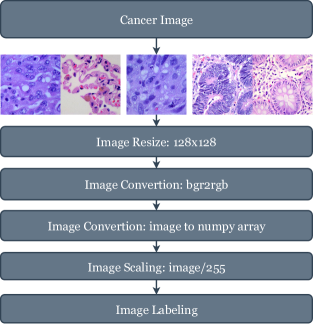
- 特徴品質とモデル入力の一貫性を向上させるために、広範な画像前処理を実施した。
- 正確性、適合率、再現率、F1スコア、AUC-ROC、MAE、MSE、RMSE、混同行列の複数の指標を用いて、モデル性能を評価した。
実験結果
リサーチクエスチョン
- RQ1ハイブリッドディープラーニングとアンサンブル学習フレームワークは、ヒストパスロジー画像からの肺がんおよび大腸がん検出の正確性を向上させることができるか?
- RQ2VGG16、VGG19、MobileNet、DenseNet169、DenseNet201 のうち、がん分類に最適な特徴抽出性能を示す転移学習モデルはどれか?
- RQ3ソフト投票を用いたアンサンブル学習は、個々のモデルと比較して分類のロバスト性と正確性において優れているか?
- RQ4標準的な機械学習モデルと比較して、提案モデルの計算効率(時間的・空間的複雑度)はいかがなっているか?
- RQ5提案モデルは、臨床現場への導入に適した低予測時間で、ほぼ完璧な正確性を達成できるか?
主な発見
- 提案モデルは、LC25000データセットを用いて肺がん検出で99.05%の正確性を達成した。
- 大腸がん検出では100%の正確性に達し、このクラスにおける優れた性能を示した。
- 肺がんおよび大腸がんの統合検出において、99.30%の正確性を達成し、優れた一般化性能を示した。
- 性能と効率のバランスが優れていることから、MobileNetが特徴抽出に最適な転移学習モデルとして選定された。
- アンサンブルソフト投票分類器は個々のモデルを上回る性能を示し、がん分類におけるモデルスタッキングの有効性を裏付けた。
- 予測時間は極めて短く、肺がん検出で2秒、大腸がん検出で0秒、統合テストで14秒であり、臨床応用の可能性を示した。
より良い研究を、今すぐ始めましょう
論文の読解から最終レビューまで、研究時間を劇的に削減しましょう。
クレジットカード登録不要
このレビューはAIが作成し、人間の編集者が確認しました。