
[論文レビュー] Magnification Prior: A Self-Supervised Method for Learning Representations on Breast Cancer Histopathological Images
本稿では、人為的ラベルなしでポジティブペアを生成できるように、マグニフィケーション要因をデータ由来の教師信号として活用する自己教師型表現学習手法であるMPCS(Magnification Prior Contrastive Similarity)を提案する。MPCSは、20%のラベルデータのみで悪性腫瘍分類において最先端性能を達成し、完全に教師ありの手法を上回り、人為的バイアスを低減することで表現学習の効率性が向上することを示している。
This work presents a novel self-supervised pre-training method to learn efficient representations without labels on histopathology medical images utilizing magnification factors. Other state-of-theart works mainly focus on fully supervised learning approaches that rely heavily on human annotations. However, the scarcity of labeled and unlabeled data is a long-standing challenge in histopathology. Currently, representation learning without labels remains unexplored for the histopathology domain. The proposed method, Magnification Prior Contrastive Similarity (MPCS), enables self-supervised learning of representations without labels on small-scale breast cancer dataset BreakHis by exploiting magnification factor, inductive transfer, and reducing human prior. The proposed method matches fully supervised learning state-of-the-art performance in malignancy classification when only 20% of labels are used in fine-tuning and outperform previous works in fully supervised learning settings. It formulates a hypothesis and provides empirical evidence to support that reducing human-prior leads to efficient representation learning in self-supervision. The implementation of this work is available online on GitHub - https://github.com/prakashchhipa/Magnification-Prior-Self-Supervised-Method
研究の動機と目的
- 病理組織画像解析におけるラベルデータの不足を解消するため、人為的ラベルなしで自己教師型事前学習を可能にする。
- データ由来の事前知識(特にマグニフィケーション要因)が、対照的表現学習のための有効な教師信号として機能するかを検討する。
- 自己教師型学習における人為的バイアスを低減することで、表現の質と一般化性能が向上するという仮説を検証する。
- BreakHis、BACH、Breast Cancer Cell Datasetを含む小規模で公開済みの乳がん組織画像データセットに対して、MPCSの有効性を評価する。
- 20%のラベルのみで、完全に教師ありの最先端手法に匹敵またはそれを上回る性能を達成することを示すことで、ラベル効率を実証する。
提案手法
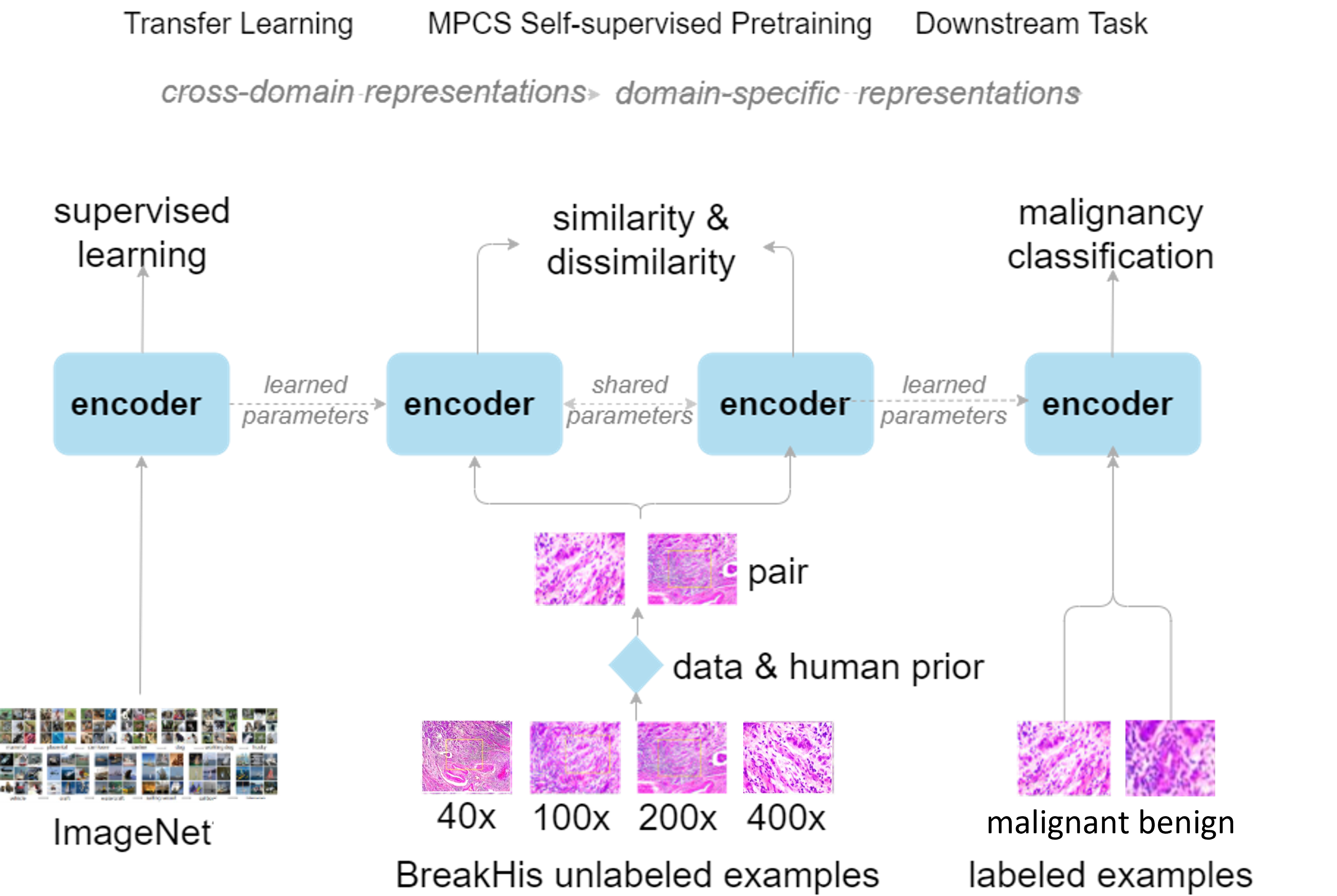
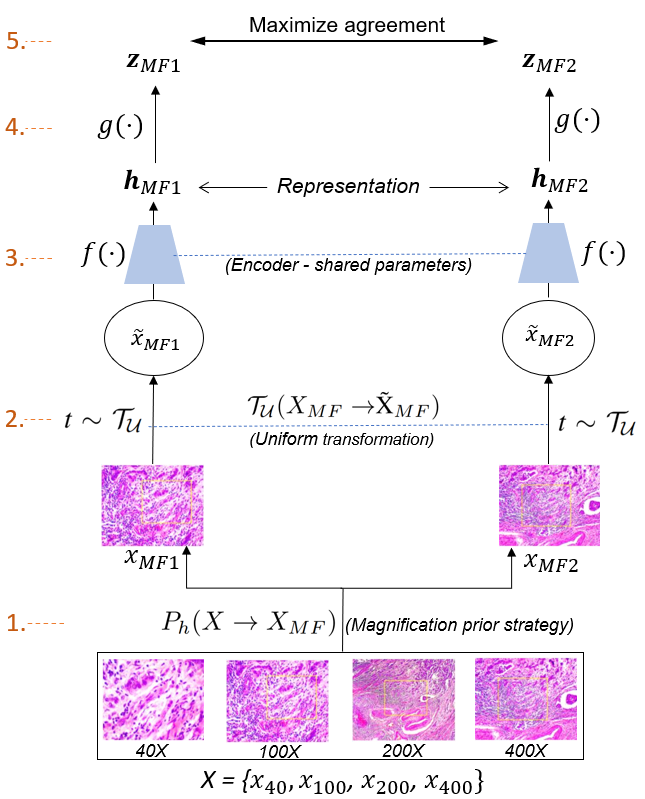
- MPCSは、マグニフィケーション要因(40X、100X、200X、400X)をデータ由来の事前知識として用い、人為的に設計された増幅処理に依存せずに、対照的学習のためのポジティブペアを生成する。
- 本手法は3つのバリエーションを採用する:MPCS-Random Pair(ランダムなビュー抽出)、MPCS-Ordered Pair(順序付き抽出)、MPCS-Fixed Pair(固定された200X–400Xペア)、それぞれ人為的バイアスの度合いが異なる。
- 対照的学習には、ImageNetで事前学習済みの特徴エンコーダ(EfficientNetおよび拡張型ResNet-50)を用いたシアンプル型ネットワークアーキテクチャを採用する。
- 自己教師型事前学習は、ラベルなしのBreakHis画像上で実施され、その後、下流の悪性腫瘍分類タスクにおける微調整が行われる。
- 線形評価と微調整を用いて、3つの公開データセット(BreakHis、BACH、Breast Cancer Cell Dataset)でモデルを評価する。
- 画像の特徴マップ可視化(CAM)を用い、MPCSモデルが病理組織画像における生物学的に関連する領域に適切に注目していることを定性的に検証する。
実験結果
リサーチクエスチョン
- RQ1マグニフィケーション要因は、人為的ラベルなしで、自己教師型対照的学習を可能にする信頼できるデータ由来の事前知識として機能するか?
- RQ2ペア抽出における人為的バイアスを低減することで、自己教師型表現学習における学習表現の質が向上するか?
- RQ3MPCSは、完全に教師ありの最先端手法と比較して、ラベル効率の面でどのように性能を発揮するか?
- RQ4事前学習段階で真のラベルにアクセスできない状況下でも、MPCSは良性と悪性のクラスを区別する特徴を学習できるか?
- RQ5異なるマグニフィケーションレベル間での評価から、MPCSの表現がマグニフィケーション不変性と耐性を有していることが確認できるか?
主な発見
- MPCSは、20%のラベルデータでの微調整でも、BreakHisを含む3つの公開データセットにおいて、完全に教師ありの最先端手法を上回る性能を達成した。
- Breast Cancer Cell Datasetでは、微調整で98.18%の精度、線形評価で96.36%の精度を達成し、既存手法を著しく上回った。
- 20%のラベルデータでのみ学習したMPCSの微調整モデルは、ImageNetで事前学習したモデルと比較して2.52%の絶対的性能向上を示した(p < 0.01)、100%ラベルで学習した最先端手法に匹敵する性能を達成した。
- 人為的バイアスが弱いMPCS-Ordered Pairは、強い人為的バイアスを持つ固定ペア(MPCS-Fixed Pair)および人為的バイアスなしのランダムペア(MPCS-Random Pair)の両方を上回った。特にラベルが少ない状況下で顕著な優位性を示した。
- t-SNE可視化により、MPCSで事前学習された特徴量は、全マグニフィケーションレベルで良性と悪性のクラスに強く分離可能であることが確認された。
- CAM解析により、MPCSで微調整したモデルは、BreakHisおよびBACHデータセットにおいて、ImageNetで事前学習したモデルよりも、注目すべき領域(例:核)をより効果的に特定していた。
より良い研究を、今すぐ始めましょう
論文の読解から最終レビューまで、研究時間を劇的に削減しましょう。
クレジットカード登録不要
このレビューはAIが作成し、人間の編集者が確認しました。