
[論文レビュー] Measurement-Induced Phase Transitions in Informational Active Matter
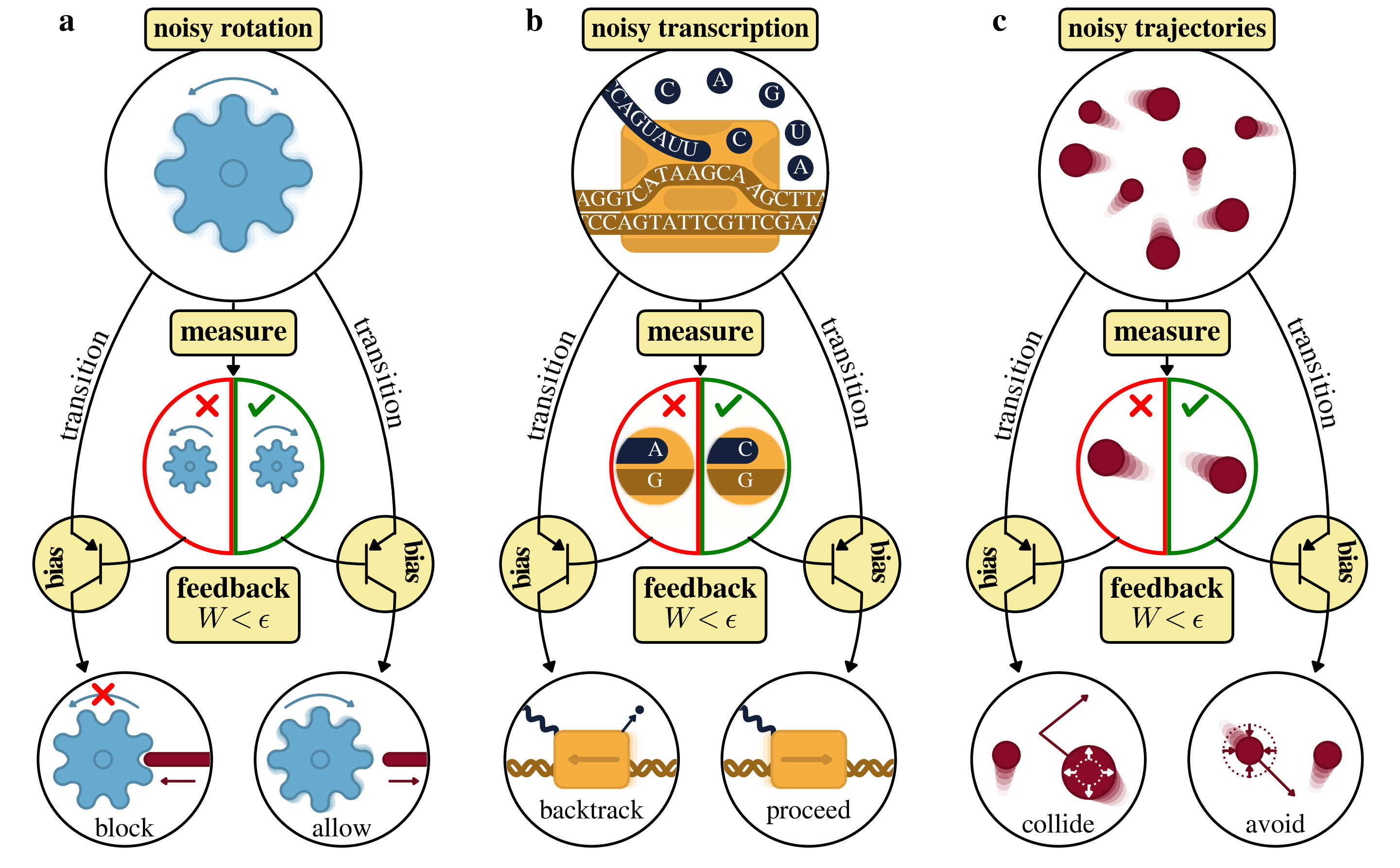
本稿では、『情報的能動物質』—熱揺らぎを測定に基づくフィードバックによって整列運動やパターン形成に変換する多数体系のクラス—を導入する。情報理論的原則と運動論的理論を活用することで、著者らは自己駆動とパターン分解能が環境ノイズに伴い増加することを示した。これは、『考えることを学ぶ』粒子(thinker particles)のシミュレーションを通じて実証された。これらの粒子は、散乱遷移の偏向を歪めるためにサイズを動的に変化させる。
Various biological and synthetic media out of equilibrium can be viewed as many-ratchet systems that rectify environmental noise through local measurements and information processing, like in Maxwell's prototypical demon. These systems pose a challenge to standard coarse-graining approaches because they are better described in terms of decision-making protocols similar to computer programs rather than force laws. Here, we study a many-body generalization of the Maxwell demon problem: a fluid composed of adaptive particles that achieve collective behavior by biasing noise-driven scattering events subject to measurements. Using a combination of information-theoretic, kinetic, and hydrodynamic tools, we elucidate how microscopic decision-making protocols, rather than microscopic forces, generate macroscopic active states sustained by continuous measurements. These include an informational version of flocking whose order parameter is bounded by the information measured, and the onset of which may be viewed as a measurement-induced phase transition. We find that the signature of such microscopic choices is an `informational activity' that selectively compresses phase space, without work, and causes deviations from equilibrium scaling with the magnitude of environmental noise. We envision applications to noise-induced patterning performed by collections of microrobots guided by reinforcement learning or programmable phoretic colloids in turbulent flows that exploit local measurements and control actions to counteract the scrambling of information by chaos.
研究の動機と目的
- 測定と遷移偏向のフィードバックを用いる微視的エージェントが、巨視的秩序を生み出すような拡張系の理論的枠組みを構築すること。
- 自己駆動とパターン分解能が、ノイズの存在によって生じるのではなく、ノイズが情報駆動制御機構を通じて生じることを示すこと。
- 従来の能動物質とは対照的に、力がノイズの増加に伴い強くなるという点で、エネルギー散逸型の『作業者』粒子とは異なったこの系の性質を明らかにすること。
- 散乱を制御するための直径の変化を可能にする『考えることを学ぶ』粒子の最小系をモデル化・シミュレーションすること。
- 微小ロボット工学、集団移動、および乱流やノイズの激しい環境を移動する生物における強化学習への応用を検討すること。
提案手法
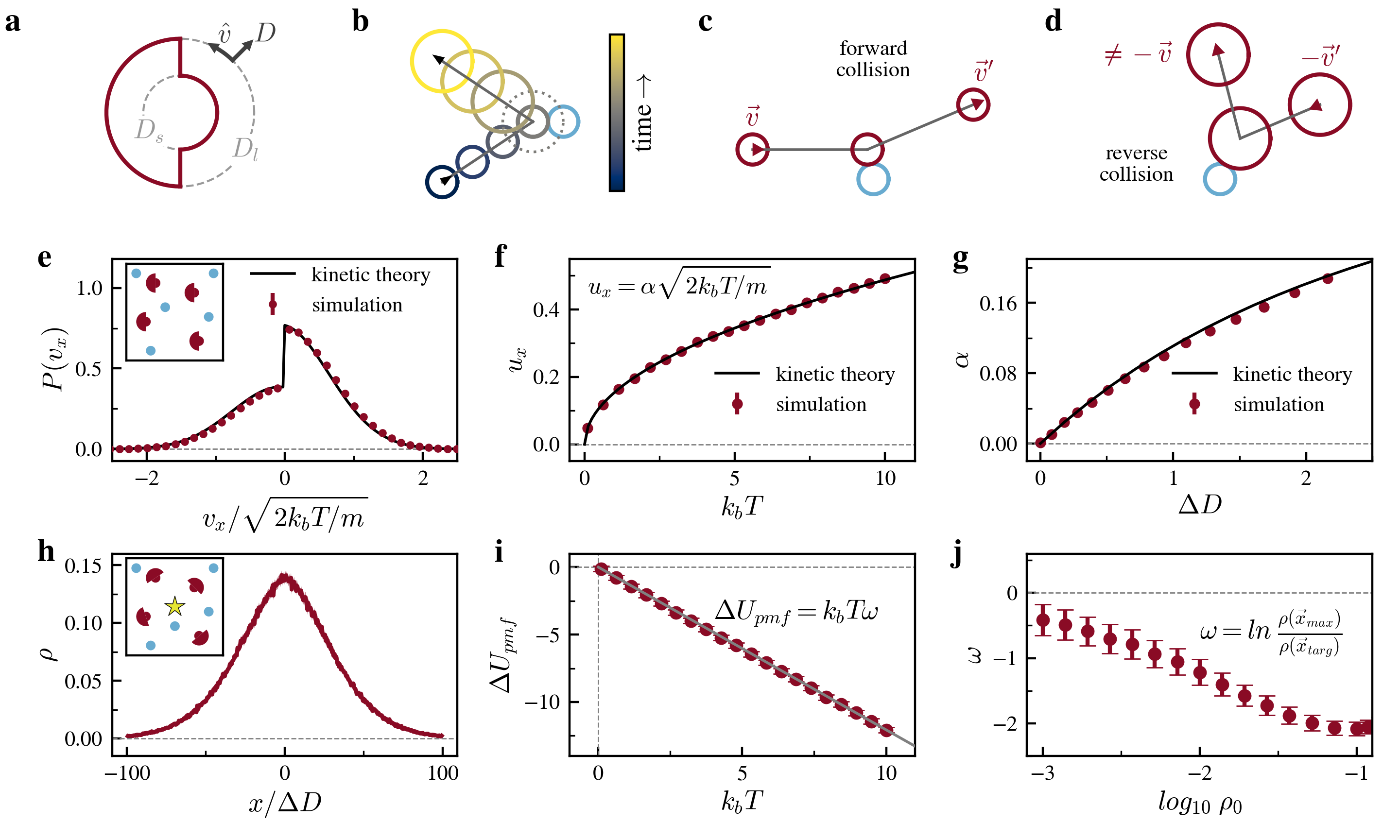
- 測定、遷移偏向、フィードバックループを含む微視的エージェント戦略から巨視的挙動を導出するための運動論的理論フレームワークを構築した。
- 詳細なバランスの破れと非平衡ダイナミクスの実現に測定が果たす役割を定量化するために、情報理論的議論を適用した。
- 局所的な場の勾配(目標パターンから導出)に基づき、小径と大径の間を動的に切り替える『考えることを学ぶ』粒子の流体をシミュレーションした。
- 周期的領域における熱揺らぎと粒子間相互作用をモデル化するため、ノイズ解像度付きのストキャスティック力を持つランジュバンダイナミクスを用いた。
- フレーム間相関を低減し、粒子の均一な分布を保証するために、クリアランス段階を用いたパターン作成プロトコルを実装した。
- 同一の配向場とシミュレーション条件で、一定の力を発揮する『作業者』粒子と比較することで、フィードバック制御の効果を明確に分離した。
実験結果
リサーチクエスチョン
- RQ1多数体系における測定に基づくフィードバックは、外部仕事なしに環境ノイズを方向性のある自己駆動に変換できるか?
- RQ2拡張的能動物質において、情報処理とノイズ駆動遷移の相互作用からどのような巨視的性質が生じるか?
- RQ3このような系におけるパターン分解能はノイズレベルに依存するか?また、フラクチュエーションの増加に伴い向上する可能性はあるか?
- RQ4測定駆動によるサイズ変調が可能な『考えることを学ぶ』粒子は、一定力に依存する『作業者』粒子に比べて、どのような点で優れているか?
- RQ5情報処理は、能動物質における詳細なバランスの破れと非平衡定常状態の実現に、どのように寄与するか?
主な発見
- 外部からのネット仕事を行わず、熱揺らぎに対する測定とフィードバックによってのみ、情報的能動物質において自己駆動が生じる。
- 従来の能動物質とは対照的に、環境ノイズが増加するほど自己駆動力が増大する。これは、揺らぎと戦うためにエネルギーを散逸する従来型とは対照的である。
- 測定に基づくフィードバック機構のおかげで感度と制御性が向上するため、ノイズが増加するほどパターン分解能が向上する。
- 『考えることを学ぶ』粒子のシミュレーションは、局所的な場の勾配に基づき直径を動的に調整することで、複雑なパターン(例:文字)を形成・維持した。
- フレーム遷移中のクリアランス手順により、空間相関が効果的に低減され、シミュレーション領域全体にわたる粒子の均一な分布が確保された。
- 測定駆動による相互作用の変調が可能であるため、『考えることを学ぶ』粒子は、特にノイズの激しい条件下で『作業者』粒子よりもパターンの忠実性と適応性に優れていた。
より良い研究を、今すぐ始めましょう
論文の読解から最終レビューまで、研究時間を劇的に削減しましょう。
クレジットカード登録不要
このレビューはAIが作成し、人間の編集者が確認しました。