
[論文レビュー] Measurement of the $B^{0} ightarrow D^{*-} \ell^{+} ν_{\ell}$ branching ratio and $|V_{cb}|$ with a fully reconstructed accompanying $B$ meson in 2019-2021 Belle II data
本論文は、2019–2021年のBelle IIデータ189.3 fb$^{-1}$における完全に再構成された$B$メソン対を用いて、$B^0 \to D^{*-} \ell^+ \nu_\ell$の分岐比と$|V_{cb}|$の高精度測定を実施した。この研究では、$\mathcal{B}(B^0 \to D^{*-} \ell^+ \nu_\ell) = (5.27 \pm 0.22_{\text{stat}} \pm 0.38_{\text{syst}})\%$を測定し、世界平均と整合的であり、CKM行列要素の制約を排他的な半レプトン性崩壊を用いて改善した。
We present a measurement of the $B^{0} ightarrow D^{*-} \ell^{+} ν_{\ell}$ ($\ell=e,μ$) branching ratio and of the CKM parameter $|V_{cb}|$ using signal decays accompanied by a fully reconstructed $B$ meson. The Belle II data set of electron-positron collisions at the $Υ(4S)$ resonance, corresponding to 189.3$\,$fb$^{-1}$ of integrated luminosity, is analyzed. With the Caprini-Lellouch-Neubert form factor parameterization, the parameters $η_{ m EW} F(1) |V_{cb}|$ and $ρ^{2}$ are extracted, where $η_{ m EW}$ is an electroweak correction, $F(1)$ is a normalization factor and $ρ^{2}$ is a form factor shape parameter. We reconstruct 516 signal decays and thereby obtain $\mathcal{B} (B^{0} ightarrow D^{*-} \ell^{+} ν_{\ell} ) = \left(5.27 \pm 0.22~ m{\left(stat ight)} \pm 0.38~ m{\left(syst ight)} ight) \%$, $η_{EW} F(1) |V_{cb}| imes 10^{3} = 34.6 \pm 1.8~ m{\left(stat ight)} \pm 1.7~ m{\left(syst ight)}$, and $ρ^{2} = 0.94 \pm 0.18~ m{\left(stat ight)} \pm 0.11~ m{\left(syst ight)}$.
研究の動機と目的
- $\Upsilon(4S)$共鳴状態における$e^+e^-$衝突で得られた完全に再構成された$B$メソン対を用いて、$B^0 \to D^{*-} \ell^+ \nu_\ell$分岐比を高精度で測定すること。
- 測定された分岐比と理論的フォーム因子、電弱放射修正を組み合わせることで、CKM行列要素$|V_{cb}|$を決定すること。
- 信号再構成にモンテカルロシミュレーションへの依存を減らすために、完全に再構成された$B$メソンをタグとして用いることで、システムティック不確実性を低減すること。
- 排他的半レプトン性$B$崩壊が、$|V_{cb}|$に関して標準模型の予測と整合的であるかを検証し、長年の$B \to D^*\ell\nu$パズルを解消すること。
提案手法
- Belle実験が$\Upsilon(4S)$共鳴状態で収集した189.3 fb$^{-1}$の$e^+e^-$衝突データを分析に用いた。
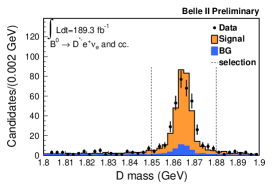
- 信号イベントは、同伴する$B^0 \bar{B}^0$対における$B^0$メソンの完全再構成を伴う$B^0 \to D^{*-} \ell^+ \nu_\ell$崩壊により選別された。
- $D^{*-}$は$D^{*-} \to \pi^- \bar{D}^0$および$\bar{D}^0 \to K^+ \pi^-$を経由して再構成され、分解能を向上させるために運動量的制約が適用された。
- ビームエネルギーとエネルギー差を含む運動量的およびトポロジカル変数を用いて、$B^0$タグ効率とバックグラウンド抑制を向上させた。
- システムティック不確実性は、イベントレベルの選別、シミュレーションサンプルサイズ、分岐比やフォーム因子などの外部入力といったデータ駆動型手法で評価された。
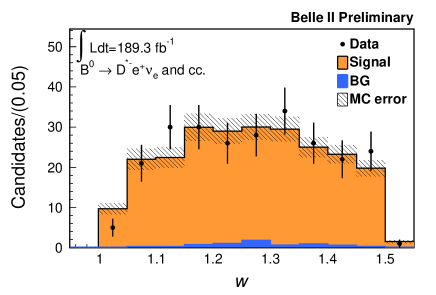
- 系統的相関を組み込んだ共分散行列を用いて、$w = q^2$分布に対するビン化された最尤フィットを実行し、$\eta_{\text{EW}}F(1)|V_{cb}|$と$\rho^2$を抽出した。
実験結果
リサーチクエスチョン
- RQ1完全に再構成された$B$メソンを用いた排他的$B^0 \to D^{*-} \ell^+ \nu_\ell$崩壊の正確な分岐比は何か?
- RQ2測定された$|V_{cb}|$値は世界平均と比較してどうなっており、$B \to D^*\ell\nu$の不一致を解消するのか?
- RQ3特に検出器効率、シミュレーションサイズ、外部入力からのシステムティック不確実性が$|V_{cb}|$決定に与える影響は何か?
- RQ4測定された$d\Gamma/dw$分布は理論モデルとどの程度整合しており、フィットの良さ(p値)は何か?
主な発見
- 測定された分岐比は$\mathcal{B}(B^0 \to D^{*-} \ell^+ \nu_\ell) = (5.27 \pm 0.22_{\text{stat}} \pm 0.38_{\text{syst}})\%$であり、世界平均の$(5.06 \pm 0.12)\%$と整合的である。
- $\eta_{\text{EW}}F(1)|V_{cb}| \times 10^3 = 34.6 \pm 1.8_{\text{stat}} \pm 1.7_{\text{syst}}$は、世界平均の$35.27 \pm 0.38$と一致している。
- $\eta_{\text{EW}} = 1.00662 \pm 0.00016$および$F(1) = 0.906 \pm 0.004_{\text{stat}} \pm 0.012_{\text{syst}}$を組み合わせることで、$|V_{cb}|$は$37.9 \pm 2.7$に決定された。
- $d\Gamma/dw$分布へのフィットでは、自由度調整済み$\chi^2$が1.6、p値が40.7%となり、理論モデルと良好な一致を示している。
- 分岐比の総システムティック不確実性は7.3%であり、主にトラッキング効率(4.1%)とレプトン識別効率(2.0%)に起因する。
- $\eta_{\text{EW}}F(1)|V_{cb}|$と$\rho^2$の共分散行列は、$w$ビン間で中程度の相関を示しており、$\rho^2 = 0.94 \pm 0.18_{\text{stat}} \pm 0.11_{\text{syst}}$であった。
この論文を読む
Nubintのビューアで原文を開き、読みながら気になる箇所をすぐに質問できます。
Nubintでこの論文を読むこのレビューはAIが論文の原文をもとに作成しました。引用する前に原文をご確認ください。