
[論文レビュー] Measuring the Variance of the Macquart Relation in z-DM Modeling
この論文は、DM分散の乱れパラメータ F を z-DM Macquart 関係における自由パラメータとして扱い、FRB データでそれをフィットさせ、局所化された合成 FRB サンプルで改善を予測し、H0 との退化も検討する前方モデリング手法を導入する。
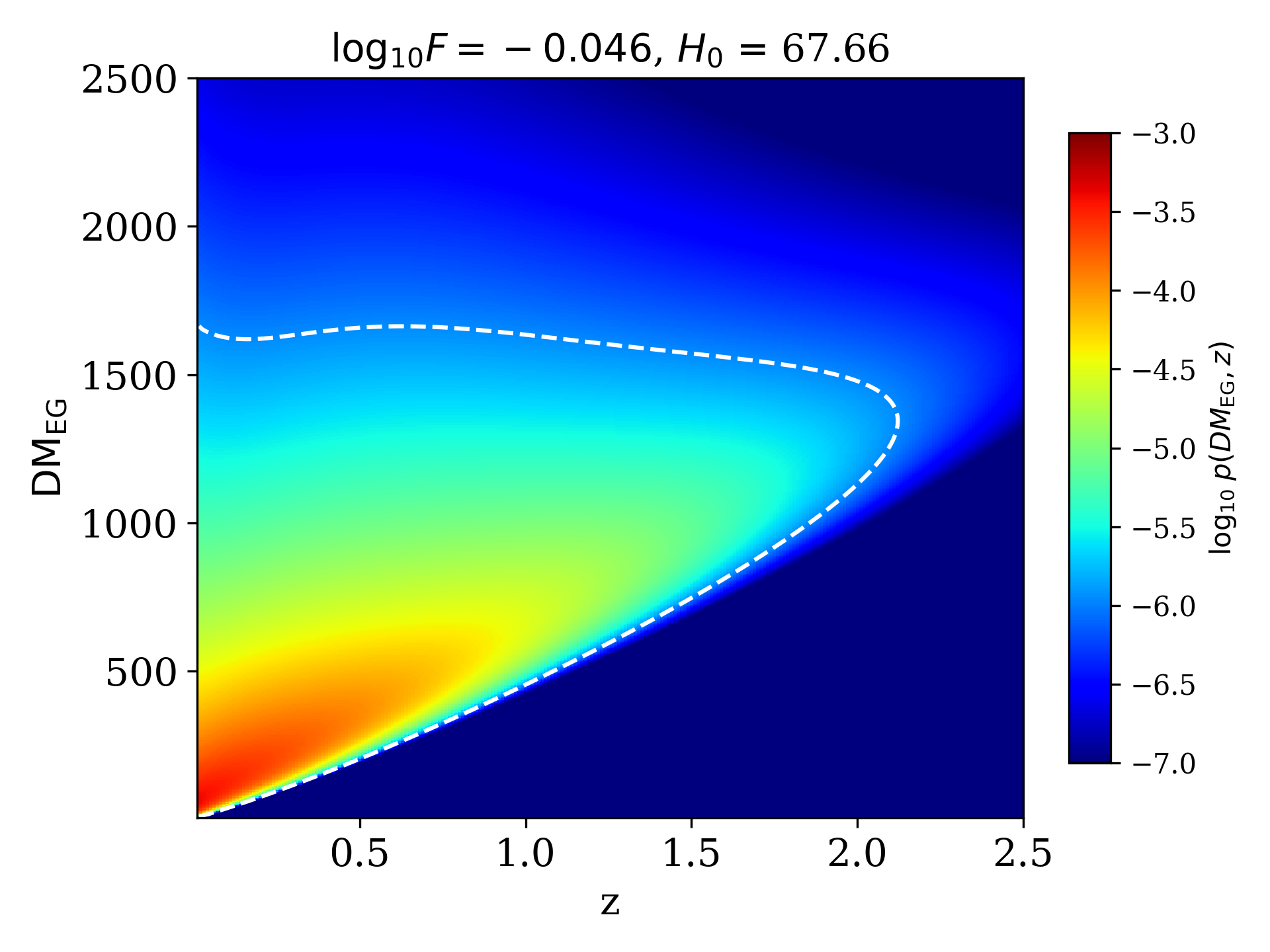
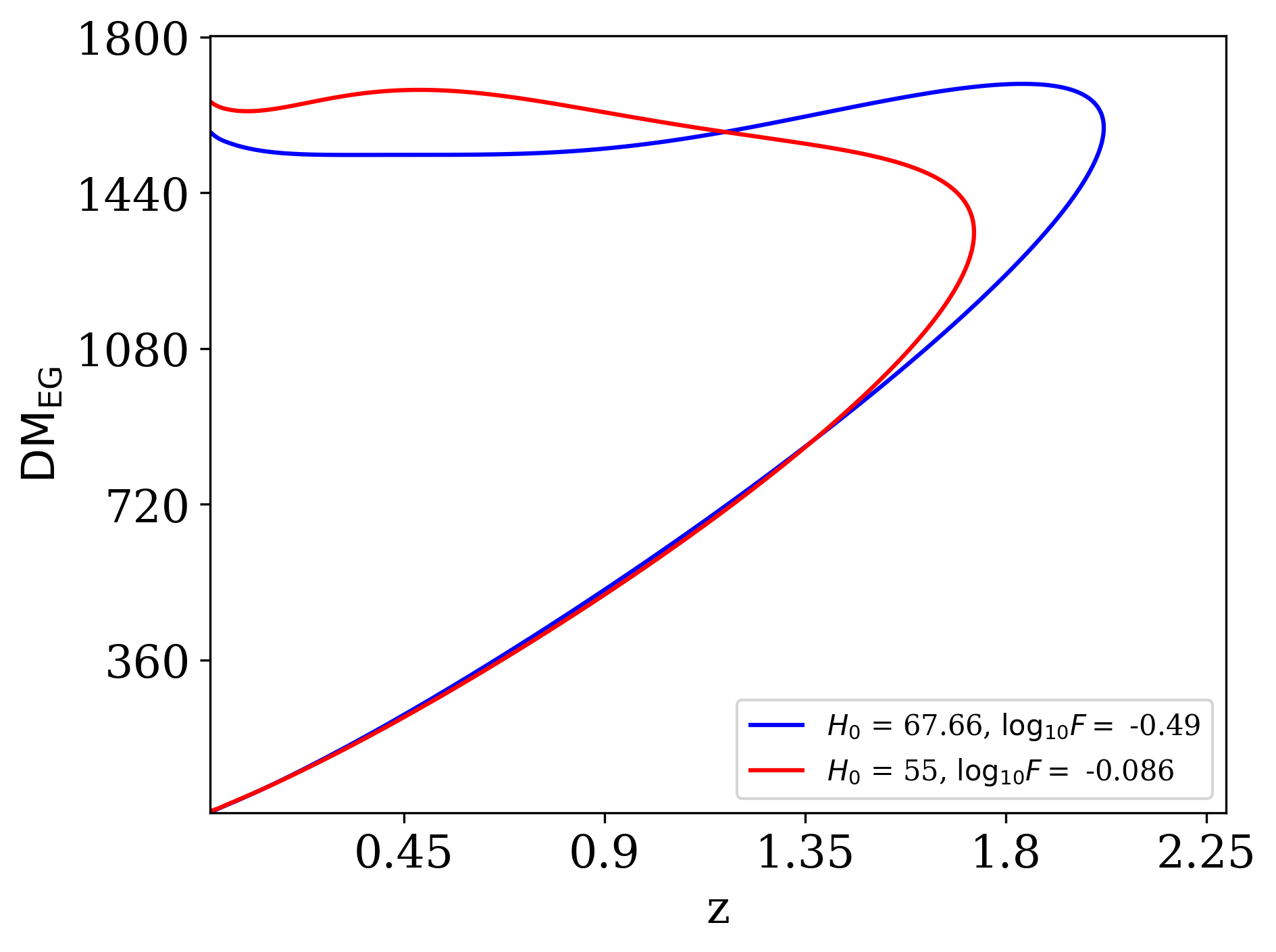
The Macquart relation describes the correlation between the dispersion measure (DM) of fast radio bursts (FRBs) and the redshift $z$ of their host galaxies. The scatter of the Macquart relation is sensitive to the distribution of baryons in the intergalactic medium (IGM) including those ejected from galactic halos through feedback processes. The width of the distribution in DMs from the cosmic web (${ m DM}_{ m cosmic}$) is parameterized by a fluctuation parameter $F$, which is related to the cosmic DM variance by $σ_{ m DM}= F z^{-0.5}$. In this work, we present a new measurement of $F$ using 78 FRBs of which 21 have been localized to host galaxies. Our analysis simultaneously fits for the Hubble constant $H_0$ and the DM distribution due to the FRB host galaxy. We find that the fluctuation parameter is degenerate with these parameters, most notably $H_0$, and use a uniform prior on $H_0$ to measure $\log_{10} F > -0.89$ at the $3σ$ confidence interval and a new constraint on the Hubble constant $H_0 = 85.3_{-8.1}^{+9.4} \, { m km \, s^{-1} \, Mpc^{-1}}$. Using a synthetic sample of 100 localized FRBs, the constraint on the fluctuation parameter is improved by a factor of $\sim 2$. Comparing our $F$ measurement to simulated predictions from cosmological simulation (IllustrisTNG), we find agreement between $0.4 < z < 2$. However, at $z < 0.4$, the simulations underpredict $F$ which we attribute to the rapidly changing extragalactic DM excess distribution at low redshift.
研究の動機と目的
- 介在領域間漂移法則(Macquart z-DM 関係)と FRB の分散測定を通じて、視線外部に存在する重粒子分布の制約を動機づける。
- IGM(宇宙間空間)内の宇宙ウェブとハローによる DM ばらつきを定量化する乱れパラメータ F を導入する。
- FRB データへ FRB 外部 DM 成分と H0 を同時に適合させて F を測定する。
- F と H0、ならびに宿主銀河 DM パラメータ間の退化を評価する。
- 局所化 FRB のサンプルが増えることで F の制約がどう改善されるかを予測する。
提案手法
- z-DM モデリング枠組み(zdm)を採用して DM_FRB を DM_ISM、DM_halo、DM_EG に分解する。
- DM_EG を DM_cosmic + DM_host としてモデル化し、DM_cosmic の分散を非正規分布 p_cosmic(Δ) で記述し、σ_DM ∝ F z^-0.5 の乱れパラメータ F を導入する。
- ホスト DM を平均 μ_host、散らばり σ_host の対数正規分布として自由パラメータとする。
- 定義されたパラメータ空間上でパラメータ尤度を得るために総当たりのグリッド探索を実施し、F と H0 を制約するために redshift(localized FRB) を取り入れる。
- F と H0 の退化を特に調べるために、H0 に Planck 値と SNe 値の間の一様事前分布を適用し、1D/2D の尤度を分析する。
- 100 個の局所化 FRB の合成サンプルを用いて F の制約を予測し、F の精度と H0 の精度の改善を検討する。
実験結果
リサーチクエスチョン
- RQ1F は宇宙ウェブとハロスの DM 分散を記述する乱れパラメータとして何を表し、FRB データはそれをどう制約できるのか。
- RQ2F は z-DM EG モデルにおける H0 および宿主 DM パラメータとどれだけ退化するのか。
- RQ3赤方偏移情報を組み込んだ局所化 FRB を含めることが F および H0 の制約をどう改善するのか。
- RQ4H0 の事前分布を含めると F の測定にどんな影響があるのか。
- RQ5局所化 FRB の合成サンプルは現在のデータと比べて F の境界をどう改善するのか。
主な発見
- 78 個の FRB(うち 21 個は赤方偏移あり)から、乱れパラメータは log10 F > -0.89 (3σ) に制約され、下限を示す。
- F を自由に変化させると H0 の制約が劣化し、H0 は H0 = 85.3(-8.1,+9.4) km/s/Mpc(H0 priors なし)となる。
- 一様 H0 事前分布を用いると log10 F = -0.48^{+0.26}_{-0.18} (1σ) で、log10 F > -0.89 (3σ) となる。
- 局所化 FRB 100 個の合成サンプルは F の制約を改善し、より厳密な H0 制約をもたらす(例: priors を用いた場合 H0 ≈ 67.6^{+3.5}_{-3.4} km/s/Mpc)。
- IllustrisTNG との比較は z が 0.4 〜 2 の範囲で一致する一方、z < 0.4 では低 z の DM_IGM 振る舞いのためシミュレーションが F を過大評価する。
より良い研究を、今すぐ始めましょう
論文設計から論文執筆まで、研究時間を劇的に削減しましょう。
クレジットカード登録不要
このレビューはAIが作成し、人間の編集者が確認しました。