
[論文レビュー] Millimeter Observations of the Type II SN2023ixf: Constraints on the Proximate Circumstellar Medium
本研究では、Submillimeter Array (SMA) を用いた、近傍のType II超新星 SN 2023ixf のミリ波長観測を行い、爆発後18.6日以内に1.3 mm(230 GHz)で放射を検出しなかった。非検出結果は、周囲星間媒体(CSM)の質量損失率を $< 10^{-6}$ M$_\odot$ yr$^{-1}$ または $> 10^{-2}$ M$_\odot$ yr$^{-1}$ に制限しており、光学スペクトロスコピーの結果と整合的であるが、X線に基づく推定と矛盾しており、非一様で閉じたCSM構造がその不一致を解消する可能性を示唆している。
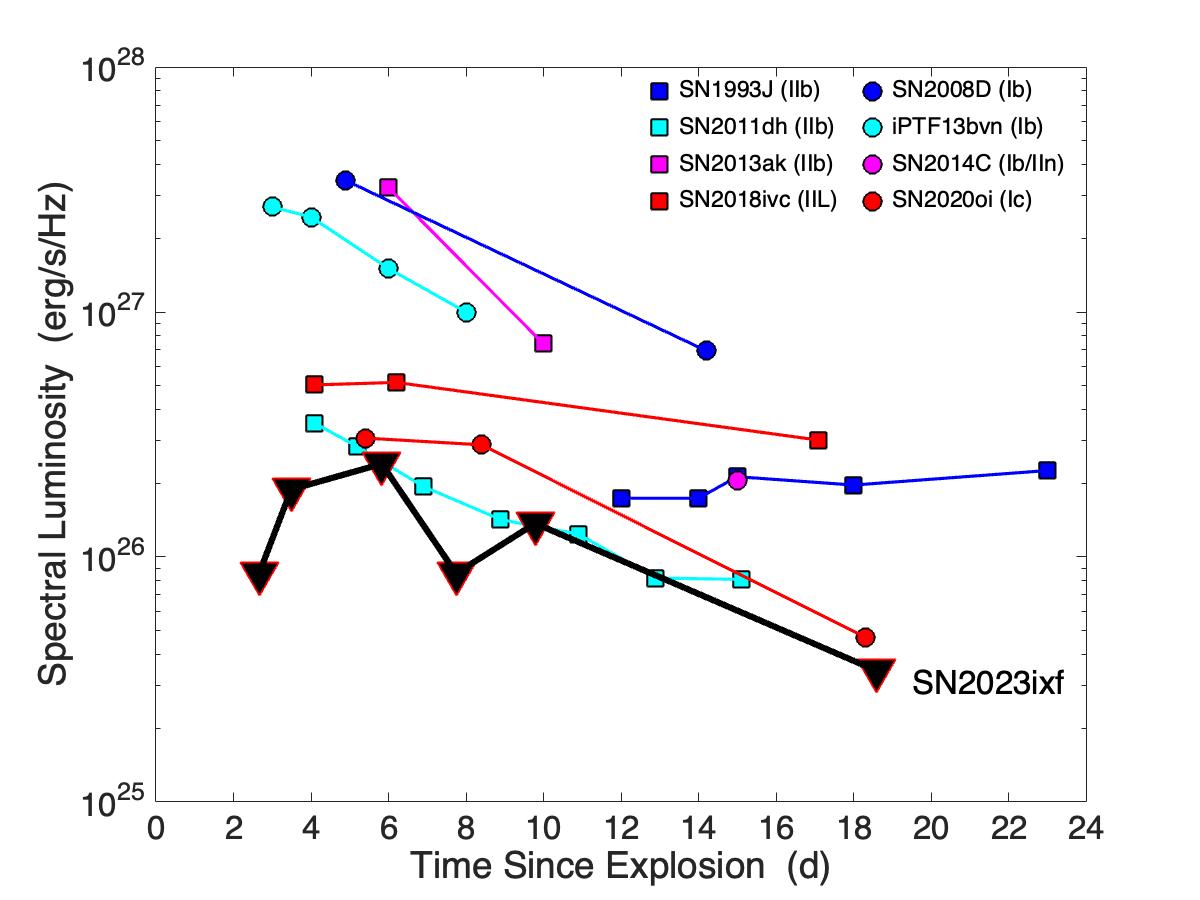
We present 1.3 mm (230 GHz) observations of the recent and nearby Type II supernova, SN2023ixf, obtained with the Submillimeter Array (SMA) at 2.6-18.6 days after explosion. The observations were obtained as part the SMA Large Program POETS (Pursuit of Extragalactic Transients with the SMA). We do not detect any emission at the location of SN2023ixf, with the deepest limits of $L_ν(230\,{ m GHz})\lesssim 8.6 imes 10^{25}$ erg s$^{-1}$ Hz$^{-1}$ at 2.7 and 7.7 days, and $L_ν(230\,{ m GHz})\lesssim 3.4 imes 10^{25}$ erg s$^{-1}$ Hz$^{-1}$ at 18.6 days. These limits are about a factor of 2 times dimmer than the mm emission from SN2011dh (IIb), about an order of magnitude dimmer compared to SN1993J (IIb) and SN2018ivc (IIL), and about 30 times dimmer than the most luminous non-relativistic SNe in the mm-band (Type IIb/Ib/Ic). Using these limits in the context of analytical models that include synchrotron self-absorption and free-free absorption we place constraints on the proximate circumstellar medium around the progenitor star, to a scale of $\sim 2 imes 10^{15}$ cm, excluding the range $\dot{M}\sim { m few} imes 10^{-6}-10^{-2}$ M$_\odot$ yr$^{-1}$ (for a wind velocity, $v_w=115$ km s$^{-1}$, and ejecta velocity, $v_{ m eje}\sim (1-2) imes 10^4$ km s$^{-1}$). These results are consistent with an inference of the mass loss rate based on optical spectroscopy ($\sim 2 imes 10^{-2}$ M$_\odot$ yr$^{-1}$ for $v_w=115$ km s$^{-1}$), but are in tension with the inference from hard X-rays ($\sim 7 imes 10^{-4}$ M$_\odot$ yr$^{-1}$ for $v_w=115$ km s$^{-1}$). This tension may be alleviated by a non-homogeneous and confined CSM, consistent with results from high-resolution optical spectroscopy.
研究の動機と目的
- 爆発後早期のミリ波長観測を用いて、SN 2023ixfの前身星の周囲星間媒体(CSM)の密度および質量損失率を制限すること。
- ミリ波バンドの制限を、既存の光学およびX線測定によるCSMの推定と比較し、多波長診断法の整合性を評価すること。
- X線とミリ波バンドで推定された質量損失率の不一致が、非球形または閉じたCSM幾何構造によって解消可能かどうかを調査すること。
- 非検出結果を解釈するにあたり、シンクロtron自己吸収および自由自由吸収を組み込んだ解析的モデルの妥当性を検証すること。
- 早期ミリ波長観測が、近接したコアコリプス超新星におけるCSM特性を独立して探査する有効な手段であることを確立すること。
提案手法
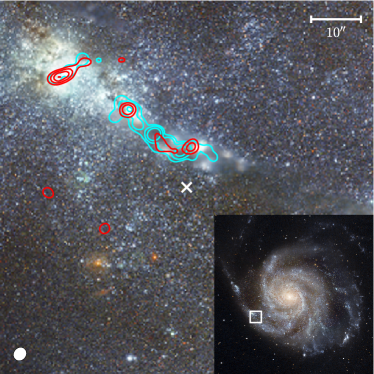
- POETS Large Programの一環として、爆発後2.6〜18.6日におけるSN 2023ixfの1.3 mm(230 GHz)観測をSubmillimeter Array (SMA) で実施した。
- 標準キャリブレータ(3C454.3、Ceres、J1419+543、J1506+426)を用いたSMAデータのキャリブレーションを行い、画像化およびデコンボリューション技術を適用して高感度連続スペクトルマップを作成した。
- 非検出結果を解釈するために、シンクロtron自己吸収および自由自由吸収の解析的モデルを適用し、放射度およびCSM質量損失率の上限を導出した。
- モデルのデグレダシーを制限するため、先行する超新星研究から得られた電子エネルギー分率 ($\epsilon_{\rm e}$) および磁場エネルギー分率 ($\epsilon_{\rm B}$) の制約を組み込んだ。
- モデル予測を、光学フラッシュスペクトロスコピーおよびハードX線観測を含む多波長データと比較し、診断法間の整合性を評価した。
- 最大探査距離として、光学およびX線診断と整合的な $\sim 2 \times 10^{15}$ cm の径方向スケールを用いた。
実験結果
リサーチクエスチョン
- RQ1爆発後2.7日、7.7日、18.6日におけるSN 2023ixfのミリ波長放射度の上限は何か?
- RQ2これらのミリ波バンド非検出結果は、前身星の周囲星間媒体の質量損失率にどのように制限を加えるか?
- RQ3ミリ波バンドの制限は、初期の光学スペクトロスコピーおよびハードX線観測から得られる推定値とどの程度一致するか?
- RQ4X線とミリ波バンドで推定されたCSM密度の不一致は、非一様または閉じたCSM幾何構造によって解消可能か?
- RQ5シンクロtron自己吸収および自由自由吸収は、コアコリプス超新星の観測されたミリ波バンド放射にどのように寄与するか?
主な発見
- SN 2023ixfの位置で1.3 mmには放射が検出されず、2.7日および7.7日には $L_{\nu}(230\,{\rm GHz}) \lesssim 8.6 \times 10^{25}$ erg s$^{-1}$ Hz$^{-1}$ の上限、18.6日には $\lesssim 3.4 \times 10^{25}$ erg s$^{-1}$ Hz$^{-1}$ の上限が得られた。
- これらのミリ波バンド放射度上限は、SN 2011dh(IIb型)の約2倍、SN 1993J(IIb型)およびSN 2018ivc(IIL型)の10倍、そして非相対論的超新星の中で最も明るいミリ波帯のものと比べて約30倍暗い。
- 非検出結果は、シンクロtron自己吸収を用いた場合 $\dot{M} \lesssim 10^{-6}$ M$_\odot$ yr$^{-1}$、自由自由吸収を用いた場合 $\dot{M} \gtrsim 10^{-2}$ M$_\odot$ yr$^{-1}$ にCSM質量損失率を制限しており、$v_w = 115$ km s$^{-1}$ の場合、$\sim$数 $\times 10^{-6} - 10^{-2}$ M$_\odot$ yr$^{-1}$ の範囲を除外する。
- ミリ波バンドの制限は、光学スペクトロスコピーに基づく $\dot{M} \sim 2 \times 10^{-2}$ M$_\odot$ yr$^{-1}$ の推定値(Jacobson-Galan et al., 2023)と整合的であるが、X線に基づく $\dot{M} \sim 7 \times 10^{-4}$ M$_\odot$ yr$^{-1}$ の推定値(Grefenstette et al., 2023)とは矛盾している。
- X線とミリ波バンドの推定値の間の矛盾は、高分解能光学スペクトロスコピー(Smith et al., 2023)が示唆するように、非一様で径方向に閉じたCSMによって解消可能である。これは、X線が低密度領域から発せられる一方、ミリ波放射が高密度で閉じたシェルで吸収される可能性を示唆する。
- 本研究は、$\sim 10^{15}$ cmスケールで、光学やX線診断とは異なるモデル仮定を用いることで、早期ミリ波長観測がCSM特性を独立して探査する有効な補足手段であることを示している。
より良い研究を、今すぐ始めましょう
論文の読解から最終レビューまで、研究時間を劇的に削減しましょう。
クレジットカード登録不要
このレビューはAIが作成し、人間の編集者が確認しました。