
[論文レビュー] Modeling and Analysis of Reconfigurable Intelligent Surfaces for Indoor and Outdoor Applications in Future Wireless Networks
本稿は、Sub-6 GHz からミリ波帯にわたる6G無線ネットワークにおける屋内・屋外環境における再構成可能知能表面(RIS)のモデリングと分析のための統一フレームワークを提案する。RISが知的な波面操作を可能にすることで、スペクトル効率と誤り性能が著しく向上することが示され、実用的な位相およびチャネル推定誤りを伴う条件下でも、複数RIS選択により非選択系と比較して最大30%高い実現可能レートが達成可能である。
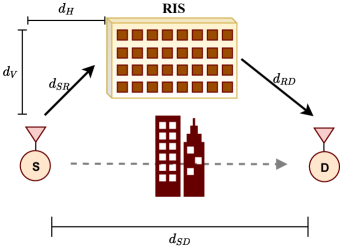
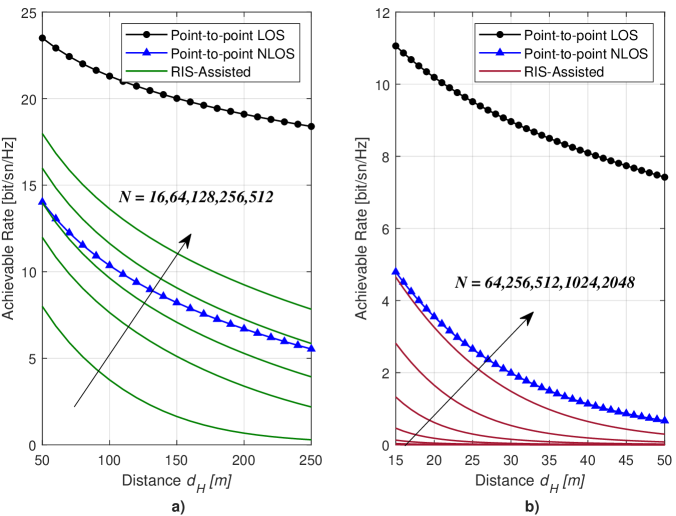
Reconfigurable intelligent surface (RIS)-empowered communication is one of the promising 6G technologies that allows the conversion of the wireless channel into an intelligent transmit entity by manipulating the impinging waves using man-made surfaces. In this paper, the potential benefits of using RISs are investigated for indoor/outdoor setups and various frequency bands (from sub 6 GHz to millimeter-waves). First, a general system model with a single RIS is considered and the effect of the total number of reflecting elements on the probabilistic distribution of the received signal-to-noise ratio and error performance is investigated under Rician fading. Also for this case, the path loss exponent is analyzed by considering empirical path loss models. Furthermore, transmission models with multiple RISs are developed and analyzed for indoor and outdoor non line-of-sight (NLOS) scenarios. The conventional RIS selection strategies are also integrated for systems equipped with multiple RISs for the first time. Through extensive simulations, it is demonstrated that the RIS-assisted systems provide promising solutions for indoor/outdoor scenarios at various operating frequencies and exhibit significant results in error performance and achievable data rates even in the presence of system imperfections such as limited range phase adjustment and imperfect channel phase estimation at RISs.
研究の動機と目的
- 多様な屋内・屋外伝搬環境におけるRISを活用した無線システムの性能向上を調査すること。
- Rician fading下での信号対雑音比(SNR)およびビット誤り率(BER)に及ぼすRIS反射素子およびパスロスモデルの影響を分析すること。
- 非直線視(NLOS)環境における実用的ハードウェア制約を考慮したマルチRIS伝送モデルの開発と評価。
- 動的ユーザー移動性を想定したマルチRISシステムにおける性能最適化を目的とした新規RIS選択戦略の導入と評価。
- 制限された位相分解能および不完全なチャネル位相推定を含む非理想状態下でのシステムのロバストネスを評価すること。
提案手法
- Rician fadingおよび実験的パスロスモデル下での確率的SNRおよびBER解析を伴う一般化された単一RISシステムモデルを構築。
- 周波数帯域にわたる座標に基づくRIS配置およびパスロスモデリングを用いて、NLOSシナリオにおけるマルチRIS伝送モデルを定式化。
- 複数のRISペア間でのSNRに基づくリンク選択を用いた新規RIS選択戦略を提案し、性能最適化を図る。
- 制限された位相シフト範囲(−150° から 140°)および非理想反射係数(|Γ| = −1 dB)を含む実用的ハードウェア制約を統合。
- ゼロ平均von Mises分布と集中パrameter κを用いて位相推定誤差をモデル化し、実世界の誤りを模擬。
- 反射素子数(N)および推定精度(κ)の変動を想定した、理想状態と非理想状態のRIS性能を比較する広範なシミュレーションを実施。
実験結果
リサーチクエスチョン
- RQ1単一RISの反射素子数が、Rician fading環境下でのSNR分布および誤り性能に与える影響は何か?
- RQ2実験的パスロスモデルが、屋内および屋外RIS支援シナリオにおける全体のシステム性能に与える影響は何か?
- RQ3複数RISが、単一RIS構成と比較して非直線視(NLOS)環境下での実現可能データレートおよび信頼性をどの程度向上させるか?
- RQ4複数RISペア間でのRIS選択が、複雑さおよび位相調整コストを低減しつつ、システム性能をどの程度向上させるか?
- RQ5制限された位相分解能および不完全なチャネル位相推定といったハードウェア制約に対して、RIS支援通信はどの程度感受性を示すか?
主な発見
- 単一RISの反射素子数を増加させることで、constructive信号結合が可能になり、SNRが著しく向上し、BERが低下する。
- RIS支援システムは、非選択マルチRISシステムと比較して、最大30%高い実現可能データレートを達成する。特に、ユーザーが最適RIS位置に近い場合に顕著である。
- SNRに基づくRIS選択は固定パス伝送を上回る性能を示し、ユーザーがRISに近い位置(例:シミュレーションでx = 5 mおよび25 m)にいる場合にピーク性能が観測される。
- 制限された位相範囲(−150° から 140°)を持つ非理想RISハードウェアであっても、誤り性能は理想RISとほぼ同等に保たれ、実装制約に対して高いロバストネスを示す。
- 位相推定誤差は性能を劣化させるが、反射素子数(N)が増加し、推定精度(κ)が向上することでその影響は緩和される。
- パスロスがRIS選択において主な要因である。同様のフェージング条件下でも、短いパスが長いパスよりも優れた性能を示す。
より良い研究を、今すぐ始めましょう
論文の読解から最終レビューまで、研究時間を劇的に削減しましょう。
クレジットカード登録不要
このレビューはAIが作成し、人間の編集者が確認しました。