
[論文レビュー] MOPI-HFRS: A Multi-objective Personalized Health-aware Food Recommendation System with LLM-enhanced Interpretation
MOPI-HFRS は、グラフベースのフレームワークでユーザーの嗜好、個別の健康性、栄養多様性を共同で最適化し、説明のためのLLM強化解釈モジュールを用いる。
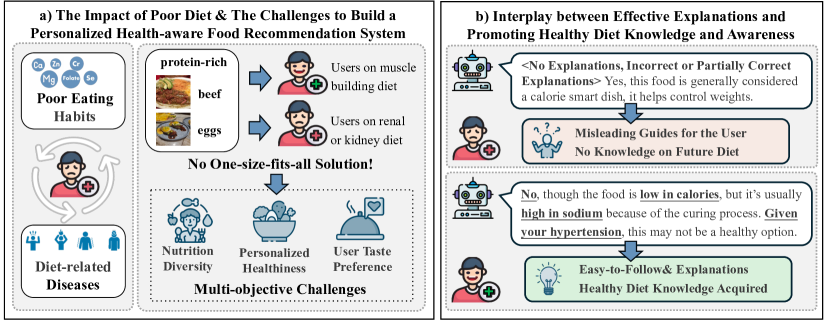
The prevalence of unhealthy eating habits has become an increasingly concerning issue in the United States. However, major food recommendation platforms (e.g., Yelp) continue to prioritize users' dietary preferences over the healthiness of their choices. Although efforts have been made to develop health-aware food recommendation systems, the personalization of such systems based on users' specific health conditions remains under-explored. In addition, few research focus on the interpretability of these systems, which hinders users from assessing the reliability of recommendations and impedes the practical deployment of these systems. In response to this gap, we first establish two large-scale personalized health-aware food recommendation benchmarks at the first attempt. We then develop a novel framework, Multi-Objective Personalized Interpretable Health-aware Food Recommendation System (MOPI-HFRS), which provides food recommendations by jointly optimizing the three objectives: user preference, personalized healthiness and nutritional diversity, along with an large language model (LLM)-enhanced reasoning module to promote healthy dietary knowledge through the interpretation of recommended results. Specifically, this holistic graph learning framework first utilizes two structure learning and a structure pooling modules to leverage both descriptive features and health data. Then it employs Pareto optimization to achieve designed multi-facet objectives. Finally, to further promote the healthy dietary knowledge and awareness, we exploit an LLM by utilizing knowledge-infusion, prompting the LLMs with knowledge obtained from the recommendation model for interpretation.
研究の動機と目的
- NHANESデータを用いた健康志向の個人化食品推奨の大規模ベンチマークを確立する。
- ユーザー嗜好、個別の健康性、栄養多様性を共同で最適化する holistic framework を開発する。
- 訓練中に健康と記述的特徴を活用する健康志向のグラフ構造学習を組み込む。
- Pareto多目的最適化を適用して対立する目的のバランスを取る。
- 推奨の説明と健康知識を提供するLLM強化解釗モジュールを導入する。
提案手法
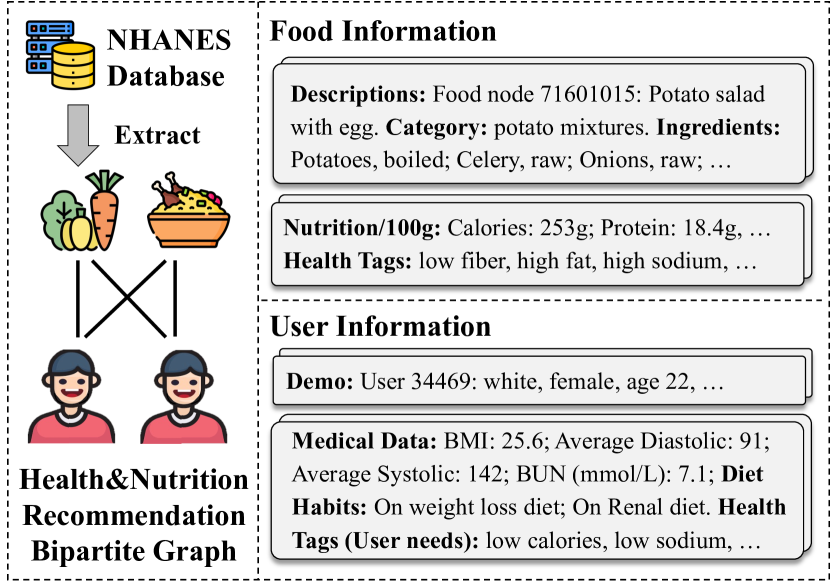
- NHANESデータから Health and Nutrition Recommendation Bipartite Graphs を構築して健康情報と食品栄養を組み込む。
- 健康志向のグラフ構造学習を特徴ベースの構造学習と健康的エッジ構造学習で開発する。
- グラフ構造プーリングを用いて複数のグラフを統合し、下流タスクのための洗練された隣接を作成する。
- Pareto多目的最適化を多重損失目的(嗜好のための BPR、健康ベースの損失、多様性損失)を用いて適用し、Pareto最適性を達成する。
- 推奨に対する説明を生成するためのドメイン情報を組み込んだプロンプトを用いた知識強化済みのLLM推論モジュールを実装する。
- LLM解釈を改善するための二つのドメイン特有の推論戦略(Refined Food Candidates, Attention on User Conditions)を提案する。
実験結果
リサーチクエスチョン
- RQ1NHANES由来の健康データを用いて、健康志向の個人化推奨システムを学習させ、ユーザー嗜好、健康性、栄養多様性のバランスを取れるか?
- RQ2Pareto 最適化は、加重和アプローチと比較して競合する目的間のトレードオフを改善するか?
- RQ3LLM はモデルからの知識注入を用いて、健康志向推奨に対する信頼できるドメイン情報付きの説明を提供できるか?
- RQ4健康志向のグラフ構造学習とエッジ符号情報は推奨品質と健康アラインメントを改善するか?
主な発見
- MOPI-HFRS は提案ベンチマーク上で多目的推奨タスクにおいて最先端のベースラインを上回る。
- 健康情報の組み込みと構造化学習により、Recall@20、NDCG@20、H-Score、および多様性指標でマクロ・フル栄養ベンチマーク全体で改善を実現。
- 提案された勾配降下法ベースの更新を用いた Pareto 最適化は、ユーザー嗜好、健康性、多様性の間で Pareto 最適なトレードオフを達成する。
- LLM強化解釈は、洗練された候補セットと条件に焦点を当てたプロンプトにより、健康性についてより豊かでドメイン認識のある説明を提供する。
- アブレーション研究は、特徴ベースの構造学習と健全なエッジ学習の双方が性能向上に寄与することを示している。
より良い研究を、今すぐ始めましょう
論文の読解から最終レビューまで、研究時間を劇的に削減しましょう。
クレジットカード登録不要
このレビューはAIが作成し、人間の編集者が確認しました。