
[論文レビュー] Most of the photons that reionized the Universe came from dwarf galaxies
この論文は z~6-8 における超暗い銀河の最初の分光観測を報告し、高い電離効率を見いだし、低光度の矮星銀河が控えめな escape fraction でも宇宙再電離を駆動し得ることを示している。
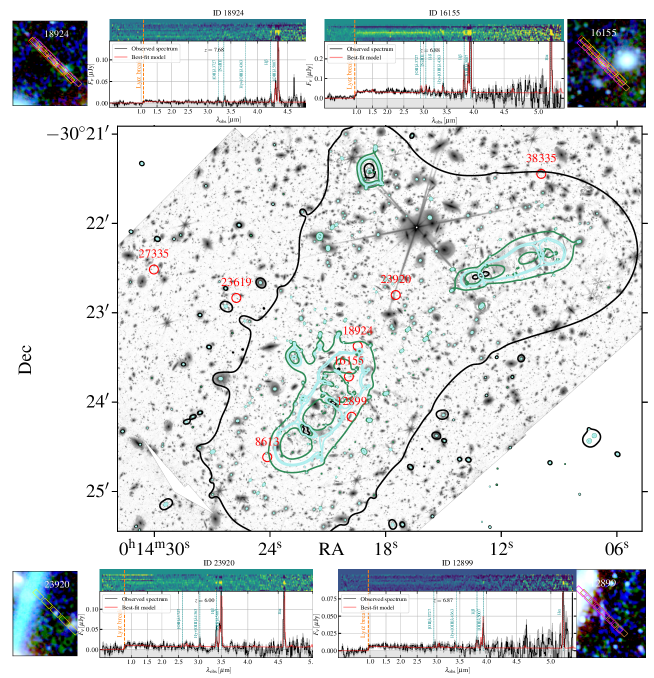
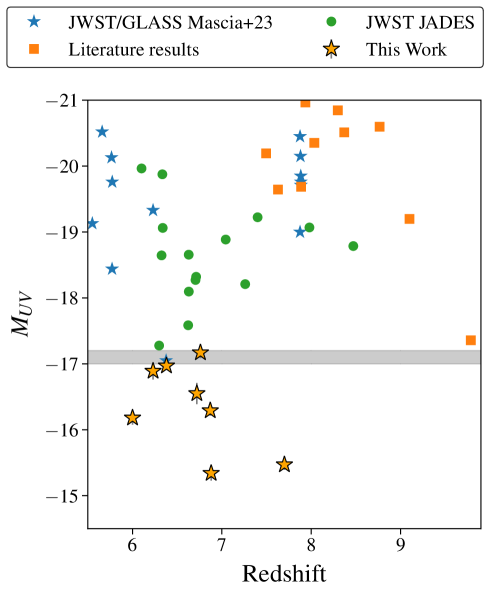
The identification of sources driving cosmic reionization, a major phase transition from neutral Hydrogen to ionized plasma around 600-800 Myr after the Big Bang (Dayal et al. 2018, Mason et al. 2019, Robertson et al. 2022), has been a matter of intense debate (Robertson et al. 2022). Some models suggest that high ionizing emissivity and escape fractions ($f_{ m esc}$) from quasars support their role in driving cosmic reionization (Madau & Haardt 2015, Mitra et al. 2018). Others propose that the high $f_{ m esc}$ values from bright galaxies generates sufficient ionizing radiation to drive this process (Naidu et al. 2020). Finally, a few studies suggest that the number density of faint galaxies, when combined with a stellar-mass-dependent model of ionizing efficiency and $f_{ m esc}$, can effectively dominate cosmic reionization (Finkelstein et al. 2019, Dayal et al. 2020). However, so far, low-mass galaxies have eluded comprehensive spectroscopic studies owing to their extreme faintness. Here we report an analysis of eight ultra-faint galaxies (in a very small field) during the epoch of reionization with absolute magnitudes between $M_{ m UV}$ $\sim -17$ to $-15$ mag (down to 0.005 $L^{\star}$. We find that faint galaxies during the Universe's first billion years produce ionizing photons with log($ξ_{\mathrm{ion}}$/ Hz erg$^{-1}$) =$25.80\pm 0.14$, a factor of 4 higher than commonly assumed values (Robertson et al. 2015). If this field is representative of the large scale distribution of faint galaxies, the rate of ionizing photons exceeds that needed for reionization, even for escape fractions of order five per cent.
研究の動機と目的
- 超微細な銀河が宇宙再電離に果たす役割を動機づけ、定量化する。
- z>6 の暗い銀河の電離光子生産効率(xi_ion)を測定する。
- z~7 で UV 力 luminosity function(UV LF)を rest-frame UV において拡張し、再電離への低光度銀河の寄与を評価する。
- これらの系の Lyman- continuum 逃逸分率(f_esc)を間接的に推定し、金属量、年齢、sSFR を分析する。
提案手法
- Abell 2744 の 8 つの ultra-faint 銀河を MSA 構成で極深 NIRSpec 分光観測。
- 重力レンズ効果(拡大率 μ ~ 2–27)を利用して intrinsic M_UV ~ -15 to -17 の銀河を探る。
- 色彩-カラー Cuts と EAZY SED フィッティングを組み合わせた JWST NIRCam および HST 画像による光度選択により z~6–8 候補を確立する。
- Bagpipes と BEAGLE による joint spectro-photometric SED フィッティングで恒星質量、年齢、金属量、SFH を導出する。
- 発光線分析(H-alpha, [NII], [OIII], H-beta, H-gamma, [OII])で赤方偏移を測定し、電離光子生産の較正を行う。
- L(H-alpha) および L_UV から xi_ion を計算し、UV 斜率と Sigma_SFR から f_esc を間接推定し、金属量推定を補助とする。
実験結果
リサーチクエスチョン
- RQ1 z>6 における ultra-faint 銀河の電離光子生産効率(xi_ion)はいくつか。
- RQ2 現実的な escape fraction を仮定した場合、 ultra-faint 銀河は再電離を維持するのに十分な電離光子を提供するか。
- RQ3 z~7 で M_UV ≈ -15 まで UV LF がどのように拡張され、電離放射出力への影響はどうなるか。
- RQ4 これらの暗い系の物理的特性(金属量、SFR、年齢、サイズ)は再電離とどう関連するか。
主な発見
- 暗い銀河の log(xi_ion / Hz erg^-1) = 25.8 ± 0.05、 canonical 値より約 4 倍高い。
- 銀河による総電離光子生産は z~7 で f_esc が 5% 程度でも宇宙を再電離できる。
- intrinsic UV 等級は M_UV ≈ -15.34(z=7 で約 0.005 L*)まで達し、UV LF を非常に暗い等級まで拡張する。
- 恒星質量は log(M*/M_sun) ≈ 5.88 〜 7.12 に広がり、非常に若い年齢(数 Myr 程度)と青い UV 斜面(β ≈ -2.07 〜 -2.53)。
- H-alpha に基づく SFR は UV ベースの SFR を上回り(SFR(H-alpha)/SFR(UV) ≈ 5–60)、最近の星形成バーストを示唆する。
- サイズはコンパクトで(レンズ補正後の有効半径 ~30–300 pc)、低質量・高 sSFR 集団と一致する。
- ガス相の金属量は非常に低く(12+log(O/H) ≈ 6.70–7.46、太陽比 1–6%)金属欠乏・電離支配系の典型である。
より良い研究を、今すぐ始めましょう
論文の読解から最終レビューまで、研究時間を劇的に削減しましょう。
クレジットカード登録不要
このレビューはAIが作成し、人間の編集者が確認しました。