
[論文レビュー] Multi-task Explainable Skin Lesion Classification
本論文は、説明可能な皮膚腫瘍診断のため、意味的セグメンテーションと分類を統合するマルチタスク・フェイシュート学習フレームワークを提案する。共有バックボーンと統合されたセグメンテーションおよび分類ヘッドを用い、両タスクを組み合わせた重み付き損失を採用することで、HAMS10000、PH2、Derm7ptを含む皮膚科内視鏡データセット全体にわたる強力な汎化性能を示しながら、最先端の精度(5ショット2クラス分類で最大77.64%)を達成した。また、Grad-CAMを用いた注意メカニズムによる説明を提供している。
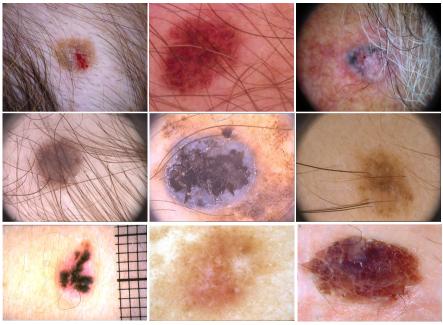
Skin cancer is one of the deadliest diseases and has a high mortality rate if left untreated. The diagnosis generally starts with visual screening and is followed by a biopsy or histopathological examination. Early detection can aid in lowering mortality rates. Visual screening can be limited by the experience of the doctor. Due to the long tail distribution of dermatological datasets and significant intra-variability between classes, automatic classification utilizing computer-aided methods becomes challenging. In this work, we propose a multitask few-shot-based approach for skin lesions that generalizes well with few labelled data to address the small sample space challenge. The proposed approach comprises a fusion of a segmentation network that acts as an attention module and classification network. The output of the segmentation network helps to focus on the most discriminatory features while making a decision by the classification network. To further enhance the classification performance, we have combined segmentation and classification loss in a weighted manner. We have also included the visualization results that explain the decisions made by the algorithm. Three dermatological datasets are used to evaluate the proposed method thoroughly. We also conducted cross-database experiments to ensure that the proposed approach is generalizable across similar datasets. Experimental results demonstrate the efficacy of the proposed work.
研究の動機と目的
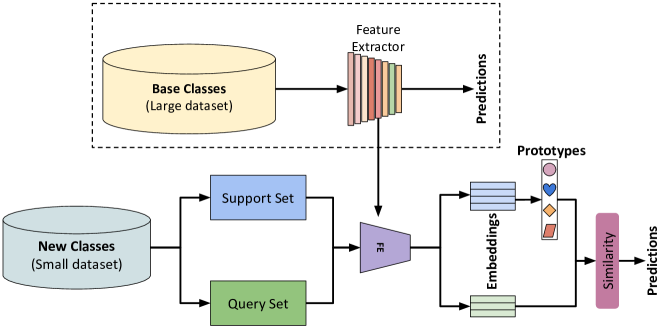
- 希少クラスを含む、限られたアノテート済み皮膚腫瘍データの課題に対処するため、最小限のラベル付き例でのみ学習可能なフェイシュート学習アプローチを構築し、良好な汎化性能を実現すること。
- 分類ネットワークにセグメンテーションネットワークをアテンションメカニズムとして統合することで、髪の毛やフケなどのアーチファクトの影響を低減し、分類のロバスト性を向上させること。
- 医療専門家が理解しやすいように、予測の意思決定プロセスを説明するためのGrad-CAM可視化を生成することで、モデルの解釈性を向上させること。
- HAM10000、PH2、Derm7ptといった多様な皮膚科内視鏡データセットにおける汎化性能を、クロスデータベース実験を通じて評価すること。
- 分類とセグメンテーションの損失のトレードオフを最適化するため、性能向上を目的とした学習可能な重みハイパーパrameter(λ)を用いること。
提案手法
- マルチタスク学習アーキテクチャを採用し、共有の特徴抽出器(ResNet50)と2つの並列ヘッド(セグメンテーション用と分類用)を有する。
- セグメンテーション出力は空間的アテンションマスクとして機能し、分類ネットワークが腫瘍領域に注目し、アーチファクトの干渉を低減する。
- 交差エントロピー(分類用)とバイナリ交差エントロピー(セグメンテーション用)を組み合わせた重み付きマルチタスク損失を採用し、λが両損失のバランスを制御する。
- 分類ヘッドにはメトリック学習を用いたプロトタイプネットワークを採用し、サポートサンプルの平均埋め込みをクラスプロトタイプとして計算し、クエリ画像の分類にはコサイン距離またはユークリッド距離を用いる。
- 解釈性はGrad-CAMにより実現され、モデルの予測に影響を与えた入力画像の特徴的な領域を強調表示する。
- モデルは1,000回のランダムなエピソードを用いたフェイシュートエピソード(1ショット、3ショット、5ショット)で訓練および評価され、95%信頼区間が75%、90%、95%で報告されている。
実験結果
リサーチクエスチョン
- RQ1セグメンテーションと分類を同時に最適化するマルチタスク学習フレームワークは、小規模データセットにおけるフェイシュート皮膚腫瘍分類性能を向上させることができるか?
- RQ2セグメンテーションをアテンションメカニズムとして用いることで、モデルの関連する腫瘍特徴への注目能力が向上し、アーチファクトによる誤分類が減少するか?
- RQ3バックボーンアーキテクチャの選択(例:VGG16、ResNet18、DenseNet-121、ResNet50)が、フェイシュート分類精度に与える影響は何か?
- RQ4分類性能を最大化するための、セグメンテーションと分類損失の最適なトレードオフ(λを用いて)は何か?
- RQ5本手法は、HAM10000、PH2、Derm7ptといった異なる皮膚科内視鏡データセット間でどの程度汎化可能か?
主な発見
- 本手法は、5ショット2クラス分類において、HAM10000で平均77.57%、PH2で76.06%、Derm7ptで77.64%の精度を達成し、95%信頼区間はそれぞれ±0.73、±0.98、±0.96であった。
- ResNet50をバックボーンとして使用した場合、5ショット設定で最も高い分類精度(HAM10000で77.57%)を示し、VGG16(73.79%)、ResNet18(76.50%)、DenseNet-121(74.21%)を上回った。
- 結合損失の最適なλ値は2であった。このとき、HAM10000で78.21%、PH2で75.85%、Derm7ptで77.83%の精度を達成した。λを高く(例:λ=5)すると、過学習のため性能が低下した。
- クロスデータベース実験により、モデルの強力な汎化能力が確認された。3つのデータセットすべてで一貫した性能を示し、ドメインシフトに対してもロバストであることが示された。
- Grad-CAM可視化により、モデルが正しく腫瘍領域を主な意思決定要因として強調表示していることが確認され、臨床利用者による信頼性と解釈性が向上した。
- アブレーションスタディにより、セグメンテーションヘッドが効果的なアテンションモジュールとして機能し、不要な画像領域やアーチファクトをフィルタリングすることで分類性能が向上することが確認された。
より良い研究を、今すぐ始めましょう
論文の読解から最終レビューまで、研究時間を劇的に削減しましょう。
クレジットカード登録不要
このレビューはAIが作成し、人間の編集者が確認しました。