
[論文レビュー] Multimass modelling of Milky Way globular clusters -- II. present-day black hole populations
本研究では、34個の銀河縁の球状星団における現在のブラックホール(BH)集団を推定するために、マルチマス分布関数モデルを用い、運動学、密度、質量関数といった複数の観測制約を統合した。ほとんどの星団ではBH質量分率が0–1%であるが、ω Cenを除き約5%である。BH含量と質量分離の間には逆相関が見られ、残骸質量分率と動的年齢の間にも相関が存在する。
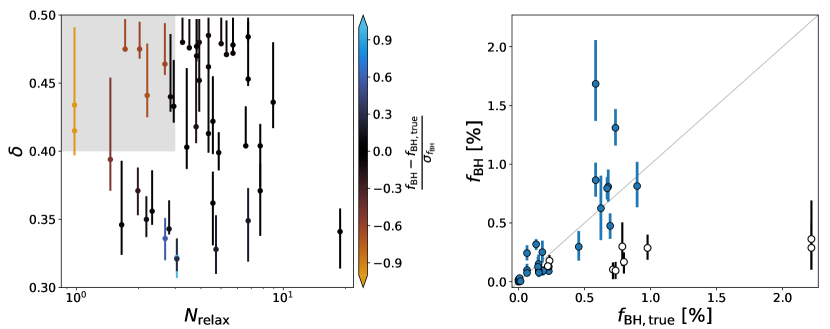
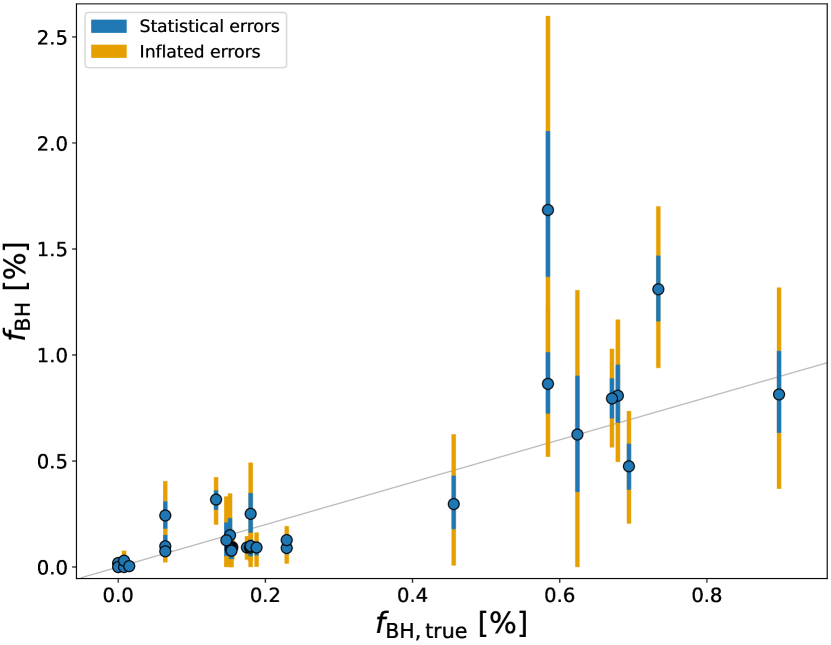
Populations of stellar-mass black holes (BHs) in globular clusters (GCs) influence their dynamical evolution and have important implications on one of the main formation channels for gravitational wave sources. Inferring the size of these populations remains difficult, however. In this work, multimass models of 34 Milky Way GCs, first presented in Dickson et al., are used to explore the present-day BH populations. Direct constraints on both the total and visible mass components provided by several observables allow these models to accurately determine the distribution of the dark mass (including BHs) within clusters, as we demonstrate in a proof-of-concept fitting of the models to mock observations extracted from Monte Carlo cluster models. New constraints on the BH population retained to the present-day in each cluster are inferred from our models. We find that BH mass fractions ranging from 0 to 1 per cent of the total mass are typically required to explain the observations, except for Omega Cen, for which we infer a mass fraction above 5 per cent, in agreement with previous works. Relationships between the dark remnant populations and other cluster parameters are examined, demonstrating a clear anti-correlation between the amount of BHs and mass segregation between visible stars, as well as a correlation between remnant mass fractions and the dynamical age of clusters. Our inferred BH populations are in good agreement overall with other recent studies using different methodologies, but with notable discrepancies for individual clusters.
研究の動機と目的
- 34個の銀河縁の球状星団の広範なサンプルにおいて、マルチマス動的モデルを用いて現在のブラックホール(BH)集団を推定すること。
- 固有運動、線速度、表面密度、質量関数といった複数の観測量を統合することで、特に星等質量ブラックホールを含む暗黒残骸の分布および総質量を制約すること。
- BH含量と質量分離や動的年齢といった星団の動的特性との関係を調査すること。
- 以前に中質量ブラックホール(IMBH)の存在が示唆された星団において、観測された運動学的・構造的データがIMBHの存在を要請するかどうかを検証すること。
- 他の手法(例:ジェーンスモデリングやN体/モンテカルロシミュレーション)の結果と照らし合わせ、推定されたBH集団の整合性を評価すること。
提案手法
- 34個の銀河縁の球状星団にわたる、固有運動、線速度、表面輝度プロファイル、質量関数といった複数の観測量を同時に適合させるマルチマス分布関数(DF)モデルを用いる。
- ベイズ推論にネステッドサンプリング(dynestyを用いて)を適用し、全BH質量、数、質量分率といったモデルパラメータの事後確率分布を探索する。
- 特に高質量領域(>1 M⊙)における星の初期質量関数(IMF)の制約を組み込み、金属量依存性も考慮する。
- モンテカルロ星団シミュレーションから抽出したモック観測を用いてモデリングフレームワークの妥当性を検証し、暗黒質量分布の回復が堅牢であることを示した。
- 推定された暗黒質量分布を用いて、ブラックホール、中性子星、白色矮星の寄与を分離し、BHは別個の質量的で大きな成分としてモデル化する。
- 統計的フィッティング手法を適用し、モデル予測と観測された運動学的・構造的データの整合性を高め、すべてのデータセットで残差を最小化する。
実験結果
リサーチクエスチョン
- RQ1本研究で対象とした34個の銀河縁の球状星団のうち、それぞれの現在のブラックホール質量分率はどの程度か?
- RQ2ブラックホールの存在は、質量分離(δパラメータで定量化)や星団の動的年齢といった観測可能な動的特性とどのように相関しているか?
- RQ3以前にIMBHの存在が示唆された星団において、観測された運動学的・構造的データが中質量ブラックホール(IMBH)の存在をどの程度要請するか?
- RQ4他の手法(例:ジェーンスモデリングやN体/モンテカルロシミュレーション)の結果と比較した場合、推定されたBH集団はどのように一致するか?
- RQ5全残骸質量分率と星団の進化状態(特に動的進化と質量分離の観点から)との関係は何か?
主な発見
- ほとんどの銀河縁の球状星団では、推定されたブラックホール質量分率は全星団質量の0%~1%の間であり、ω Cenを除き約5%である。
- BH質量分率とδパラメータの間には明確な逆相関が確認され、可視星の間で質量分離が顕著に弱い星団ではBH集団が顕著に多いことが示された。
- サンプル内で最も動的進化が進んだ星団では、BH、中性子星、白色矮星を含む全残骸質量分率が全質量の約70%に達しており、BHがその暗黒質量の大部分を占めている。
- モデル結果は、他の最近の研究(異なる手法を用いたもの)と良好に一致しているが、特にBH集団が小さいか大きな星団では顕著な相違が認められた。
- 以前にそれらの星団にIMBHが存在すると示唆されたが、そのような星団においてもIMBHの存在にあたえる証拠は得られず、観測データは星等質量ブラックホールの集団によって十分に説明可能であった。
- モデルの事後分布から、M15における全BH質量は約80 M⊙(90%信用区間:50–130 M⊙)であると推定された。これは以前の推定と一致しており、一部のジェーンスモデリング結果よりわずかに低く、一致するCMCシミュレーションとも整合性を示した。
より良い研究を、今すぐ始めましょう
論文の読解から最終レビューまで、研究時間を劇的に削減しましょう。
クレジットカード登録不要
このレビューはAIが作成し、人間の編集者が確認しました。