
[論文レビュー] Multispecies Animal Re-ID Using a Large Community-Curated Dataset
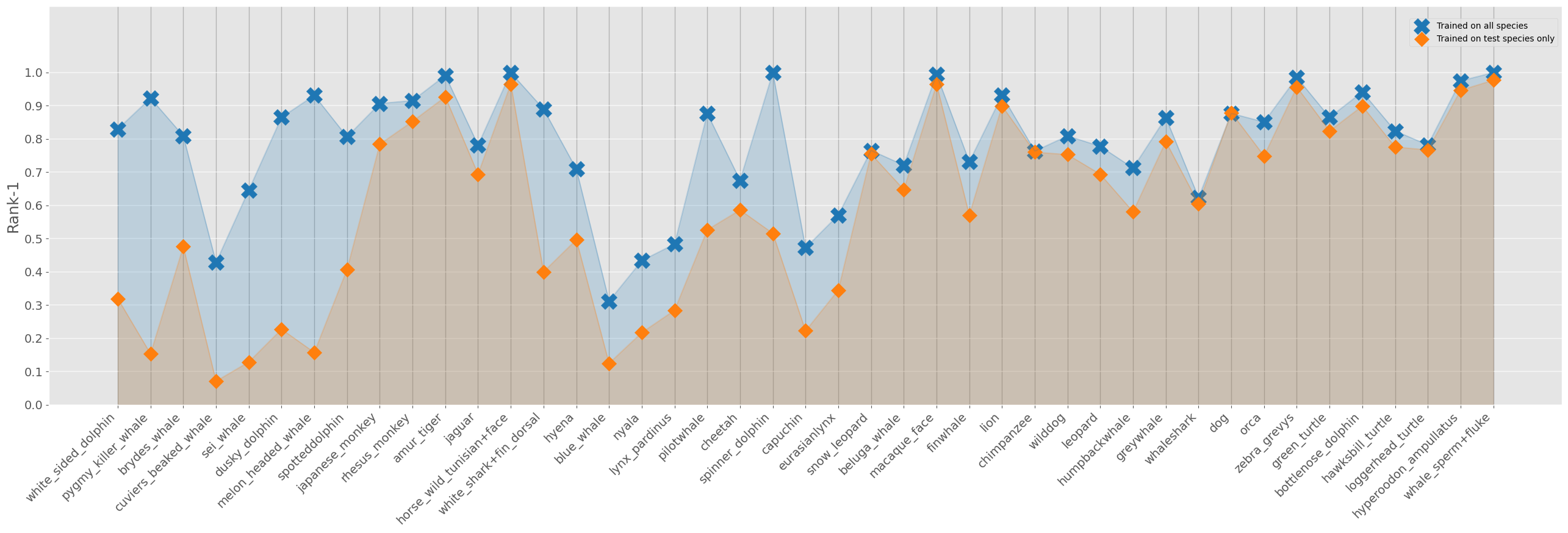
本論文では、49種、37,138頭の個体、225,374枚の画像を含む大規模なコミュニティがキュレートしたデータセットを用い、EfficientNetV2バックボーンと動的マージンを備えたサブセンターアークフェイス損失を用いてトレーニングされた、マルチスプライス動物再識別モデルMiewIDを提案する。このモデルは、単一スプライスモデルに対して平均12.5%のトップ1精度向上を達成し、未学習スプライスにおいてMegaDescriptorを著しく上回り、33種のスプライスで平均19.2%のトップ1精度向上を示した。
Recent work has established the ecological importance of developing algorithms for identifying animals individually from images. Typically, a separate algorithm is trained for each species, a natural step but one that creates significant barriers to wide-spread use: (1) each effort is expensive, requiring data collection, data curation, and model training, deployment, and maintenance, (2) there is little training data for many species, and (3) commonalities in appearance across species are not exploited. We propose an alternative approach focused on training multi-species individual identification (re-id) models. We construct a dataset that includes 49 species, 37K individual animals, and 225K images, using this data to train a single embedding network for all species. Our model employs an EfficientNetV2 backbone and a sub-center ArcFace loss function with dynamic margins. We evaluate the performance of this multispecies model in several ways. Most notably, we demonstrate that it consistently outperforms models trained separately on each species, achieving an average gain of 12.5% in top-1 accuracy. Furthermore, the model demonstrates strong zero-shot performance and fine-tuning capabilities for new species with limited training data, enabling effective curation of new species through both incremental addition of data to the training set and fine-tuning without the original data. Additionally, our model surpasses the recent MegaDescriptor on unseen species, averaging an 19.2% top-1 improvement per species and showing gains across all 33 species tested. The fully-featured code repository is publicly available on GitHub, and the feature extractor model can be accessed on HuggingFace for seamless integration with wildlife re-identification pipelines. The model is already in production use for 60+ species in a large-scale wildlife monitoring system.
研究の動機と目的
- 各動物スプライス用に別々の再識別モデルをトレーニングする際の高コストとスケーラビリティの障壁を軽減すること、特にデータが乏しいスプライスを対象とする。
- 複数スプライスで1つのモデルをトレーニングすることで、スプライス固有のモデルに比べて性能が向上するかを検討すること。
- 限られたトレーニングデータで新しい未学習スプライスに対して、モデルのゼロショット一般化能力およびファインチューニング能力を評価すること。
- 個別スプライスモデルの再トレーニングとデプロイの必要性を減らし、効率的かつ大規模な野生動物モニタリングを可能にすること。
提案手法
- 59の多様なデータセットから得た49種、37,138頭の個体、225,374枚のアノテート済み画像を含む大規模でコミュニティがキュレートしたマルチスプライスデータセットを構築した。
- 効率的な特徴抽出を実現するEfficientNetV2-Mバックボーンと、動的マージンを備えたサブセンターアークフェイス損失を用いて、1つの埋め込みネットワークをトレーニングした。これにより、クラス間およびクラス内分離が向上した。
- 未学習スプライスに対するゼロショット推論と、限られたデータで新しいスプライスに対するファインチューニングを実施し、単一スプライス学習ベースラインと比較してモデル性能を評価した。
- 33種の未学習スプライスにおいて、最近のMegaDescriptorモデルと性能を比較し、一般化能力およびロバストネスを評価した。
- バックボーンの効率性を検証するため、EfficientNetV2-MとSwinV2-Baseを比較したところ、このタスクにおいてEfficientNetV2-Mが優れた性能を示した。
- GitHubに完全なコードベース、HuggingFaceにモデル重みをリリースし、野生動物モニタリングパイプラインへの統合を可能にした。
実験結果
リサーチクエスチョン
- RQ1複数スプライスで1つのモデルをトレーニングすることで、スプライスごとに別々にモデルをトレーニングするのと比べて、性能が向上するか?
- RQ2トレーニング時に見なかったスプライスに対して、マルチスプライスモデルの一般化能力はどの程度高いか、特に限られたデータでの性能はどうか?
- RQ3少量のアノテート済み画像(例:25〜200枚)でのファインチューニングにより、新しいスプライスに対して効果的にモデルを最適化できるか?
- RQ4既存のマルチスプライストレーニングセットに新しいスプライスのデータを直接組み込むことで、ファインチューニングやスクラッチからの再トレーニングよりも優れた結果が得られるか?
- RQ5バックボーンアーキテクチャの選択(例:EfficientNetV2対ビジョントランスフォーマー)が、マルチスプライス動物再識別における性能に与える影響は何か?
主な発見
- マルチスプライスのMiewIDモデルは、単一スプライスモデルに対して平均12.5%のトップ1精度向上を達成し、個別スプライスでの向上幅は-0.2%から77.3%まで変動した。
- 33種の未学習スプライスにおいて、MiewIDはMegaDescriptorを平均19.2%のトップ1精度向上で上回り、優れたゼロショット一般化能力を示した。
- 限られたデータ(例:25〜200枚)でMiewIDをファインチューニングした結果、特に小規模データセットにおいて、単一スプライス学習と同等またはそれ以上の性能を達成した。
- 既存のマルチスプライストレーニングセットに新しいスプライスのデータを直接組み込むことで、ファインチューニングのみよりも一貫して優れた結果が得られた。
- EfficientNetV2-MバックボーンはSwinV2-Baseよりも平均トップ1精度で4.5%向上し、このタスクにおける特徴学習能力の優位性を示した。
- 本モデルは、Wildbookの野生動物モニタリングシステムで60種以上ですでに本番運用されており、実世界でのスケーラビリティと実用性を実証した。

より良い研究を、今すぐ始めましょう
論文の読解から最終レビューまで、研究時間を劇的に削減しましょう。
クレジットカード登録不要
このレビューはAIが作成し、人間の編集者が確認しました。