
[論文レビュー] NeuroGraph: Benchmarks for Graph Machine Learning in Brain Connectomics
NeuroGraph は静的および動的な脳グラフベンチマークを作成し、35のデータセットと15のベースラインを探索して、fMRI由来のコネクトーム上でグラフニューラルネットワークをデモグラフィック、課題、認知特性の予測に対してベンチマークします。
Machine learning provides a valuable tool for analyzing high-dimensional functional neuroimaging data, and is proving effective in predicting various neurological conditions, psychiatric disorders, and cognitive patterns. In functional magnetic resonance imaging (MRI) research, interactions between brain regions are commonly modeled using graph-based representations. The potency of graph machine learning methods has been established across myriad domains, marking a transformative step in data interpretation and predictive modeling. Yet, despite their promise, the transposition of these techniques to the neuroimaging domain has been challenging due to the expansive number of potential preprocessing pipelines and the large parameter search space for graph-based dataset construction. In this paper, we introduce NeuroGraph, a collection of graph-based neuroimaging datasets, and demonstrated its utility for predicting multiple categories of behavioral and cognitive traits. We delve deeply into the dataset generation search space by crafting 35 datasets that encompass static and dynamic brain connectivity, running in excess of 15 baseline methods for benchmarking. Additionally, we provide generic frameworks for learning on both static and dynamic graphs. Our extensive experiments lead to several key observations. Notably, using correlation vectors as node features, incorporating larger number of regions of interest, and employing sparser graphs lead to improved performance. To foster further advancements in graph-based data driven neuroimaging analysis, we offer a comprehensive open-source Python package that includes the benchmark datasets, baseline implementations, model training, and standard evaluation.
研究の動機と目的
- MLタスクのためのfMRIデータのグラフベース表現を探索する。
- 静的および動的な脳グラフの大規模ベンチマークスイート(NeuroGraph)を作成する。
- 多様なGNNとベースラインを評価して有効なパイプラインを特定する。
- データセット、モデル、評価プロトコルを含むオープンソースツールキットを提供する。
提案手法
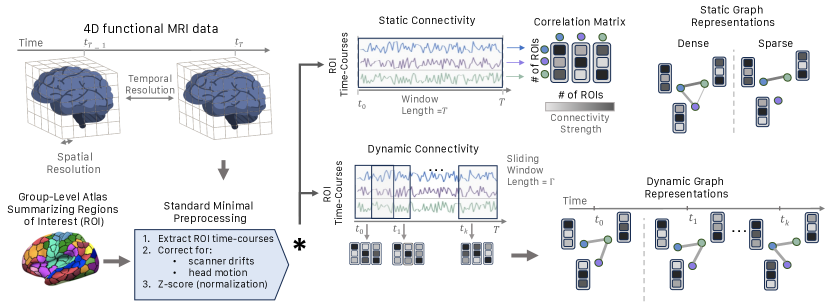
- ROIと相関ベースのエッジを用いてfMRIデータをグラフ表現に変換する。
- ROIsとスパース性を変えて静的および動的な脳グラフを構築する。
- 35データセットに対して、10個のGNNを含む15のベースラインモデルと5つの非GNNベースラインを評価する。
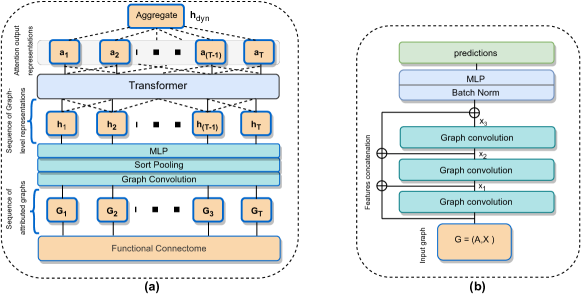
- 残差接続と連結された多層表現を備えたGNN∗アーキテクチャを提案する。
- GNNとトランスフォーマーを組み合わせた動的グラフ処理モジュールを全体表現に統合する。
実験結果
リサーチクエスチョン
- RQ1どのノード特徴量設定(CORR、BOLD、または両方)が最良の予測性能をもたらすか?
- RQ2ROIsの数(100、400、1000)はモデルの精度と汎化能力にどう影響するか?
- RQ3エッジのスパース閾値(上位5/10/20%)は信号とスパース性のバランスを最適化するのか?
- RQ4脳グラフにおいてタスクを超えて最も効果的なグラフ畳み込み手法はどれか?
主な発見
- 相関ベースのノード特徴量は、ROIsとタスクを問わず一貫して性能を向上させる。
- 1000個のROIsとスパースなグラフを用いると、多くのデータセットで強い結果を得ることが多い。
- 静的データセットでは、残差接続とMLP融合を備えたGNN∗が一般的に他のベースラインを上回る。
- 動的グラフは競争力があるが、データセットの制約により時に性能が低い場合がある;UniMP は引き続き堅牢。
- 大規模なROIsと相関機能を伴うスパース性がベンチマークで有望な設定として浮上する。
- 本研究はデータセット、ベースライン、訓練/評価パイプラインを含むオープンソースの NeuroGraph ツールキットを提供する。
より良い研究を、今すぐ始めましょう
論文の読解から最終レビューまで、研究時間を劇的に削減しましょう。
クレジットカード登録不要
このレビューはAIが作成し、人間の編集者が確認しました。