
[論文レビュー] Neutral material around the B[e] supergiant star LHA 115-S 65: An outflowing disk or a detached Keplerian rotating disk?
本研究は、小マゼラン雲に位置する急速回転するB[e]超巨星LHA 115-S 65の原始星周囲環境を、高分解能および低分解能の光学スペクトルを用いて調査した。[O i]発光線および二重ピークを持つ[Ca ii]線は、高密度で中性で縁面に近い円盤を示している。線輝度および線形のモデリングにより、吹き出し円盤よりも分離したケプラーラー回転円盤が支持され、S 65はLBVの前段階にある可能性があることが示唆され、明るい青色変星(LBVs)と類似した特徴を示している。
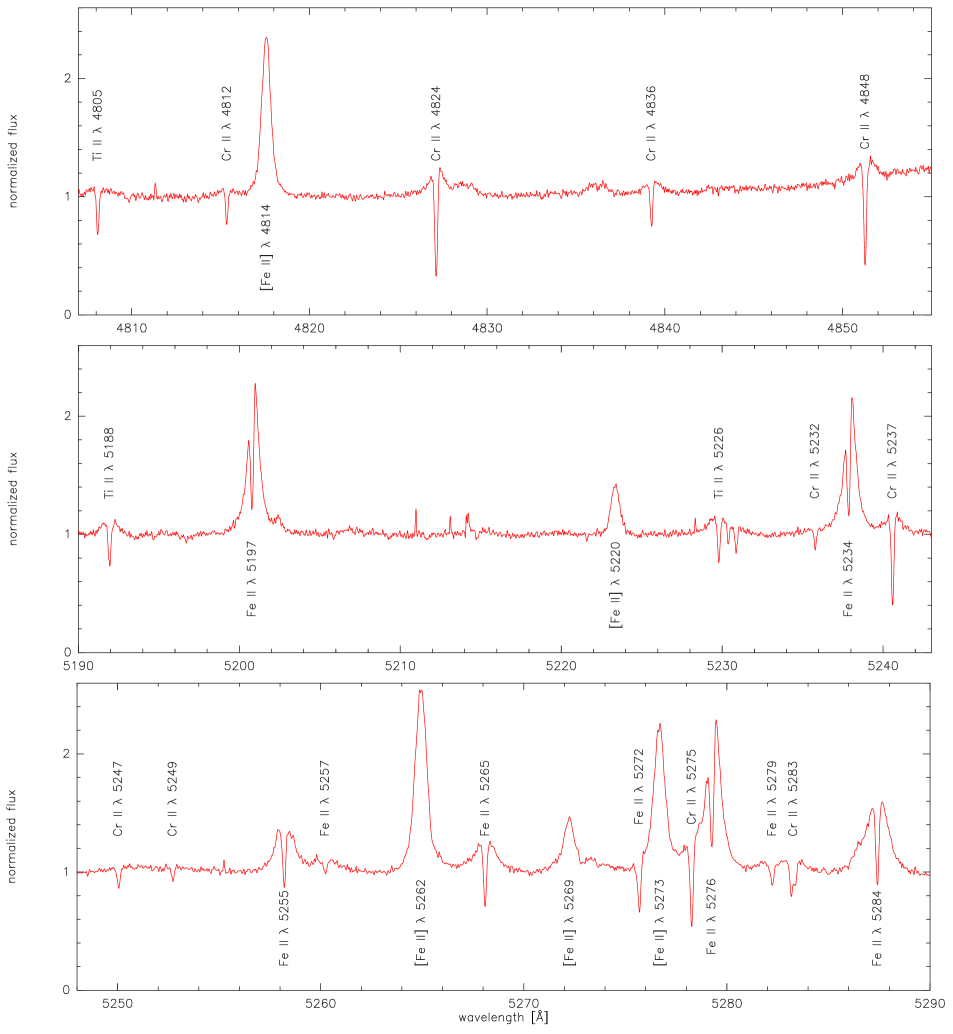
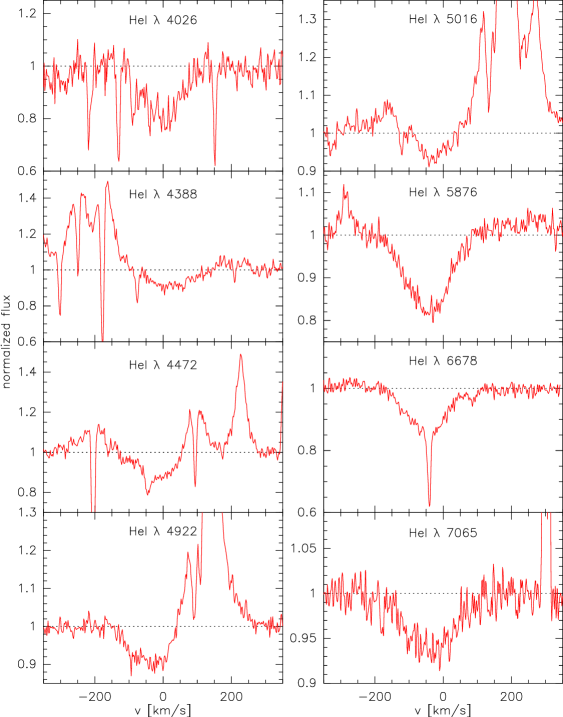
B[e] supergiants are surrounded by large amounts of hydrogen neutral material, traced by the emission in the optical [OI] lines. This neutral material is most plausibly located within their dense, cool circumstellar disks, which are formed from the (probably non-spherically symmetric) wind material released by the star. Neither the formation mechanism nor the resulting structure and internal kinematics of these disks (or disk-like outflows) are well known. However, rapid rotation, lifting the material from the equatorial surface region, seems to play a fundamental role. The B[e] supergiant LHA 115-S 65 (S65) in the SMC is one of the two most rapidly rotating B[e] stars known. Its almost edge-on orientation allows a detailed kinematical study of its optically thin forbidden emission lines. With a focus on the [OI] lines, we test the two plausible disk scenarios: the outflowing and the Keplerian rotating disk. Based on high- and low-resolution optical spectra, we investigate the density and temperature structure in those disk regions that are traced by the [OI] emission to constrain the disk sizes and mass fluxes needed to explain the observed [OI] line luminosities. In addition, we compute the emerging line profiles expected for either an outflowing disk or a Keplerian rotating disk, which can directly be compared to the observed profiles. Both disk scenarios deliver reasonably good fits to the line luminosities and profiles of the [OI] lines. Nevertheless, the Keplerian disk model seems to be the more realistic one, because it also agrees with the kinematics derived from the large number of additional lines in the spectrum. As additional support for the presence of a high-density, gaseous disk, the spectrum shows two very intense and clearly double-peaked [CaII] lines. We discuss a possible disk-formation mechanism, and similarities between S65 and the group of LBVs.
研究の動機と目的
- B[e]超巨星LHA 115-S 65周囲の中性原始星周囲物質の運動学的構造を特定すること。
- 観測された[O i]発光が吹き出し円盤かケプラーラー回転円盤かを検証すること。
- [O i]線輝度および線形を用いて、円盤の物理的性質(質量、サイズ、質量フラックス)を制約すること。
- S 65が明るい青色変星(LBVs)と、回転、質量放出、円盤構造の点で類似しているかどうかを評価すること。
- 急速な回転が質量星における高密度の赤道原始星周囲円盤形成に果たす役割を調査すること。
提案手法
- 欧州南観測所(ESO)のラ・シルヤ観測所にある1.52mおよび2.2m望遠鏡を用いて、LHA 115-S 65の高分解能および低分解能光学スペクトルを取得した。
- [O i] λ6300発光線の輝度を分析し、円盤形成領域内の全中性水素質量を推定した。
- 2つの円盤状況(吹き出し円盤および分離したケプラーラー回転円盤)の出射線形をモデリングした。
- 観測された二重ピーク[Ca ii]線を、高密度で縁面に近い円盤幾何構造の独立した証拠として用いた。
- 両モデルの予測線形と観測線形を比較し、最適な運動学的構造を特定した。
- 多数の追加発光線の運動学的特性と一致するかを評価し、ケプラーラー円盤モデルの妥当性を検証した。
実験結果
リサーチクエスチョン
- RQ1LHA 115-S 65周囲の原始星周囲物質は、吹き出し円盤かケプラーラー回転円盤のどちらが適切な記述か?
- RQ2[O i]発光線によって示される円盤領域内の全中性水素質量はどの程度か?
- RQ3[O i]および[Ca ii]の観測線形は、原始星周囲円盤の幾何構造および運動学的特性をどのように制約するか?
- RQ4HR図におけるLHA 115-S 65の位置に加え、その高い回転速度が、明るい青色変星(LBVs)への関連を示唆するか?
- RQ5回転誘発質量放出、特に臨界回転速度付近での現象によって、円盤形成機構を説明できるか?
主な発見
- [O i]線輝度から、発光線が示す領域内の全ガス質量は約1.5 × 10⁻² M☉であると示された。
- 円盤内のイオン化水素分率は0.1%未満であり、円盤が水素的に主に中性であることを確認した。
- 二重ピーク[Ca ii]線は、高密度で縁面に近い原始星周囲円盤の強力な独立的証拠を提供した。
- 線形のモデリングにより、ケプラーラー回転円盤が吹き出し円盤よりも優位であることが示され、ケプラーラーモデルが観測された運動学的特性をよりよく再現した。
- 星のHR図における位置はLBV不安定帯の最小領域に近く、回転速度は臨界限界の75%を超えており、LBVへの進化的な関連が示唆された。
- S 65の円盤質量および吹き出し速度は、LBVネbulaeで観測された値と整合しており、さらなる進化的関連を支持する証拠となった。
より良い研究を、今すぐ始めましょう
論文設計から論文執筆まで、研究時間を劇的に削減しましょう。
クレジットカード登録不要
このレビューはAIが作成し、人間の編集者が確認しました。