
[論文レビュー] Neutrino physics with the PTOLEMY project: active neutrino properties and the light sterile case
この論文はPTOLEMYプロジェクトの理論枠組みと、トリチウムでのニュートリノ捕獲を通じた宇宙ニュートリノ背景 CNBの感度研究を概説しており、絶対ニュートリノ質量スケールへの影響と軽いeVスケールのステレオニューニュートリノを含む。
The PTOLEMY project aims to develop a scalable design for a Cosmic Neutrino Background (CNB) detector, the first of its kind and the only one conceived that can look directly at the image of the Universe encoded in neutrino background produced in the first second after the Big Bang. The scope of the work for the next three years is to complete the conceptual design of this detector and to validate with direct measurements that the non-neutrino backgrounds are below the expected cosmological signal. In this paper we discuss in details the theoretical aspects of the experiment and its physics goals. In particular, we mainly address three issues. First we discuss the sensitivity of PTOLEMY to the standard neutrino mass scale. We then study the perspectives of the experiment to detect the CNB via neutrino capture on tritium as a function of the neutrino mass scale and the energy resolution of the apparatus. Finally, we consider an extra sterile neutrino with mass in the eV range, coupled to the active states via oscillations, which has been advocated in view of neutrino oscillation anomalies. This extra state would contribute to the tritium decay spectrum, and its properties, mass and mixing angle, could be studied by analyzing the features in the beta decay electron spectrum.
研究の動機と目的
- Cosmic Neutrino Background (CNB) の直接検出を動機づけ、その宇宙論的・素粒子物理学的含意。
- β-decayエンドポイントとCNB捕獲信号を通じた絶対ニュートリノ質量スケールへのPTOLEMYの感度を評価。
- 軽いステレオニュートリノ(eVスケール)のβスペクトルとCNB検出への影響を探る。
- ニュートリノ質量の順序付けとエネルギー分解能が検出の見通しと事象数にどのように影響するかを評価。
提案手法
- CNB捕獲率をトリチウムに対して導出し、|U_{ei}|^2 とクラスタリング因子 f_{c,i}を用いてニュートリノ質量固有状態に結びつける。
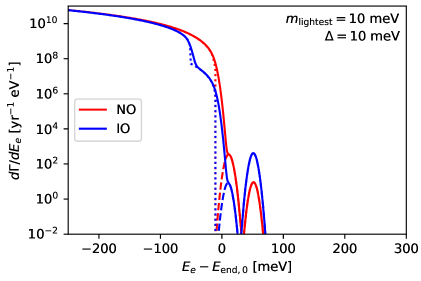
- 検出器のエネルギー分解能を取り入れ、CNB信号とβ背景の両方をGaussian(全幅Δ)で畳み込む。
- ベイズ枠組みを用いてニュートリノ質量スケールとステレオニュートリノパラメータへのPTOLEMYの感度を予測する。
- 公式に示された断面積と電弱形因子を用いてβ崩壊背景スペクトラムとニュートリノ捕獲信号を計算する。
- 混合要素U_{ei}とクラスタリング項を通じて捕獲率と信号特徴における質量順序の影響を評価する。
実験結果
リサーチクエスチョン
- RQ1β-崩壊エンドポイントとCNB捕獲信号からPTOLEMYの標準ニュートリノ質量スケールへの感度はどのくらいか。
- RQ2エネルギー分解能Δはβ崩壊背景を超えてCNB捕獲ピークを解決する能力に如何に影響するか。
- RQ3軽いステレオニュートリノ(m ~ eV)のβスペクトルとCNB捕獲信号への影響は、特にU_{e4}とΔm^2_{41}を通じてどのように現れるか。
- RQ4銀河内のニュートリノ質量順序と潜在的クラスタリングはCNB捕獲率をどう修正するか。
主な発見
- Diracニュートリノの場合、100 gのトリチウムに対する統合CNB捕獲信号は、クラスタリング強化を無視すると約4イベント/年である。
- Majoranaニュートリノは、質量/順序条件次第で最大で2倍程度高いレートを生み出す可能性がある。
- 局所的な relic ニュートリノ過剰密度は、クラスタリングによって、質量が約60 meVのとき捕獲レートを10-20%、質量が約150 meVのとき最大で約200%まで増加させ得る(ハローモデルに依存)。
- 軽いステレオニュートリノ(m4 ~ 1 eV)の存在はβスペクトルを修正し、特にU_{e4}とΔm^2_{41}を通じてスペクトル特徴と混合を分析することにより制約可能である。
- 逆順序における運動学的特徴は、重い質量固有状態によるβスペクトルの顕著な歪を生じ、振る舞いのモデル非依存の手がかりを提供する。
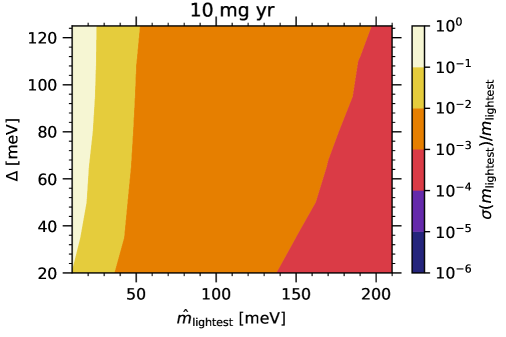
- 検出の見通しはCNB信号とβ背景を分離するのに十分なエネルギー分解能を達成することに強く依存している(Δは関連する質量分裂より小さくなければならない)。
より良い研究を、今すぐ始めましょう
論文設計から論文執筆まで、研究時間を劇的に削減しましょう。
クレジットカード登録不要
このレビューはAIが作成し、人間の編集者が確認しました。