
[論文レビュー] New Resonances of Supernova Neutrinos in Twisting Magnetic Fields
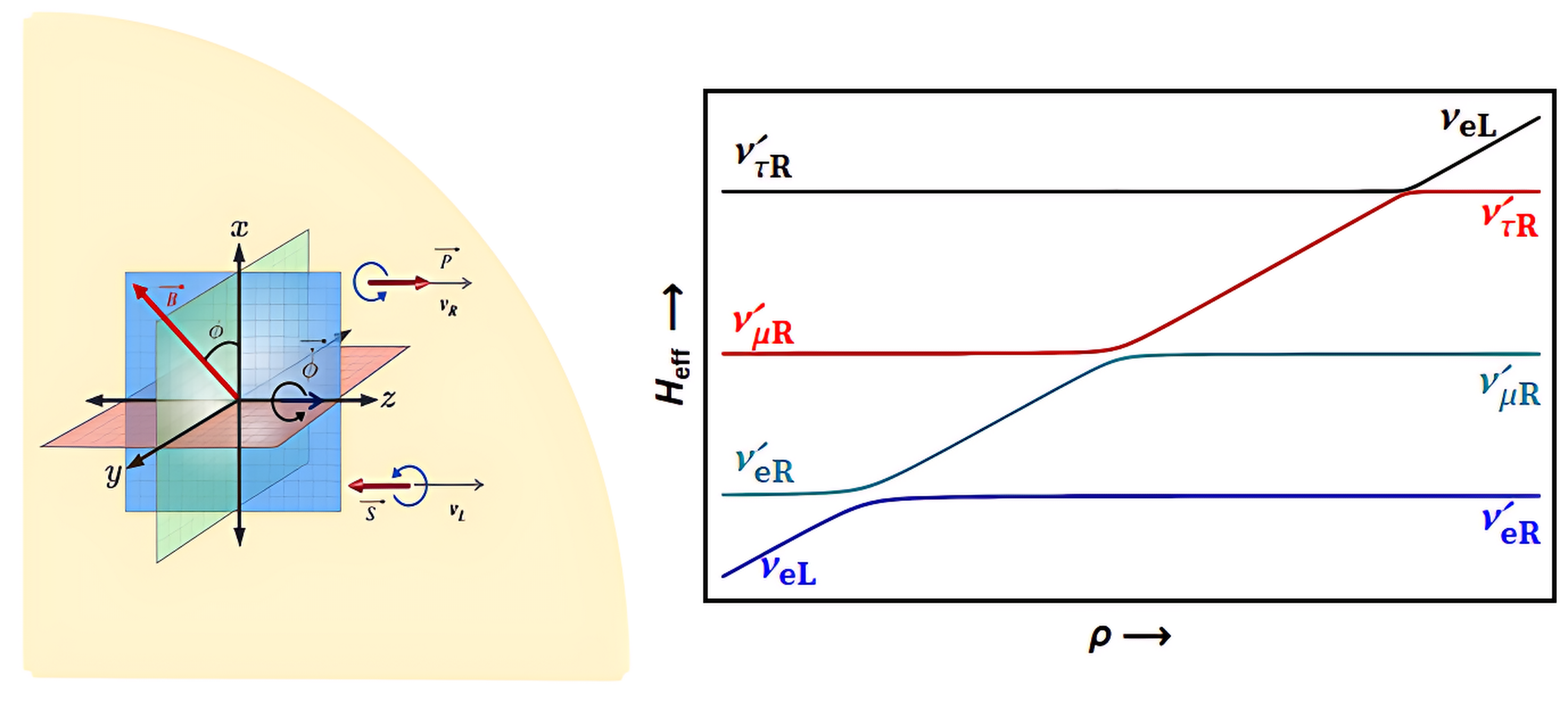
本論文は、超新星におけるねじれ磁場が、幾何的(ベリー)位相を介してディラックニュートリノにおける新しいタイプの共鳴スピン変換を誘発することを提案している。この現象は中性子生成期のバースト中にニュートリノのフレーバー構成を顕著に変化させる。磁気モーメントが $10^{-15}\mu_B$ と非常に小さい場合でも、今後の実験(DUNE や Hyper-Kamiokande)で測定可能なフラックス変調を引き起こす可能性があり、現在の実験感度を超えて非ゼロのニュートリノ磁気モーメントを探索する手がかりを提供する。
We investigate the effect of resonant spin conversion of the neutrinos induced by the geometrical phase in a twisting magnetic field. We find that the geometrical phase originating from the rotation of the transverse magnetic field along the neutrino trajectory can trigger a new resonant spin conversion of Dirac neutrinos inside the supernova, even if there were no such transitions in the fixed-direction field case. We have shown that even though resonant spin conversion is too weak to affect solar neutrinos, it could have a remarkable consequence on supernova neutronization bursts where very intense magnetic fields are quite likely. We demonstrate how the flavor composition at Earth can be used as a probe to establish the presence of non-negligible magnetic moments, potentially down to $10^{-15}~μ_B$ in upcoming neutrino experiments like the Deep Underground Neutrino Experiment (DUNE), and the Hyper-Kamiokande (HK). Possible implications are analyzed.
研究の動機と目的
- 超新星における回転する横磁場がニュートリノスピン・フレーバー変換に与える影響を調査すること。
- 固定磁場配置では共鳴が存在しない状況でも、磁場回転に起因する幾何的位相がディラックニュートリノにおける共鳴的スピン変換を引き起こすかどうかを特定すること。
- 超新星の中性子生成期バースト中の時間依存的フラックス変動を通じて、非ゼロのニュートリノ磁気モーメントが $10^{-15}\mu_B$ まで検出可能かどうかを評価すること。
- DUNE や Hyper-Kamiokande といった今後の実験が、この新しい共鳴を標準模型を越える物理学のプローブとしてどれほど感度を持つのかを評価すること。
提案手法
- 磁場回転に起因する動的位相と幾何的位相を含むハミルトニアンを用いて、ねじれ磁場内でのニュートリノの時間発展をモデル化すること。
- 回転する横磁場内でのニュートリノスピン進化の有効ハミルトニアンを導出し、回転角 $\phi(r)$ を通じてベリー位相を組み込むこと。
- 超新星の中性子生成期バースト段階における $\nu_e$、$\bar{\nu}_e$ および他のフレーバーの時間依存的フラックスをシミュレートすること。
- 正規化不確実性と時間チャンクの変動を考慮するために、磁気モーメントへの感度を評価するための $\chi^2$ 評価統計量と、余剰パrameter $\xi$ を用いること。
- DUNE(液体アルゴン TPC)および Hyper-Kamiokande(水チェレンコフ)の検出器固有の応答関数を適用し、エネルギーチャンクごとの検出可能なイベントレートを計算すること。
- 場のねじれ速度($\dot{\phi} = \pm 0.9\,\text{m}^{-1}$)の変化が、異なるニュートリノ種および質量順序のケースにおけるフラックス抑制に与える影響を評価すること。
実験結果
リサーチクエスチョン
- RQ1回転する横磁場が、固定磁場配置では共鳴が存在しない状況でも、幾何的位相を介してディラックニュートリノにおける新しい共鳴的スピン変換を誘発できるか?
- RQ2この新しい共鳴によって引き起こされる超新星ニュートリノフラックスの最大抑制率は何か?また、磁場のねじれ速度およびニュートリノ質量順序にどのように依存するか?
- RQ3DUNE や Hyper-Kamiokande といった今後の実験が、時間依存的フラックス変動を通じて $10^{-15}\mu_B$ に達する非ゼロのニュートリノ磁気モーメントをどの程度まで検出可能か?
- RQ4ねじれ磁場の存在が中性子生成期からのニュートリノのフレーバー構成に与える影響は何か?また、これは標準的混合効果と区別可能か?
主な発見
- ねじれ磁場は、固定方向の磁場では観測されない幾何的(ベリー)位相を介して、ディラックニュートリノにおける新しい共鳴的スピン変換を誘発する。
- 反転質量順序(IO)の場合、この新しい共鳴は、場のねじれ速度に依存して最初の 20 ms の間に $\nu_e$ の中性子生成ピークを最大で 81% 減少させる。
- $\dot{\phi} = +0.9\,\text{m}^{-1}$ のケース2では、ほぼすべての検出チャンネルと時間窓で 70% を超える抑制が生じ、観測に最適である。
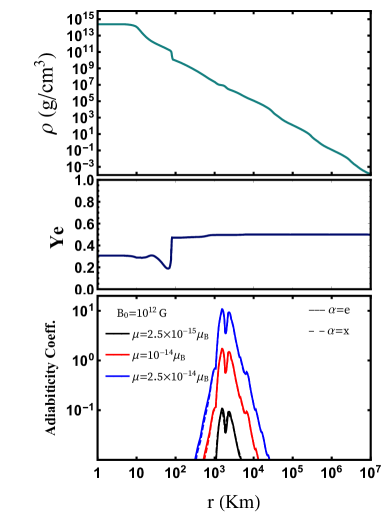
- DUNE および Hyper-Kamiokande は、$B_0 = 10^{12}\,\text{G}$ を仮定した場合、90%信頼水準で $4-8 \times 10^{-15}\mu_B$ までの非ゼロニュートリノ磁気モーメントを発見可能である。
- 全体の正規化ではなく、時間構造の変化が主要な観測量である。なぜなら、宇宙空間の磁場は時間的構造に影響を与えないため、共鳴信号を明確に分離できるからである。
- 結果は自然性の限界に近い。$10^{-15}\mu_B$ よりも大きな磁気モーメントは、ループ補正において許容できないほど大きなニュートリノ質量を引き起こす可能性があるため、この領域は検証可能な重要な窓である。
より良い研究を、今すぐ始めましょう
論文の読解から最終レビューまで、研究時間を劇的に削減しましょう。
クレジットカード登録不要
このレビューはAIが作成し、人間の編集者が確認しました。