
[論文レビュー] Nonlinear sigma models for monitored dynamics of free fermions
The paper derives an SO(N) nonlinear sigma model as the effective field theory for monitored dynamics of a multi-flavor Majorana chain, analyzing entanglement scaling and phase structure in the replica limit N→1.
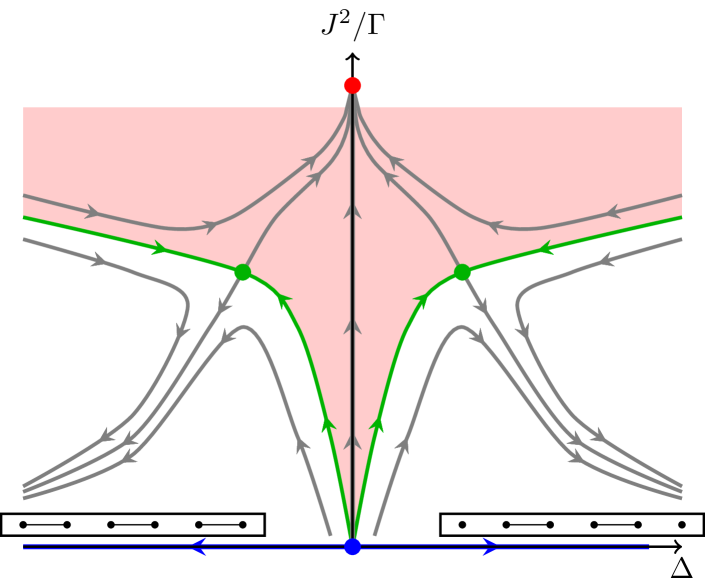
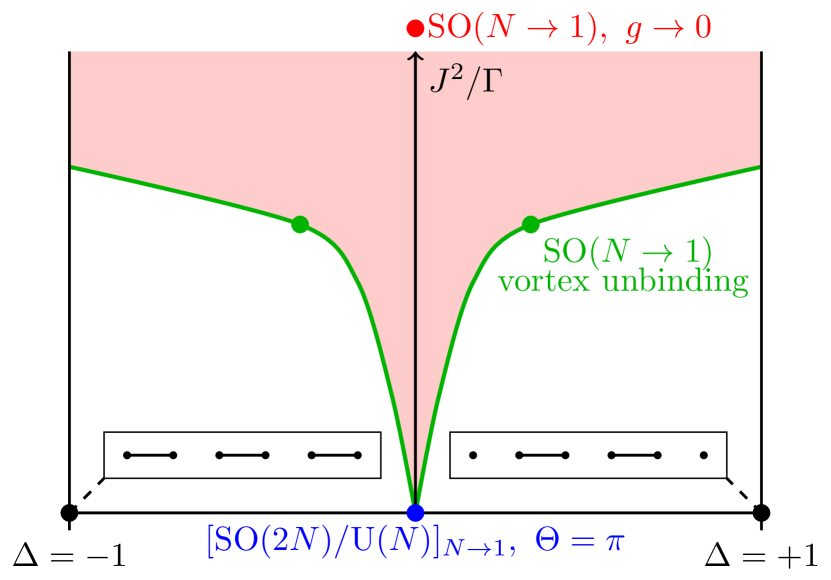
We derive field theory descriptions for measurement-induced phase transitions in free fermion systems. We focus on a multi-flavor Majorana chain, undergoing Hamiltonian evolution with continuous monitoring of local fermion parity operators. Using the replica trick, we map the dynamics to the imaginary time evolution of an effective spin chain, and use the number of flavors as a large parameter for a controlled derivation of the effective field theory. This is a nonlinear sigma model for an orthogonal $N imes N$ matrix, in the replica limit $N o 1$. (On a boundary of the phase diagram, another sigma model with higher symmetry applies.) Together with known results for the renormalization-group beta function, this derivation establishes the existence of stable phases -- nontrivially entangled and disentangled respectively -- in the physically-relevant replica limit $N o 1$. In the nontrivial phase, an asymptotically exact calculation shows that the bipartite entanglement entropy for a system of size $L$ scales as $(\log L)^2$, in contrast to findings in previously-studied models. Varying the relative strength of Hamiltonian evolution and monitoring, as well as a dimerization parameter, the model's phase diagram contains transitions out of the nontrivial phase, which we map to vortex-unbinding transitions in the sigma model, and also contains separate critical points on the measurement-only axis. We highlight the close analogies as well as the differences with the replica approach to Anderson transitions in disordered systems.
研究の動機と目的
- Develop a universal, long-wavelength description of measurement-induced phase transitions in free fermion systems.
- Derive an effective nonlinear sigma model for a multi-flavor Majorana chain under continuous local parity measurements.
- Establish entanglement scaling and phase structure in the physically relevant replica limit N→1.
- Map phase transitions to vortex-like defects in the sigma model and relate to localization-inspired RG flows.
提案手法
- Apply the replica trick to average over measurement randomness and Hamiltonian noise.
- Map the replicated density-matrix dynamics to an effective SO(2N) spin chain.
- Proceed to a controlled large-NF (flavor index) expansion to derive the SO(N) nonlinear sigma model.
- Identify the manifold of the sigma model and the role of the replica limit N→1.
- Compute universal entanglement scaling in the stable nontrivial phase, verifying with numerics.
実験結果
リサーチクエスチョン
- RQ1What is the universal field-theory description of monitored dynamics for free fermions in the replica limit N→1?
- RQ2What are the phase structure and critical properties of monitored Majorana chains under local parity measurements?
- RQ3How does entanglement scale in the nontrivial phase, and how does it compare to other monitored-system models?
- RQ4What are the roles of topological defects (vortices/instantons) in transitions out of the nontrivial phase?
- RQ5How do boundary conditions and symmetry class affect the effective field theory and phase diagram?
主な発見
- A nonlinear sigma model with an SO(N) target manifold describes the monitored free-fermion dynamics in the replica limit N→1.
- In the nontrivial stable phase, the bipartite entanglement entropy scales as S_n ~ ((n+1)/(96 n)) (ln L)^2 for system size L.
- The phase diagram features transitions to disentangled area-law phases via vortex-instanton physics on the sigma-model side.
- On the measurement-only axis (J=0) there are separate critical points with distinct sigma-model descriptions.
- The results connect to, and extend, localization-type RG thinking to the N→1 replica setting for monitored systems.
- The N=1 case (or equivalently monitored Ising dual) mirrors boundary phenomena with higher-symmetry sigma models on a phase-diagram boundary.
より良い研究を、今すぐ始めましょう
論文設計から論文執筆まで、研究時間を劇的に削減しましょう。
クレジットカード登録不要
このレビューはAIが作成し、人間の編集者が確認しました。