
[論文レビュー] On-chip quantum interference between independent lithium niobate-on-insulator photon-pair sources
この論文は、酸化物インシュレータ上に周期的ポーリングを施したリチウニオブート(LNOI)波導を用いた独立した二つの光子対源のオンチップ量子干渉を実証している。プログラマブルなマハチンドレ・インターフェーラーと高輝度なSPDC源を統合することで、96.8(3.6)%の可視性を達成した量子干渉を実現し、高い不相干渉性と輝度を備えたスケーラブルなオンチップ統合量子フォトニクス回路を実現した。
Generating and interfering non-classical states of light is fundamental to optical quantum information science and technology. Quantum photonic integrated circuits provide one pathway towards scalability by combining nonlinear sources of non-classical light and programmable circuits in centimeter-scale devices. The key requirements for quantum applications include efficient generation of indistinguishable photon-pairs and high-visibility programmable quantum interference. Here, we demonstrate a lithium niobate-on-insulator (LNOI) integrated photonic circuit that generates a two-photon path-entangled state, and a programmable interferometer for quantum interference. We generate entangled photons with $\sim2.3 imes10^8$ pairs/s/mW brightness and perform quantum interference experiments on the chip with $96.8\pm3.6\%$ visibility. LNOI is an emerging photonics technology that has revolutionized high-speed modulators and efficient frequency conversion. Our results provide a path towards large-scale integrated quantum photonics including efficient photon-pair generation and programmable circuits for applications such as boson sampling and quantum communications.
研究の動機と目的
- 高輝度な光子対生成とプログラマブルな量子干渉を組み合わせることで、スケーラブルでオンチップ統合された量子フォトニクス回路の実現を目的とする。
- シリコンおよび窒化ケイ酸ケイムのプラットフォームの限界を克服するため、酸化物インシュレータ上に形成されたリチウニオブート(LNOI)の強力な非線形性および電気光学的特性を活用する。
- オンチップ干渉を用いて独立して生成された光子間で高可視性の量子干渉を達成することを目的とし、ボソンサンプリングや量子通信における量子優位性の実現に不可欠な要件を満たす。
- LNOI技術が、1つの統合プラットフォーム上で効率的な光子対生成と高精度な量子干渉を両立できることを実証する。
提案手法
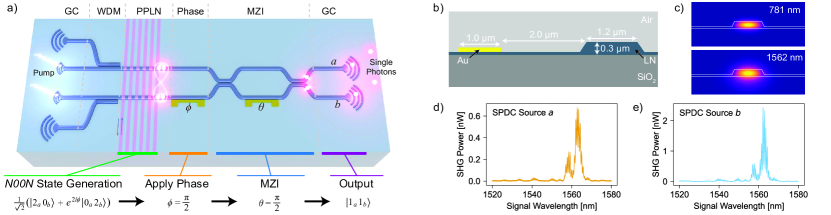
- チップには、自己発生的パラメトリック下変換(SPDC)を用いて経路エンタングルドN00N状態を生成するための、同一の周期的ポーリングを施したLNOI波導が2本統合されている。
- 熱光的位相シフタを備えたマハチンドレ・インターフェーラー(MZI)により、2つの出力モード間の可変な量子干渉が可能である。
- 光子対生成は781 nmのポンプレーザーによって駆動され、型II位相整合を介して1562 nmの相関した光子対が生成される。
- オンチップの輝度は約2.3×10⁸対/s/mWと測定され、一般的なバルクSPDC源を大きく上回っている。
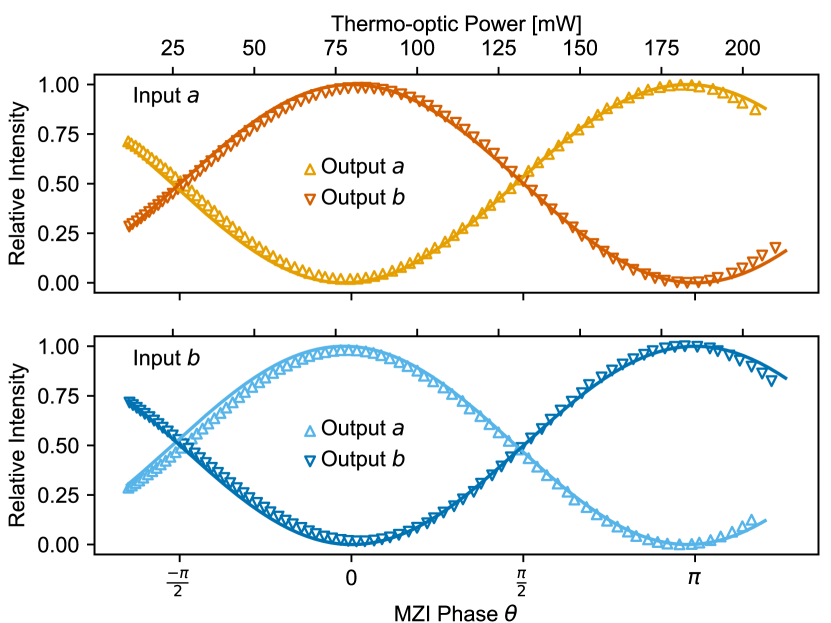
- 量子干渉の可視性は、N00N状態およびMZIの制御された位相スイープを実施し、単一光子検出器を用いて出力状態を測定することで定量される。
- オフチップでのホン=オウ=マーテル(HOM)実験により、光子の不相干渉性が検証され、ディップ幅71.9(0.5) fsで83.2±0.1%の可視性が測定された。
実験結果
リサーチクエスチョン
- RQ1LNOIを用いた独立したオンチップ光子対源が、高可視性の量子干渉を達成できるか?
- RQ2周期的ポーリングを施したLNOI波導におけるSPDC源のオンチップ輝度はどの程度か?
- RQ31つのLNOIチップに、高効率な光子対生成とプログラマブルな干渉素子を統合できるか?
- RQ4オンチップ量子干渉の可視性は、オフチップでのHOM測定による光子不相干渉性と比較してどの程度か?
- RQ5LNOI技術が、短期的な量子優位性を実現するためのスケーラブルで統合された量子フォトニクス回路をどの程度実現できるか?
主な発見
- 独立して生成された光子間のオンチップ量子干渉で96.8(3.6)%の可視性を達成し、高い不相干渉性を実証した。
- オンチップ光子対輝度は約2.3×10⁸対/s/mWに達し、一般的な自由空間SPDC源(ppKTPを含む)を大きく上回った。
- ホン=オウ=マーテル実験により、光子の不相干渉性が確認され、83.2±0.1%の可視性が得られた。これはファイバー分波器の帯域幅に制限されている。
- ファイバー結合後の光子のスペクトル帯域幅は約50 nmと推定され、71.9(0.5) fsのHOMディップ幅と整合的であった。
- オフチップ部品の帯域制限および誤差合わせの不完全さが原因で、オンチップ干渉の可視性はオフチップ測定に比べて低下した。
- SPDC源とプログラマブルな干渉素子を1つのLNOIチップに統合することで、ボソンサンプリングや量子メトロロジーなどの量子情報処理タスクに適したスケーラブルなプラットフォームが実現された。
より良い研究を、今すぐ始めましょう
論文の読解から最終レビューまで、研究時間を劇的に削減しましょう。
クレジットカード登録不要
このレビューはAIが作成し、人間の編集者が確認しました。