
[論文レビュー] On the Image-Based Detection of Tomato and Corn leaves Diseases : An in-depth comparative experiments
本論文は、畳み込みニューラルネットワーク(CNN)を用いた転移学習を活用し、画像ベースでトマトおよびトウモロコシの葉の病気を検出するための新規なディープラーニングフレームワークを提案する。Xception、EfficientNetB0、およびカスタムモデルを含む複数のアーキテクチャを評価し、バッチ正規化を用いることで、PlantVillageから新たに収集したデータセット上で最大99.9%の訓練精度および98.0%の検証精度を達成し、高い性能を示した。
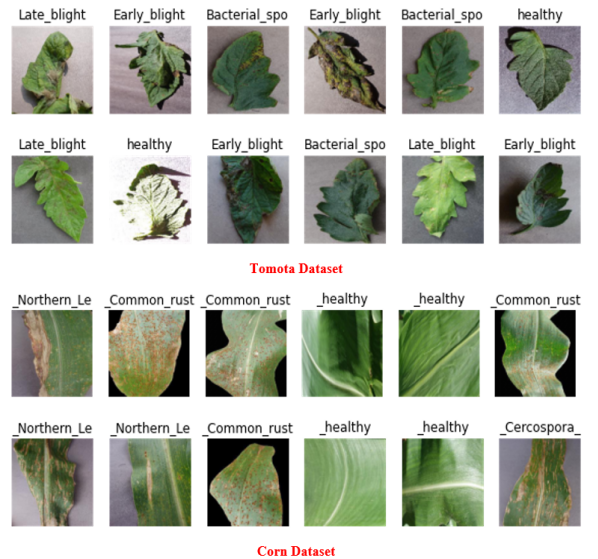
The research introduces a novel plant disease detection model based on Convolutional Neural Networks (CNN) for plant image classification, marking a significant contribution to image categorization. The innovative training approach enables a streamlined and efficient system implementation. The model classifies two distinct plant diseases into four categories, presenting a novel technique for plant disease identification. In Experiment 1, Inception-V3, Dense-Net-121, ResNet-101-V2, and Xception models were employed for CNN training. The newly created plant disease image dataset includes 1963 tomato plant images and 7316 corn plant images from the PlantVillage dataset. Of these, 1374 tomato images and 5121 corn images were used for training, while 589 tomato images and 2195 corn images were used for testing/validation. Results indicate that the Xception model outperforms the other three models, yielding val_accuracy values of 95.08% and 92.21% for the tomato and corn datasets, with corresponding val_loss values of 0.3108 and 0.4204, respectively. In Experiment 2, CNN with Batch Normalization achieved disease detection rates of approximately 99.89% in the training set and val_accuracy values exceeding 97.52%, accompanied by a val_loss of 0.103. Experiment 3 employed a CNN architecture as the base model, introducing additional layers in Model 2, skip connections in Model 3, and regularizations in Model 4. Detailed experiment results and model efficiency are outlined in the paper's sub-section 1.5. Experiment 4 involved combining all corn and tomato images, utilizing various models, including MobileNet (val_accuracy=86.73%), EfficientNetB0 (val_accuracy=93.973%), Xception (val_accuracy=74.91%), InceptionResNetV2 (val_accuracy=31.03%), and CNN (59.79%). Additionally, our proposed model achieved a val_accuracy of 84.42%.
研究の動機と目的
- 画像分類を用いて、自動的で正確かつ効率的な植物病害の検出システムを開発すること。
- 植物の品種同定を超えた商業的ソリューションが不足している現状に対処すること。
- トマトやトウモロコシなどの主要作物における病害の早期発見を可能にすることで、農業の持続可能性を向上させること。
- 病害分類のための、新たに拡張されたトマトおよびトウモロコシの葉画像データセットの作成と検証を行うこと。
- バッチ正規化や正則化などの技術を用いて、複数のディープラーニングアーキテクチャの比較とモデル性能の最適化を行うこと。
提案手法
- 初期学習に、事前学習済みのCNNモデル(Inception-V3、DenseNet-121、ResNet-101-V2、Xception)を用いた転移学習を実施。
- PlantVillageデータセットから1,963枚のトマトおよび7,316枚のトウモロコシの葉画像を収集し、訓練用および検証用に分割した新しいデータセットを構築。
- モデルの汎化性能および耐性を向上させるために、データオーグメンテーションおよび前処理技術を適用。
- 訓練の安定性と精度を向上させるために、カスタムCNNアーキテクチャにバッチ正規化を実装。
- 4つのモデルバリエーション(ベースラインCNN、より深いアーキテクチャ(モデル2)、スキップ接続(モデル3)、正則化モデル(モデル4))を設計・評価。
- トマトおよびトウモロコシのデータセットを統合(訓練用17,603枚、テスト用4,409枚)し、MobileNet、EfficientNetB0、InceptionResNetV2を含むモデルの学習および比較を実施。

実験結果
リサーチクエスチョン
- RQ1新たに収集したデータセット上で、どの事前学習済みCNNアーキテクチャがトマトおよびトウモロコシの葉の病害分類に最も優れているか?
- RQ2バッチ正規化の統合は、植物病害検出モデルの精度および損失にどのように影響するか?
- RQ3スキップ接続や正則化などのアーキテクチャ的変更は、モデルの汎化性能および性能をどの程度向上させるか?
- RQ4トマトおよびトウモロコシの葉を統合したデータセット上で学習する場合と、個別に学習する場合とで、モデルの性能はどのように異なるか?
- RQ5過学習を最小限に抑えるとともに、検証精度および損失の面で、カスタムモデルが標準アーキテクチャを上回ることができるか?
主な発見
- Xceptionモデルは、トマトデータセットで95.08%の最高検証精度と0.3108の最低検証損失を達成し、Inception-V3、DenseNet-121、ResNet-101-V2を上回った。
- トウモロコシデータセットでは、Xceptionが92.21%の検証精度と0.4204の検証損失を達成し、両作物において優れた性能を示した。
- CNNモデルにバッチ正規化を適用した結果、99.90%の訓練精度、98.0%の検証精度、0.103の低損失を達成し、優れた汎化性能を示した。
- 提案されたカスタムモデルは、統合されたトマトおよびトウモロコシデータセットで84.42%の検証精度と0.4713の検証損失を達成し、過学習を抑えており、頑健性を示した。
- EfficientNetB0は、統合データセットで93.973%の検証精度を達成し、MobileNet(86.73%)およびXception(74.91%)を上回ったが、InceptionResNetV2は31.03%と著しく低い性能を示した。
- スキップ接続と正則化を組み合わせたモデル(モデル4)は、ベースラインモデルよりも優れた性能を示し、アーキテクチャ的改善の有効性を確認した。
より良い研究を、今すぐ始めましょう
論文の読解から最終レビューまで、研究時間を劇的に削減しましょう。
クレジットカード登録不要
このレビューはAIが作成し、人間の編集者が確認しました。