
[論文レビュー] On the Prospects of Incorporating Large Language Models (LLMs) in Automated Planning and Scheduling (APS)
このポジションペーパーは、APSにおけるLLMsの利用に関する126件の研究を8つのカテゴリにわたって調査し、従来のプランナーとの神経シンボリック統合を提唱します。
Automated Planning and Scheduling is among the growing areas in Artificial Intelligence (AI) where mention of LLMs has gained popularity. Based on a comprehensive review of 126 papers, this paper investigates eight categories based on the unique applications of LLMs in addressing various aspects of planning problems: language translation, plan generation, model construction, multi-agent planning, interactive planning, heuristics optimization, tool integration, and brain-inspired planning. For each category, we articulate the issues considered and existing gaps. A critical insight resulting from our review is that the true potential of LLMs unfolds when they are integrated with traditional symbolic planners, pointing towards a promising neuro-symbolic approach. This approach effectively combines the generative aspects of LLMs with the precision of classical planning methods. By synthesizing insights from existing literature, we underline the potential of this integration to address complex planning challenges. Our goal is to encourage the ICAPS community to recognize the complementary strengths of LLMs and symbolic planners, advocating for a direction in automated planning that leverages these synergistic capabilities to develop more advanced and intelligent planning systems.
研究の動機と目的
- 柔軟性と文脈適応性のギャップに対処するため、LLMsを古典的なAPSと統合する動機づけ。
- APSにおけるLLMsの応用を8つの明確な領域に分類し、構造化された洞察を得る。
- 現在のLLMベースのAPSアプローチのギャップと限界を識別し、今後の研究を指針とする。
- APS機能の高度化を目指す核心的方向として、神経-シンボリックAIのパラダイムを推進する。
提案手法
- APSにおけるLLMsに関する126件の論文の総合的な文献調査を実施する。
- 論文を8つのカテゴリに分類する:Language Translation, Plan Generation, Model Construction, Multi-agent Planning, Interactive Planning, Heuristics Optimization, Tool Integration, Brain-Inspired Planning。
- カテゴリごとの強み、ギャップ、将来の機会の質的総合を提供する。
- 神経-シンボリック統合を象徴的プランナーと結びつけるための洞察を抽出・統合する。
- 協同著者間のレビューを含む手動のカテゴリー化プロセスを用いて、一貫した分類体系と網羅性を確保する。
実験結果
リサーチクエスチョン
- RQ1APSにおけるLLM応用の8つのカテゴリは何で、各カテゴリを特徴づける問題点/ギャップは何か?
- RQ2これらのカテゴリ全体で、LLMsは従来のシンボリック・プランナーを補完するのか、それとも置換するのかの程度はどの程度か?
- RQ3神経-シンボリック統合が改善された計画システムへの道筋としての証拠は何か?
主な発見
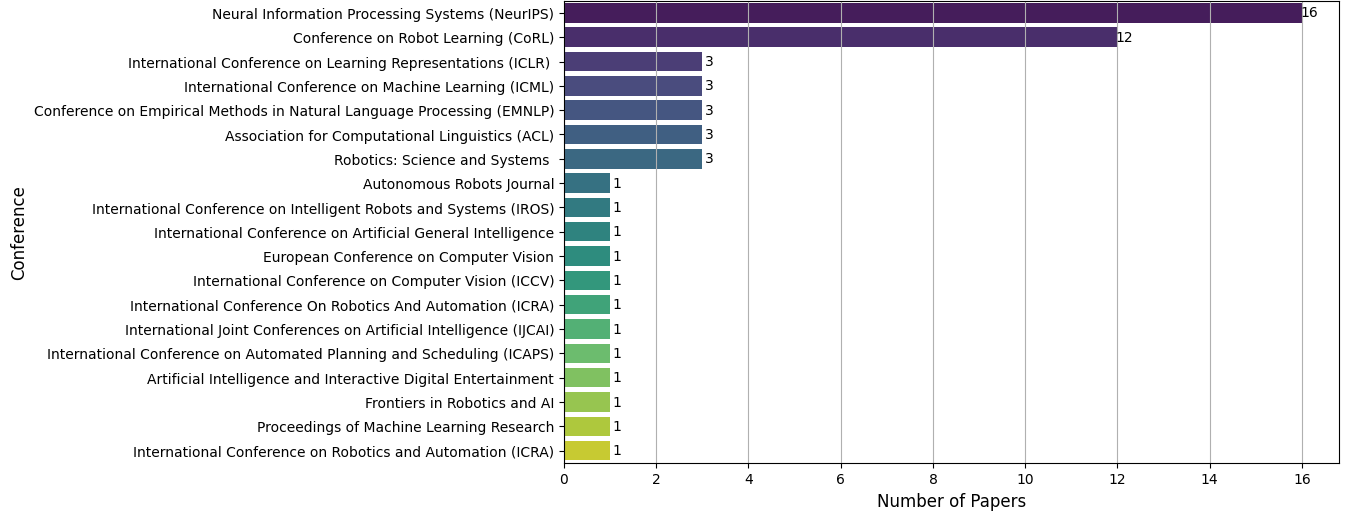
- Eight-category taxonomy established for LLMs in APS, with Plan Generation being the most explored (53 papers) and Brain-Inspired Planning least represented (5 papers).
- LLMs excel at Language Translation but face limits in plan optimality, completeness, and generalization in Plan Generation.
- Neuro-symbolic approaches are identified as a promising direction to combine LLMs’ language capabilities with the precision of symbolic planners.
- Interactive Planning and Tool Integration show strong potential for adaptability and cross-system coordination, despite challenges like tool over-reliance and grounding.
- Gaps include grounding, grounding-of-affordances, standardization of inter-agent communication, and the need for world models to improve low-level reasoning.
- The study argues for integrating LLMs with symbolic planners to achieve dynamic, context-aware, and scalable APS.
より良い研究を、今すぐ始めましょう
論文の読解から最終レビューまで、研究時間を劇的に削減しましょう。
クレジットカード登録不要
このレビューはAIが作成し、人間の編集者が確認しました。