
[論文レビュー] On the Radio Stripe Deployment for Indoor RF Wireless Power Transfer
本稿は、室内RF無線パワー伝送システムにおける無線ストライプネットワークの最適配置戦略を提案し、エネルギー効率を最大化するための最小受信電力を最大化することを目的としている。幾何学的プログラミングを用いて、直線型および多角形形状の無線ストライプを設計し、パスロスを低減し、特に長尺なストライプと低周波数で、近帯域ビームフォーキングを可能にすることで、集中型フルデジタルアレイを上回る性能を達成している。
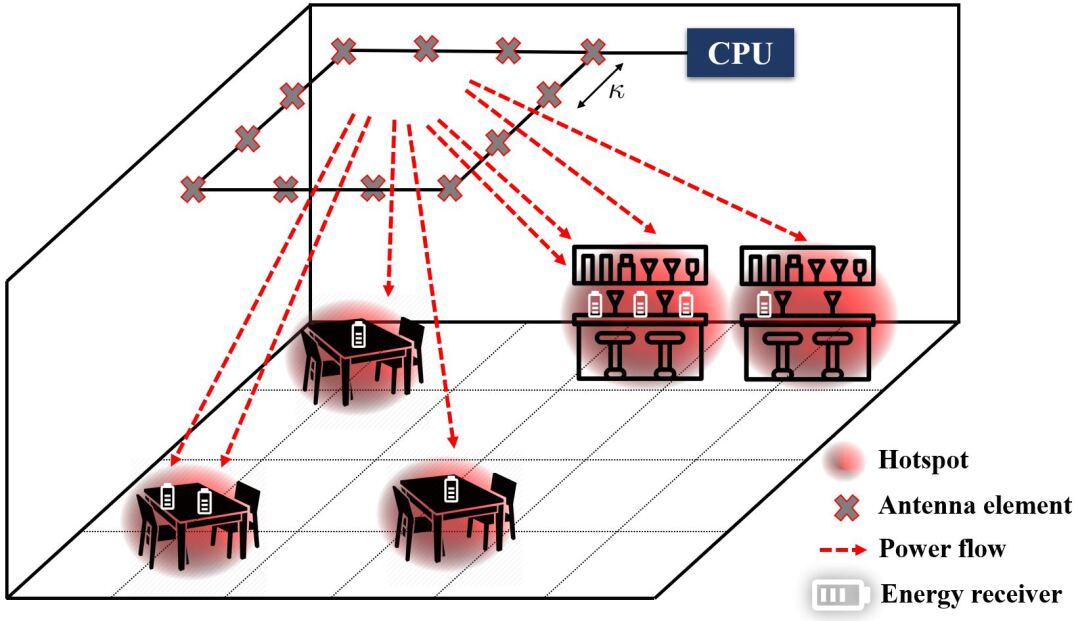
One of the primary goals of future wireless systems is to foster sustainability, for which, radio frequency (RF) wireless power transfer (WPT) is considered a key technology enabler. The key challenge of RF-WPT systems is the extremely low end-to-end efficiency, mainly due to the losses introduced by the wireless channel. Distributed antenna systems are undoubtedly appealing as they can significantly shorten the charging distances, thus, reducing channel losses. Interestingly, radio stripe systems provide a cost-efficient and scalable way to deploy a distributed multi-antenna system, and thus have received a lot of attention recently. Herein, we consider an RF-WPT system with a transmit radio stripe network to charge multiple indoor energy hotspots, i.e., spatial regions where the energy harvesting devices are expected to be located, including near-field locations. We formulate the optimal radio stripe deployment problem aimed to maximize the minimum power received by the users and explore two specific predefined shapes, namely the straight line and polygon-shaped configurations. Then, we provide efficient solutions relying on geometric programming to optimize the location of the radio stripe elements. The results demonstrate that the proposed radio stripe deployments outperform a central fully-digital square array with the same number of elements and utilizing larger radio stripe lengths can enhance the performance, while increasing the system frequency may degrade it.
研究の動機と目的
- 高いパスロスによる室内環境におけるRF無線パワー伝送(WPT)のエンドツーエンド効率の低さに対処すること。
- 充電距離の短縮とエネルギー配信の向上を目的として、集約型アレイとは異なりコスト効率の高い代替手段としての分散型アンテナ配置(無線ストライプ)を検討すること。
- 事前に定義された室内エネルギー・ホットスポットにおける最小受信電力を最大化する最適化問題を定式化し、解くこと。
- 同一のハードウェア制約下で、中央集中型フルデジタル正方形アレイのベンチマークと性能を比較すること。
- 無線ストライプの形状(直線対多角形)、長さ、動作周波数がシステム性能に与える影響を評価すること。
提案手法
- ユーザーの位置における最小受信電力を最大化する目的で、無線ストライプ配置問題を幾何学的プログラミング(GP)最適化として定式化する。
- 送信機をケーブルに沿って配置されたアンテナ素子の分散アレイとしてモデル化し、等間隔かつ位相制御を行う。
- 事前に定義された2種類の形状(直線型および多角形形状)を想定し、ビームフォーミングゲインを最適化するための素子位置を最適化する。
- 最大比伝送(MRT)および半正定値プログラミング(SDP)に基づくプレコーディングを用いてビームフォーミング重みを計算する。
- 球面波面を考慮する近帯域チャネルモデルを採用し、遠距離ビームフォーミングを超えた空間的電力集束を可能にする。
- 周波数、全出力電力、素子数、ホットスポット位置などのシステムパラメータを設定し、さまざまな構成での性能を評価する。
実験結果
リサーチクエスチョン
- RQ1室内RF-WPTにおいて、無線ストライプ配置の性能は、中央集中型フルデジタルアレイと比較して最小受信電力の面でどのように異なるか?
- RQ2室内ホットスポットにおける最小エネルギー収率を最大化するための無線ストライプ素子の最適配置(直線型対多角形形状)は何か?
- RQ3無線ストライプ長の増加がシステム性能に与える影響は何か?また、エネルギー配信の向上が一貫して見られるか?
- RQ4高周波数では、単位長あたりのアンテナ素子数が増加するが、パスロスが増加するため、システム効率に与える影響は何か?
- RQ5異なる形状(直線型対多角形)がビームフォーミングの指向性および近帯域集束能力に与える影響は何か?
主な発見
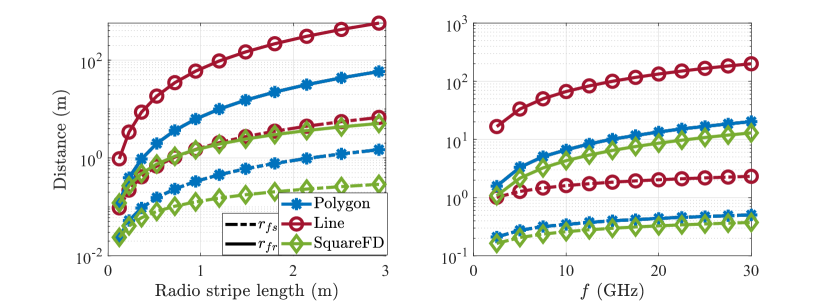
- 提案された無線ストライプ配置は、特に近帯域条件下で、中央集中型フルデジタル正方形アレイを上回る最小受信電力を達成している。
- 無線ストライプ長の増加により、より大きな領域に多数の素子を分散配置でき、ビームフォーミングの自由度が向上し、ユーザーまでの平均距離が短くなるため、性能が向上する。
- 高周波数では、単位長あたりのアンテナ素子数が増加するが、パスロスの増加によりシステム性能が劣化する。
- 多角形形状の無線ストライプは、MRTベースのプレコーディングにおいて、ホットスポットへの均一な近接性のおかげで、直線型構成よりも優れた性能を示す。
- 大規模な領域では、中央集中型アレイがアンテナ素子が集約しているためパスロスが高くなるため、無線ストライプと中央アレイとの性能差が拡大する。
- SDPベースのプレコーディングでは、多角形形状の配置が最も優れた性能を示すが、直線型配置では著しく性能が低下し、中央-FDベンチマークに近づく。
より良い研究を、今すぐ始めましょう
論文の読解から最終レビューまで、研究時間を劇的に削減しましょう。
クレジットカード登録不要
このレビューはAIが作成し、人間の編集者が確認しました。