
[論文レビュー] On the Secrecy Design of STAR-RIS assisted Uplink NOMA Networks
本稿では、完全および統計的盗聴者CSIの下で物理層セキュリティを強化するため、STAR-RIS支援上行NOMAネットワーク向けの機密ビームフォーミング設計を提案する。交替的ハイブリッドビームフォーミング(AHB)アルゴリズムを導入し、受信ビームフォーミング、送信電力、および反射/透過係数を共同最適化することで、より高い機密容量と低い機密アウトージョ確率を達成する。
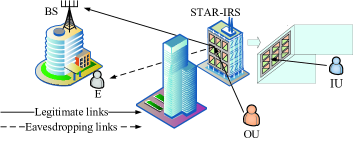
This paper investigates the secure transmission in a simultaneously transmitting and reflecting reconfigurable intelligent surface (STAR-RIS) assisted uplink non-orthogonal multiple access system, where the legitimate users send confidential signals to the base station by exploiting STAR-RIS to reconfigure the electromagnetic propagation environment proactively. Depending on the availability of the eavesdropping channel state information (CSI), both the full CSI and statistical CSI of the eavesdropper are considered. For the full eavesdropping CSI scenario, we adopt the adaptive-rate wiretap code scheme with the aim of maximizing minimum secrecy capacity subject to the successive interference cancellation decoding order constraints. To proceed, we propose an alternating hybrid beamforming (AHB) algorithm to jointly optimize the receive beamforming, transmit power, and reflection/transmission coefficients. While for the statistical eavesdropping CSI scenario, the constant-rate wiretap code scheme is employed to minimize the maximum secrecy outage probability (SOP) subject to the quality-of-service requirements of legitimate users. Then, we derive the exact SOP expression under the constant-rate coding strategy and develop an extended AHB algorithm for the joint secrecy beamforming design. Simulation results demonstrate the effectiveness of the proposed scheme. Moreover, some useful guidance about the quantification of phase shift/amplitude and the deployment of STAR-RIS is provided.
研究の動機と目的
- 無線ブロードキャスト特性に起因して盗聴の脅威にさらされるSTAR-RIS支援NOMAネットワークにおける物理層セキュリティメカニズムの欠如に取り組む。
- SIC復調順序制約を満たす条件下で、完全な盗聴者CSIのもとで機密容量を最大化する機密ビームフォーミング設計。
- 正当なユーザーのQoS要件を満たしつつ、盗聴者の統計的CSIしか入手できない状況で機密アウトージョ確率を最小化する。
- 安全なNOMAシステムにおけるSTAR-RISの実用的導入および位相シフト/アモニチュード量子化ガイドラインの提供。
提案手法
- 完全な盗聴者CSIの下で、最小機密容量を最大化するための適応レートワイヤータップ符号化を採用する。
- 受信ビームフォーミング、送信電力、および反射/透過係数を共同最適化する交替的ハイブリッドビームフォーミング(AHB)アルゴリズムを開発する。
- ラグランジュ双対性とKKT条件を用いて、最適なランク1の受信ビームフォーミング行列を導出する。
- 統計的CSIの下で、最大機密アウトージョ確率(SOP)を最小化するための定常レートワイヤータップ符号化を適用する。
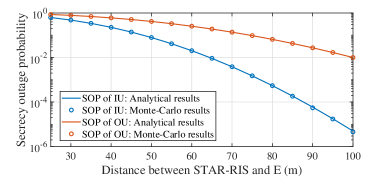
- 定常レート符号化下でのSOPの正確な解析的表現を導出し、機密アウトージョ性能の最適化を可能にする。
- AHBアルゴリズムを統計的CSI下での機密ビームフォーミングの共同最適化に拡張し、収束性とサブ最適性能を保証する。
実験結果
リサーチクエスチョン
- RQ1完全な盗聴者CSIのもとで、STAR-RIS支援上行NOMAにおける機密容量をどのように最大化できるか?
- RQ2送信電力、受信ビームフォーミング、および反射/透過係数をどのように共同最適化することで、機密レートを最大化できるか?
- RQ3盗聴者の統計的CSIしか入手できない状況で、どのようにして機密アウトージョ確率を最小化できるか?
- RQ4異なるCSI仮定下での機密性能の限界とトレードオフは何か?
- RQ5安全なNOMAシステムにおけるSTAR-RISの実用的導入および位相シフト量子化戦略として最適なものは何か?
主な発見
- 提案されたAHBアルゴリズムはサブ最適解に収束し、実行可能集合の連続性とコンパクト性により収束が保証されている。
- 最適な受信ビームフォーミング行列はランク1であり、KKT条件とラグランジュ双対性を用いて導出された。
- 定常レート符号化下でのSOPの正確な表現が導出され、機密アウトージョ性能の精密最適化が可能になった。
- シミュレーション結果は、提案手法が機密容量の向上とSOPの低減に有効であることを確認している。
- 本研究は、位相シフト/アモニチュード量子化および安全なNOMA伝送のための最適STAR-RIS配置に関する実用的ガイドラインを提供している。
より良い研究を、今すぐ始めましょう
論文の読解から最終レビューまで、研究時間を劇的に削減しましょう。
クレジットカード登録不要
このレビューはAIが作成し、人間の編集者が確認しました。