
[論文レビュー] Optimal ANN-SNN Conversion for High-accuracy and Ultra-low-latency Spiking Neural Networks
この論文は、量子化クリップ-フロア-シフト活性化を導入し、ANNを訓練してANN-SNN変換が超低待機時間(最短で4タイムステップ)で推定変換誤差をゼロにし、CIFAR-10/100とImageNetで最先端の精度を達成する。
Spiking Neural Networks (SNNs) have gained great attraction due to their distinctive properties of low power consumption and fast inference on neuromorphic hardware. As the most effective method to get deep SNNs, ANN-SNN conversion has achieved comparable performance as ANNs on large-scale datasets. Despite this, it requires long time-steps to match the firing rates of SNNs to the activation of ANNs. As a result, the converted SNN suffers severe performance degradation problems with short time-steps, which hamper the practical application of SNNs. In this paper, we theoretically analyze ANN-SNN conversion error and derive the estimated activation function of SNNs. Then we propose the quantization clip-floor-shift activation function to replace the ReLU activation function in source ANNs, which can better approximate the activation function of SNNs. We prove that the expected conversion error between SNNs and ANNs is zero, enabling us to achieve high-accuracy and ultra-low-latency SNNs. We evaluate our method on CIFAR-10/100 and ImageNet datasets, and show that it outperforms the state-of-the-art ANN-SNN and directly trained SNNs in both accuracy and time-steps. To the best of our knowledge, this is the first time to explore high-performance ANN-SNN conversion with ultra-low latency (4 time-steps). Code is available at https://github.com/putshua/SNN\_conversion\_QCFS
研究の動機と目的
- ANN-SNN変換誤差の3つの主な源(クリッピング、量子化、不均一性)を理解・モデル化する。
- ANNの活性化をSNNの発火挙動に合わせるための活性化関数置換(quantization clip-floor)を提案する。
- 超低遅延の下で期待変換誤差がゼロになり得ることを証明し、標準ベンチマークで最先端の結果を示す。
- 超低遅延とピーク精度のバランスを取るための量子化ステップLの選択指針を提供する。
提案手法
- Integrate-and-Fire (IF) SNNsとReLUベースのANNsからANN-SNN変換フレームワークを導出する。
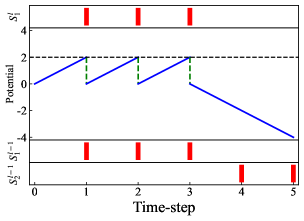
- 変換誤差をクリッピング誤差、量子化誤差、不均一性誤差に分解する。
- 訓練時にはquantization clip-floor活性化(およびシフト変種)を導入して、変換済みSNNが時刻Tでの活性化と一致するようにする;特定条件下でゼロの期待誤差を証明する。
- 定理1: T = L および θ = λ のとき、quantization clip-floor活性化を使用すると推定変換誤差がゼロ。
- 定理2: shift φ = 1/2 を用いると、任意の T と L に対してゼロ期待変換誤差。
- proposed activationを実現するためにfloor演算子に対するstraight-through estimatorを用いてANNを訓練する。
実験結果
リサーチクエスチョン
- RQ1超低タイムステップでANN-SNN変換はゼロの変換誤差を達成できるか?
- RQ2低遅延でSNNの発火レートをより良く近似するには、ANNの活性化をどのように修正すべきか?
- RQ3量子化ステップLとシフトφがデータセット・アーキテクチャ全体で変換精度に与える影響は?
主な発見
| Architecture | Method | ANN | T=2 | T=4 | T=8 | T=16 | T=32 | T=64 | T>=512 |
|---|---|---|---|---|---|---|---|---|---|
| VGG-16 | RMP | 93.63% | - | - | - | - | 60.30% | 90.35% | 93.63% |
| VGG-16 | TSC | 93.63% | - | - | - | - | 92.79% | 93.63% | 93.63% |
| VGG-16 | RTS | 95.72% | - | - | - | - | 76.24% | 90.64% | 95.73% |
| VGG-16 | RNL | 92.82% | - | - | - | 57.90% | 85.40% | 91.15% | 92.95% |
| VGG-16 | SNNC-AP | 95.72% | - | - | - | 93.71% | 95.14% | 95.79% | 95.59% |
| VGG-16 | Ours | 95.52% | 91.18% | 93.96% | 94.95% | 95.40% | 95.54% | 95.55% | 95.59% |
| ResNet-20 | RMP | 91.47% | - | - | - | - | - | - | 91.36% |
| ResNet-20 | TSC | 91.47% | - | - | - | - | - | 69.38% | 91.42% |
| ResNet-20 | Ours | 91.77% | 73.20% | 83.75% | 89.55% | 91.62% | 92.24% | 92.35% | 92.41% |
| ResNet-18 | RTS 1 | 95.46% | - | - | - | - | 84.06% | 92.48% | 94.42% |
| ResNet-18 | SNNC-AP 1 | 95.46% | - | - | - | - | 94.78% | 95.30% | 95.45% |
| ResNet-18 | Ours | 96.04% | 75.44% | 90.43% | 94.82% | 95.92% | 96.08% | 96.06% | 96.06% |
| ResNet-34 | RMP | 70.64% | - | - | - | - | - | 65.47% | - |
| ResNet-34 | TSC | 70.64% | - | - | - | - | 61.48% | 65.10% | - |
| ResNet-34 | Ours | 74.32% | 59.35% | 69.37% | 72.35% | 73.15% | 73.37% | 73.39% | - |
| VGG-16 | RMP (ImageNet) | 73.49% | - | - | - | - | 48.32% | 73.09% | - |
| VGG-16 | TSC (ImageNet) | 73.49% | - | - | - | - | 69.71% | 73.46% | - |
| VGG-16 | Ours (ImageNet) | 74.29% | 50.97% | 68.47% | 72.85% | 73.97% | 74.22% | 74.32% | - |
| ResNet-18 | RMP (ImageNet) | - | - | - | - | - | - | - | - |
| ResNet-18 | TSC (ImageNet) | - | - | - | - | - | - | - | - |
| ResNet-18 | Ours (ImageNet) | - | 59.35% | 69.37% | 72.35% | 73.15% | 73.37% | 73.39% | - |
- 超低遅延でCIFAR-10/100およびImageNetの複数アーキテクチャで最先端の精度を達成。
- T = L および φ = 0 のとき、層ごとに推定変換誤差がゼロ。実用的な結果として低タイムステップでほぼゼロまたはゼロのギャップを示す。
- quantization clip-floor-shift活性化を用いて訓練したANNは、L ≥ 4 の場合ReLUベースのANNに近い性能を維持。
- CIFAR-10では、4タイムステップの結果が従来のいくつかのANN-SNN手法を上回る。
- ImageNetでは、タイムステップを減らすことで最先端の結果を示し、T = 16–32で顕著な改善。
- 量子化ステップL=4または8は超低遅延とピーク精度のバランスを効果的にとる。
より良い研究を、今すぐ始めましょう
論文設計から論文執筆まで、研究時間を劇的に削減しましょう。
クレジットカード登録不要
このレビューはAIが作成し、人間の編集者が確認しました。