
[論文レビュー] Optimal Resource Allocation Design for Large IRS-Assisted SWIPT Systems: A Scalable Optimization Framework
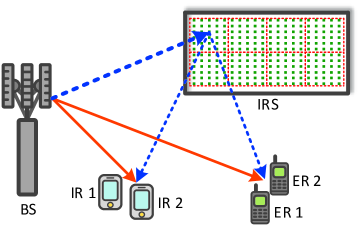
本稿は、非線形エネルギー効率モデルを用いた大規模な知能反射表面(IRS)支援同時無線情報・電力伝送(SWIPT)システムにおけるスケーラブルな最適化フレームワークを提案する。IRSをタイルに分割し、事前に最適な位相シフト設定(送信モード)をオフラインで事前計算することで、分枝限定法とペナルティに基づく逐次凸近似を用いたビームフォーミングとモード選択の共同最適化により、大規模なIRSにおいても高いエネルギー効率を実現するとともに、オンライン運用を効率的に行える。
In this paper, we study the optimal resource allocation algorithm design for large intelligent reflecting surface (IRS)-assisted simultaneous wireless information and power transfer (SWIPT) systems. To facilitate efficient system design for large IRSs, instead of jointly optimizing all the IRS elements, we partition the IRS into several tiles and employ a scalable optimization framework comprising an offline design stage and an online optimization stage. In the offline stage, the IRS elements of each tile are jointly designed to support a set of different phase shift configurations, referred to as transmission modes, while the best transmission mode is selected from the set for each tile in the online stage. Given a transmission mode set, we aim to minimize the total base station (BS) transmit power by jointly optimizing the beamforming and the transmission mode selection policy taking into account the quality-of-service requirements of information decoding and non-linear energy harvesting receivers, respectively. Although the resource allocation algorithm design is formulated as a non-convex combinatorial optimization problem, we solve it optimally by applying the branch-and-bound (BnB) approach which entails a high computational complexity. To strike a balance between optimality and computational complexity, we also develop an efficient suboptimal algorithm capitalizing on the penalty method and successive convex approximation. Our simulation results show that the proposed designs enable considerable power savings compared to several baseline schemes. Moreover, our results reveal that by properly adjusting the numbers of tiles and transmission modes, the proposed scalable optimization framework indeed facilitates online design for large IRSs.
研究の動機と目的
- 非線形エネルギー効率(EH)モデルを有するSWIPTシステムにおける大規模IRSの最適化に伴う高い計算複雑性に対処すること。
- IRSサイズに伴いスケーリングが著しく悪化する要素単位のIRS最適化の限界を克服すること。
- オフライン設計とオンライン選択を分離することで、大規模IRSにおける効率的なオンラインリソース割り当てを可能にすること。
- 情報受信機および非線形エネルギー効率受信機のQoS要件を満たしつつ、基地局の送信電力を最小化すること。
- タイル数およびモード数を調整可能なパラメータとして用いることで、性能と複雑性の間の柔軟なトレードオフを提供すること。
提案手法
- 最適化の複雑性を低減するため、大規模なIRSを複数のタイルに分割すること。
- 各タイルの最適な位相シフト設定(送信モード)を事前に計算するためのオフライン段階を導入すること。
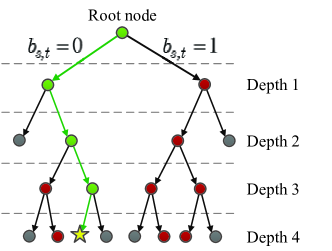
- 非凸な組み合わせ最適化問題を正確に解くために分枝限定法(BnB)を用いること。
- 計算複雑性を低減するため、ペナルティ法と逐次凸近似を用いた近似最適化アルゴリズムを開発すること。
- 線形近似よりも精度の高い物理ベースの非線形エネルギー効率モデルを用いて、非線形エネルギー効率をモデル化すること。
- 情報受信機およびエネルギー受信機のQoS制約下で、ビームフォーミングベクトルと送信モード選択を共同最適化すること。
実験結果
リサーチクエスチョン
- RQ1大規模なIRS支援SWIPTシステムにおけるリソース割り当てを、最適性を損なわずにスケーラブルに実現する方法は何か?
- RQ2非線形エネルギー効率モデルを用いることと線形モデルを用いることの、システム性能および電力効率に与える影響は何か?
- RQ3提案されたタイルベースの分割と送信モード選択フレームワークは、オンライン最適化の複雑性と性能にどのように影響を与えるか?
- RQ4大規模なIRS展開において、タイル数、送信モード数、およびシステム性能の間にはどのようなトレードオフが存在するか?
- RQ5提案されたフレームワークは、ベースライン手法と比較して顕著な電力削減を達成できるか、かつ大規模IRSにおいて計算的に実行可能か?
主な発見
- 提案されたスケーラブルな最適化フレームワークは、特に非線形エネルギー効率モデルを用いる場合、ベースライン手法と比較して顕著な電力削減を実現できる。
- ペナルティ法と逐次凸近似に基づく近似最適化アルゴリズムは、著しく低い計算複雑性でほぼ最適な性能を達成できる。
- タイル数および送信モード数を適切に調整することで、大規模IRSシステムにおける性能と複雑性の間の柔軟なトレードオフを実現できる。
- 物理ベースの非線形EHモデルは、特に fading 条件下で線形モデルよりもより正確で実用的なシステム設計を可能にする。
- 最適なビームフォーミング行列がランク1であることが示され、これにより効率的な実装が可能になり、信号処理が簡素化される。
より良い研究を、今すぐ始めましょう
論文の読解から最終レビューまで、研究時間を劇的に削減しましょう。
クレジットカード登録不要
このレビューはAIが作成し、人間の編集者が確認しました。