
[論文レビュー] Optimization of the geometrical stability in square ring laser gyroscopes
本論文は、正方形リングレーザー干渉計の幾何的安定性を向上させるための制御戦略を提案する。両対角線および周囲長を絶対長に測定・ロックすることで、一般相対性理論の検証に必要な地球の自転の高精度検出を可能にする。この手法によりスケール因子の変動が2次的に抑制され、非モノリシック(異種材料)のキャビティ構造が、GINGERプロジェクトが求める $10^{-14}$ rad/s の感度を満たすことが可能となる。
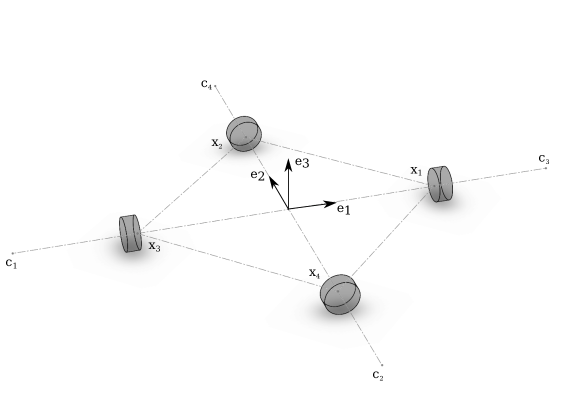
Ultra sensitive ring laser gyroscopes are regarded as potential detectors of the general relativistic frame-dragging effect due to the rotation of the Earth: the project name is GINGER (Gyroscopes IN GEneral Relativity), a ground-based triaxial array of ring lasers aiming at measuring the Earth rotation rate with an accuracy of 10^-14 rad/s. Such ambitious goal is now within reach as large area ring lasers are very close to the necessary sensitivity and stability. However, demanding constraints on the geometrical stability of the laser optical path inside the ring cavity are required. Thus we have started a detailed study of the geometry of an optical cavity, in order to find a control strategy for its geometry which could meet the specifications of the GINGER project. As the cavity perimeter has a stationary point for the square configuration, we identify a set of transformations on the mirror positions which allows us to adjust the laser beam steering to the shape of a square. We show that the geometrical stability of a square cavity strongly increases by implementing a suitable system to measure the mirror distances, and that the geometry stabilization can be achieved by measuring the absolute lengths of the two diagonals and the perimeter of the ring.
研究の動機と目的
- 大面積リングレーザー干渉計において、Lense-Thirring効果を検出するための極めて高い幾何的安定性を維持する課題に対処すること。
- 標準材料を用いた異種材料(非モノリシック)キャビティ構造の利用を可能とするために、アクティブなミラー位置制御を開発すること。
- キャビティの変形に起因するスケール因子 $\mathbf{k}_S$ の変動を最小限に抑える制御戦略を同定すること。
- 正方形キャビティ幾何構造が、周囲長およびスケール因子の静的点を提供し、変形下でも安定動作を可能にすることを示すこと。
- 光路長およびスケール因子への影響を分類するための、フェルマーの原理に基づく形式的記述を提供すること。
提案手法
- ミラーの曲率中心位置によって決定されるビーム経路を用いて、フェルマーの原理に基づき光学キャビティの幾何構造をモデル化する。
- 剛体運動およびキャビティの残存歪みを分類するための変形パラメータ $\tau_\alpha$ を定義する。
- 正規化された周囲長 $\widehat{p}^*$ およびスケール因子 $\widehat{k}^*$ を、正規化された変形パラメータ $\widetilde{\tau}_\alpha = \tau_\alpha / d_0$ の二次形式として導出する。ここで $d_0$ は名目上の対角線長である。
- 制約条件を課す:対角線長が等しいこと($||\mathbf{c}_3 - \mathbf{c}_1|| = ||\mathbf{c}_4 - \mathbf{c}_2|| = d_0$)により、正方形幾何構造の周りでの対称性を保ち、システムを安定化させる。
- 対角線ロックがなされた状態では、$\mathbf{k}_S$ および周囲長の変動が $\widetilde{\tau}_\alpha$ の2次項にのみ依存することを示し、高精度な制御が可能になる。
- 大きなミラーの曲率半径($h = L/r \approx 1/\sqrt{2}$ を避ける)が、変形に対する感度を最小限に抑えつつキャビティの安定性を維持する最適設計であることを同定する。
実験結果
リサーチクエスチョン
- RQ1正方形リングレーザーキャビティにおける幾何的歪みは、どのようにモデル化・分類され、スケール因子 $\mathbf{k}_S$ に及ぼす影響を評価できるか?
- RQ2一般相対性理論の検証に向けた $10^{-14}$ rad/s の感度を達成するためのキャビティ幾何構造を安定化する制御戦略は何か?
- RQ3なぜ正方形キャビティ幾何構造が、変形下でもスケール因子の変動を最小限に抑えるのに特に適しているのか?
- RQ4対角線長の測定と周囲長制御は、キャビティ周囲長およびスケール因子の静的点を達成するためにどのように寄与するか?
- RQ5ミラーの曲率半径は、残存歪みに対する感度を最小限に抑えるために果たす役割は何か?
主な発見
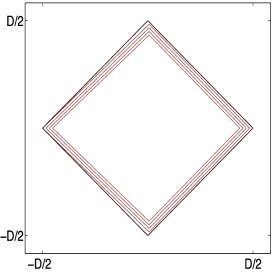
- 両対角線を同じ絶対長 $d_0$ にロックすることで、キャビティ周囲長に静的点が形成され、これは正方形幾何構造に対応する。
- 対角線ロックがなされた状態では、スケール因子 $\mathbf{k}_S$ および周囲長の変動が、変形パラメータ $\widetilde{\tau}_\alpha$ の2次項にのみ依存するため、高安定性が達成できる。
- $\widetilde{\tau}_5^2$ の係数が周囲長およびスケール因子の両式で同一であるため、対角線長の揺らぎが両者に直接影響することを示している。
- 最適設計では、$h = L/r \approx 1/\sqrt{2}$ を避けるべきであり、この点では、縦断面での共焦点的挙動によりキャビティが不安定化する。
- 数マイクロメートルの範囲内でミラー位置を制御することで、$\mathbf{k}_S$ における幾何的安定性を $10^{10}$ 分の1の精度で達成でき、GINGERプロジェクトの要件を満たす。
- この形式的記述は、超高安定な光学周波数基準を用いた異種材料キャビティのアクティブ制御を支援し、基礎物理学向けの大規模リングレーザー配列の実現を可能にする。
より良い研究を、今すぐ始めましょう
論文設計から論文執筆まで、研究時間を劇的に削減しましょう。
クレジットカード登録不要
このレビューはAIが作成し、人間の編集者が確認しました。