
[論文レビュー] Optimizing quantum gates towards the scale of logical qubits
本論文では、68個の超伝導キュービットを対象として周波数トレースを調整するためのスネーク最適化手法を用いたスケーラブルな制御最適化戦略を提示している。未最適化ゲートと比較して物理的誤り率を約3.7倍低減し、距離23のサーフェスコード論理キュービットで耐障害性を達成した。これは大規模量子誤り訂正の実現可能性を示している。
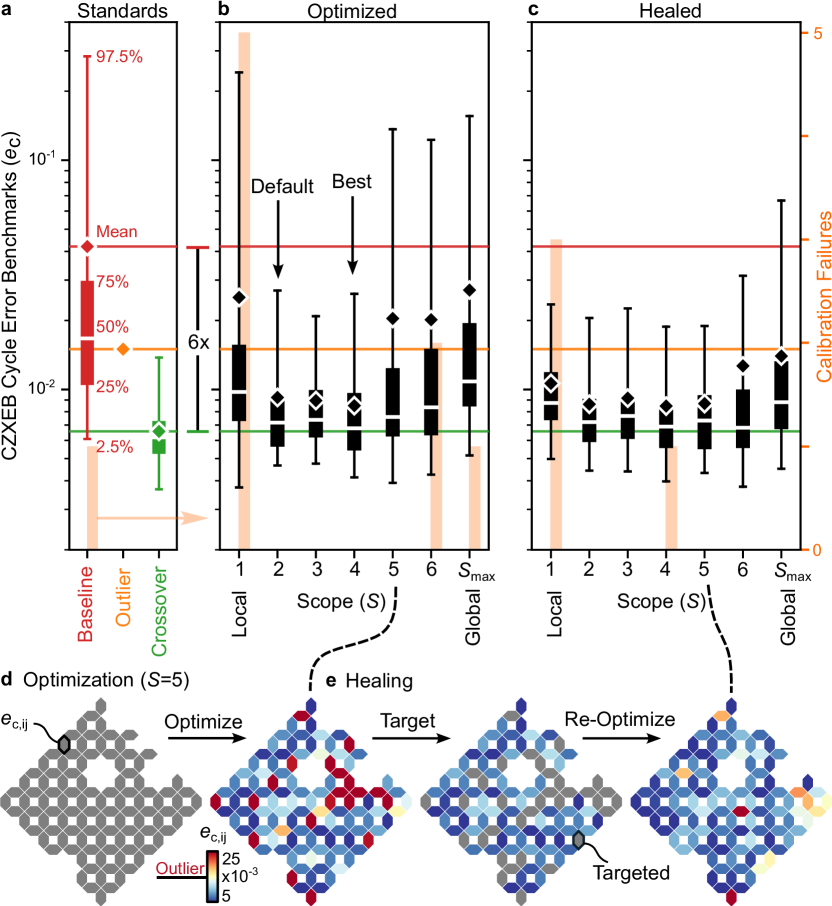
A foundational assumption of quantum error correction theory is that quantum gates can be scaled to large processors without exceeding the error-threshold for fault tolerance. Two major challenges that could become fundamental roadblocks are manufacturing high performance quantum hardware and engineering a control system that can reach its performance limits. The control challenge of scaling quantum gates from small to large processors without degrading performance often maps to non-convex, high-constraint, and time-dependent control optimization over an exponentially expanding configuration space. Here we report on a control optimization strategy that can scalably overcome the complexity of such problems. We demonstrate it by choreographing the frequency trajectories of 68 frequency-tunable superconducting qubits to execute single- and two-qubit gates while mitigating computational errors. When combined with a comprehensive model of physical errors across our processor, the strategy suppresses physical error rates by $\sim3.7 imes$ compared with the case of no optimization. Furthermore, it is projected to achieve a similar performance advantage on a distance-23 surface code logical qubit with 1057 physical qubits. Our control optimization strategy solves a generic scaling challenge in a way that can be adapted to a variety of quantum operations, algorithms, and computing architectures.
研究の動機と目的
- 大規模な超伝導プロセッサにおいて、高い性能と短い実行時間で量子ゲート制御最適化のスケーラビリティを実現すること。
- 量子ハードウェアにおける周波数依存の物理的誤りに起因する非凸的で高制約的かつ時間的に変化する最適化問題を克服すること。
- さまざまなアルゴリズムやアーキテクチャに適応可能な汎用的で柔軟な最適化フレームワークを構築すること。
- 表面コードの閾値内に物理的誤り率を低減することで、耐障害性量子計算を実現すること。
- 大規模プロセッサ上で性能を維持しつつ、実行時間の非線形的低減を実現するストーチング技術によるスケーラビリティの妥当性を検証すること。
提案手法
- 非凸的で高次元の制御問題を時間的に変化する周波数トレース上で解くために、高設定可変性・次元に依存しない最適化エンジン「スネーク最適化手法」を採用する。
- 物理的誤り(例:緩和、位相崩壊、パルス歪み、不要結合)を周波数依存メカニズムとしてモデル化し、アルゴリズム誤りを推定し最適化をガイドする。
- 生成モデルを用いてプロセッサ規模の誤りランドスケープをシミュレートし、さまざまな量子アルゴリズム向けに最適化フレームワークを訓練する。
- プロセッサをR個の非重複領域に分割し、並列で最適化を実行し、再結合することで実行時間のスケーリングを低減する「ストーチング」を実装する。
- 歴史的特性データを活用してハードウェアの不安定性を予測・緩和し、長時間にわたる安定した計算を可能にする。
- モデルベース最適化と将来のモデルフリー強化学習の統合により、性能推定器への依存度を低減する。

実験結果
リサーチクエスチョン
- RQ1低実行時間と高い性能を維持しつつ、スケーラブルな制御最適化戦略が大規模な超伝導プロセッサに効果的に適用可能か。
- RQ2周波数トレース最適化が、マルチキュービット量子ゲートにおける物理的誤り率をどの程度低減できるか。
- RQ3ストーチング技術が、領域境界で誤りの外れ値を増幅させることなく最適化品質を保持できるか。
- RQ41057個の物理キュービット(距離23のサーフェスコード)を用いた論理キュービットで、最適化フレームワークが耐障害性誤り率に到達できるか。
- RQ5スネーク最適化手法の設定可変性が、多様な量子操作とアーキテクチャへの適応をどのように可能にするか。
主な発見
- 68キュービットプロセッサ上での未最適化ゲートと比較して、最適化戦略により物理的誤り率が約3.7倍低減された。
- 1057個の物理キュービット(距離23のサーフェスコード)を用いた論理キュービットでも、同様の誤り低減性能が予測された。
- 68キュービットプロセッサではR=2、シミュレートされた1057キュービットプロセッサではR=4のストーチングを実施したが、接合部で誤りの外れ値が増幅されず、ストーチングなしの構成と同等の誤り率が得られた。
- ストーチング適用後の68キュービット構成の誤り率は $ e_c = 6.4^{+4.4}_{-1.8} imes 10^{-3} $、1057キュービット構成では $ e_c = 6.3^{+4.3}_{-2.9} imes 10^{-3} $ であり、安定性が裏付けられた。
- スコープ $ S=2 $ での全プロセッサ最適化に要する実行時間は約1.4時間であり、0.5時間の予算を上回っていたが、ストーチングにより非線形的スケーリングが実現され、$ N \rightarrow 10^4 $ 個のキュービットに対しても $ R=128 $ 時に実行可能となった。
- この戦略は、既に測定、SWAPゲート、最適化・計測・シミュレーション分野の量子アルゴリズムの最適化に応用されており、広範な適用可能性が示された。
より良い研究を、今すぐ始めましょう
論文の読解から最終レビューまで、研究時間を劇的に削減しましょう。
クレジットカード登録不要
このレビューはAIが作成し、人間の編集者が確認しました。