
[論文レビュー] OPUS: An Integrated Assessment Model for Satellites and Orbital Debris
OPUSは、人工衛星運用者の理論的経済モデルと遊星力学のシミュレーションを統合した評価モデルであり、軌道デブリ低減のための政策干渉を評価することを目的としている。軌道混雑状態と経済的インcentives(発射コストや廃棄規制など)への行動的反応を両方モデル化することで、軌道利用料といった政策手段が持続可能性と経済的福祉を向上させることを示しており、宇宙交通管理戦略の評価に有用なツールを提供する。
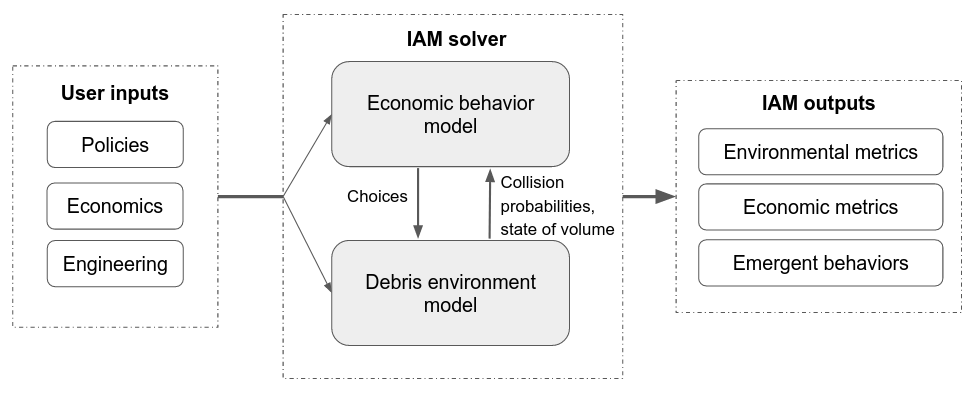
An increasingly salient public policy challenge is how to manage the growing number of satellites in orbit, including large constellations. Many policy initiatives have been proposed that attempt to address the problem from different angles, but there is a paucity of analytical tools to help policymakers evaluate the efficacy of these different proposals and any potential counterproductive outcomes. To help address this problem, this paper summarizes work done to develop an experimental integrated assessment model -- Orbital Debris Propagators Unified with Economic Systems (OPUS) -- that combines both astrodynamics of the orbital population and economic behavior of space actors. For a given set of parameters, the model first utilizes a given astrodynamic propagator to assess the state of objects in orbit. It then uses a set of user-defined economic and policy parameters -- e.g. launch prices, disposal regulations -- to model how actors will respond to the economic incentives created by a given scenario. For the purposes of testing, the MIT Orbital Capacity Tool (MOCAT) version 4S was used as the primary astrodynamics propagator to simulate the true expected target collision probability ($p_c$) for a given end-of-life (EOL) disposal plan. To demonstrate propagator-agnosticism, a Gaussian mixture probability hypothesis density (GMPHD) filter was also used to simulate $p_c$. We also explore economic policy instruments to improve both sustainability of and economic welfare from orbit use. In doing so, we demonstrate that this hybrid approach can serve as a useful tool for evaluating policy proposals for managing orbital congestion. We also discuss areas where this work can be made more robust and expanded to include additional policy considerations.
研究の動機と目的
- 空間政策評価において遊星力学と経済的行動を統合する分析ツールの不足に対処すること。
- 経済的インセンティブが衛星展開およびデブリ低減に与える影響をシミュレートできるハイブリッドモデルの開発。
- 軌道利用料、脱軌時間、デブリ回収補助金といった政策案の有効性を政策立案者が評価できるようにすること。
- 既存のデブリ分析ツールと互換性を持つ、プロパゲータに依存しないフレームワークの構築。
- 主な政策パラメータに対する感度分析を可能とし、宇宙持続可能性評価の妥当性を高めること。
提案手法
- OPUSは二段階モデルアーキテクチャを採用しており、軌道物体の状態と衝突確率をシミュレートする遊星力学プロパゲータ(例:MOCAT-4S または GMPHD フィルタ)を用いる。
- これに、ロケット市場における均衡条件に基づく理論的裏付けのある発射行動経済モデルを組み合わせる。
- 発射価格、廃棄規制、軌道利用料といった経済的パラメータに基づき、発射頻度を内生的に決定する。
- 物理エンジンと経済モデルを分離することで、複数のデブリ追跡ツールとの互換性を確保する、プロパゲータに依存しない設計を実現する。
- プロパゲーションは MATLAB で実施し、分析と可視化は R で行う。
- 政策シナリオは、税制、廃棄要件、市場構造といった経済的パラメータを変化させることでテストする。
実験結果
リサーチクエスチョン
- RQ1軌道利用料といった経済的インセンティブは、衛星コンステレーションの展開およびデブリ低減行動にどのように影響を与えるか?
- RQ2ミッション後処理のタイムラインを変化させると、長期的な軌道混雑状態と衝突確率にどのような影響が生じるか?
- RQ3空間持続可能性と経済的福祉の両面で、異なる経済政策手段はどのように比較されるか?
- RQ4物理学と経済学を統合したハイブリッドモデルは、宇宙交通管理政策の評価をどの程度改善できるか?
- RQ5大規模なコンステレーションや非商業的主体は、軌道混雑における政策干渉の有効性にどのように影響を与えるか?
主な発見
- OPUSは、軌道利用料がデブリ蓄積を効果的に低減させ、長期的な軌道持続可能性を向上させられることを示している。
- モデルは、25年以内のミッション後処理基準を厳しくすることで、衝突確率を顕著に低下させられることを示している。
- 脱軌性能ボンドや標的補助金といった経済的インセンティブは、衛星設計および終末運用行動を変化させ、長期的なデブリリスクを低減する効果がある。
- プロパゲータに依存しない設計により、異なる遊星力学ツール間で一貫した結果が得られ、モデルの強靭性と互換性が向上している。
- 感度分析から、発射コストの低下は、効果的な経済的・規制的対策が伴わない限り、混雑状態を悪化させる可能性があることが明らかになった。
- OPUSは、逆衛星兵器実験や商業需要の変化といった複雑な政策シナリオをシミュレートでき、予期しない結果の理解に貢献している。
より良い研究を、今すぐ始めましょう
論文の読解から最終レビューまで、研究時間を劇的に削減しましょう。
クレジットカード登録不要
このレビューはAIが作成し、人間の編集者が確認しました。