
[論文レビュー] Origins and lifetimes of secular and tidal bars in simulated disc galaxies
研究はTNG50のMW質量のディスク銀河307個を分析し、長期的(secular)と潮汐誘発(tidal)バーを同定、潮汐強度指標S_barを導入し、バー形成経路と中央の星形成質量比および寿命との関係を示す。
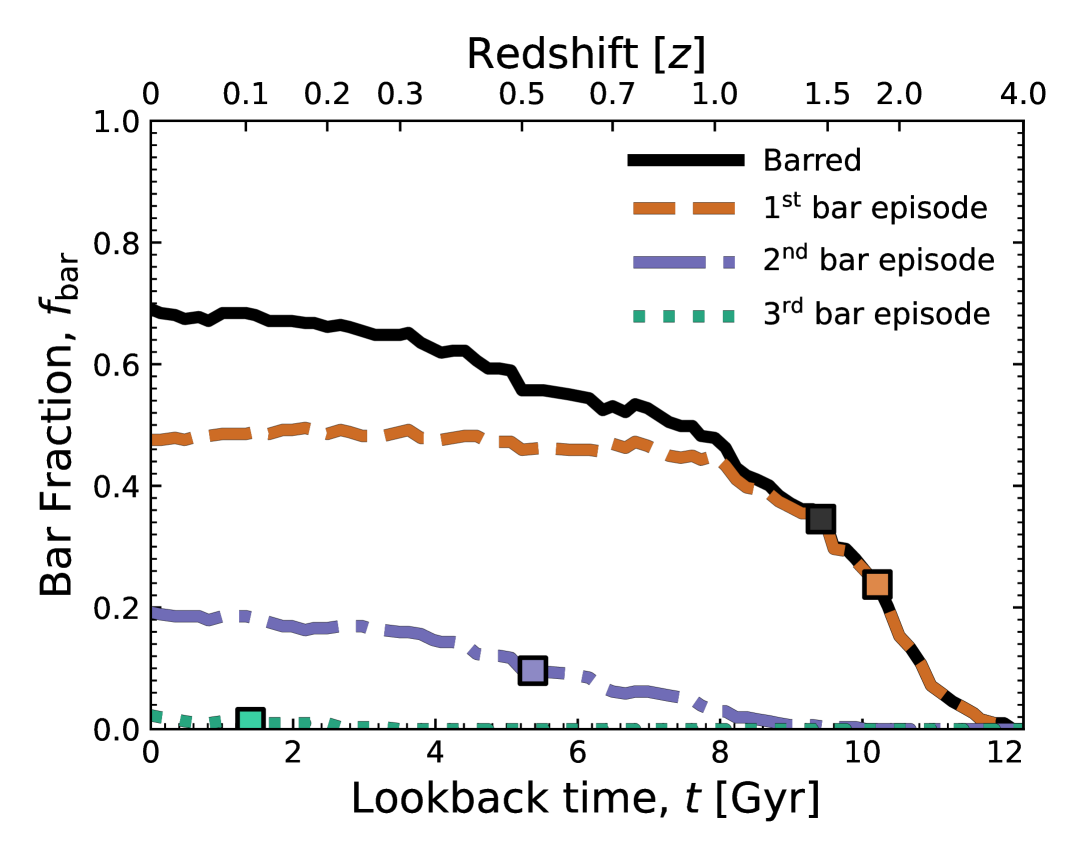
We investigate the formation of stellar bars in 307 Milky Way-mass disc galaxies in the TNG50 cosmological simulation. Most bars form rapidly in dynamically cold discs shortly after the central stellar mass exceeds that of dark matter. In these cases, bar formation is consistent with secular instabilities driven by the disc's self-gravity, which organises stellar orbits into a coherent bar structure. However, around 25 per cent of barred galaxies are dark matter dominated at the time of bar formation, $t_{bar}$, and remain so thereafter. We trace the origin of these bars to tidal perturbations induced by passing satellites or mergers using a new metric, $S_{bar}$, quantifying the tidal field acting on the galaxy. At the time of bar formation, we find a negative correlation between $S_{bar}$ and the central stellar-to-dark matter mass fraction, indicating that more dark matter-dominated discs require stronger tides to trigger bar formation. These tidally induced bars are more likely to be transient than those that form secularly, although bar properties are otherwise similar. However, the host galaxies differ: secular bars arise in relatively compact discs, while tidal bars appear in extended discs whose properties resemble those of unbarred galaxies. Tidal perturbations can therefore induce bars in galaxies otherwise stable to secular formation, highlighting the dual role of the internal galactic structure and the external environment in bar formation.
研究の動機と目的
- TNG50を用いて宇宙論的文脈でMW質量ディスク銀河におけるバーの形成を調査する。
- ディスク自己重力と外部潮汐摂動がバー形成に果たす役割を明らかにする。
- バー形成時に銀河に作用する潮汐場を定量化する新しい指標を開発・適用する。
- サンプル全体でバー発生の寿命と再発を特徴付ける。
提案手法
- 顔方向の星表面密度のフーリエ分解を用いてバーを識別し、m=2モード(A2)とバー特性(A2_max, R_bar, phi_2, Omega_bar)に焦点を当てる。
- t_barをA2_max >= 0.2かつR_bar >= 1.4 * epsilon_cを満たす少なくとも三つのスナップショットでバー相の開始と定義する。
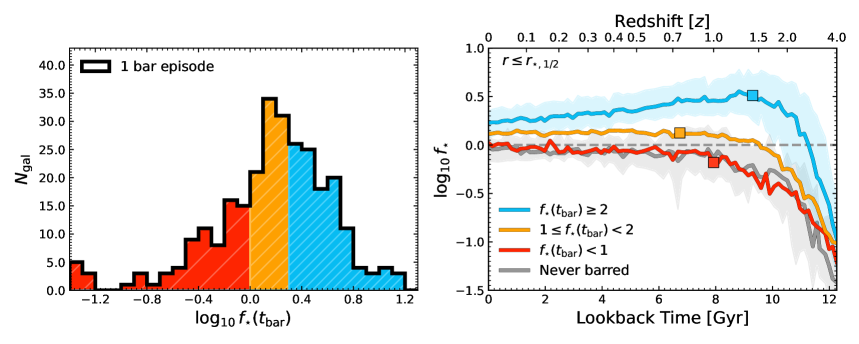
- 中心部の星-ダークマター質量比f_star(t_bar)をr_star,1/2内で計算し、バー形成時のディスクが星優勢かDM優勢かを分類する。
- 周囲の質量分布から潮汐テンソルTを定義し、Tの固有値のノルムとしてスカラーSを定義して潮汐強度を定量化する(S_bar = t_dynの1つ前の最大S)。
- f_star(t_bar)とS_barの相関を分析し、長期的バーと潮汐誘発バーの寿命と特性を比較する。
実験結果
リサーチクエスチョン
- RQ1MW質量ディスクのバーの形成は長期的か潮汐的か、どの程度の割合か?
- RQ2バー形成時の中央の星-DM質量比は長期的バー形成の可能性にどう影響するか?
- RQ3グローバルな潮汐場指標は長期的バーと潮汐誘発バーを識別できるか、また寿命とどう関係するか?
- RQ4潮汐誘発バーは観測可能な性質で長期的バーと異なるか、環境はその進化をどう形作るか?
主な発見
- バー銀河の約25%はバー形成時にDM支配であり、その後もDM支配のままであることから潮汐トリガーがこれらのバーを助長する可能性がある。
- S_barとf_star(t_bar)の間には負の相関があり、よりDM優勢のディスクほどバー形成を誘発するためにはより強い潮汐が必要である。
- 長期的バーは比較的コンパクトで星優勢のディスクで形成される傾向があり、長寿命である。一方、潮汐誘発バーは拡張ディスクで形成されやすく、短命である。
- バーは星系優勢・DM優勢の双方のディスクで形成可能だが、支配的な形成経路はディスク中心部の質量支配と潮汐環境に依存する。
- バーの寿命はディスクの性質と相関する。星優勢ディスクでは長寿命のバー(中央値 ≈ 9 Gyr)、DM優勢ディスクでは短寿命のバー(中央値 ≈ 2 Gyr)。
- 潮汐摂動は星的に安定で長期的形成が起きにくい銀河にもバーを誘発でき、内部構造と外部環境の二重の役割を強調する。
より良い研究を、今すぐ始めましょう
論文設計から論文執筆まで、研究時間を劇的に削減しましょう。
クレジットカード登録不要
このレビューはAIが作成し、人間の編集者が確認しました。