
[論文レビュー] Overview of the Instrumentation for the Dark Energy Spectroscopic Instrument
本論文は、宇宙の歴史を通じて2000万個の銀河およびクェーサーの赤方偏移を測定するためにマヤル・望遠鏡に設置されたマルチオブジェクトスペクトログラフ、ダークエネルギースペクトログラフ(DESI)の設計、統合、およびコンMISSIONINGを提示する。DESIは初年度に1500万個を超える赤方偏移を達成し、宇宙膨張の測定精度、ダークエネルギーの進化、ニュートリノ質量の測定において前例のない精度を実現した。
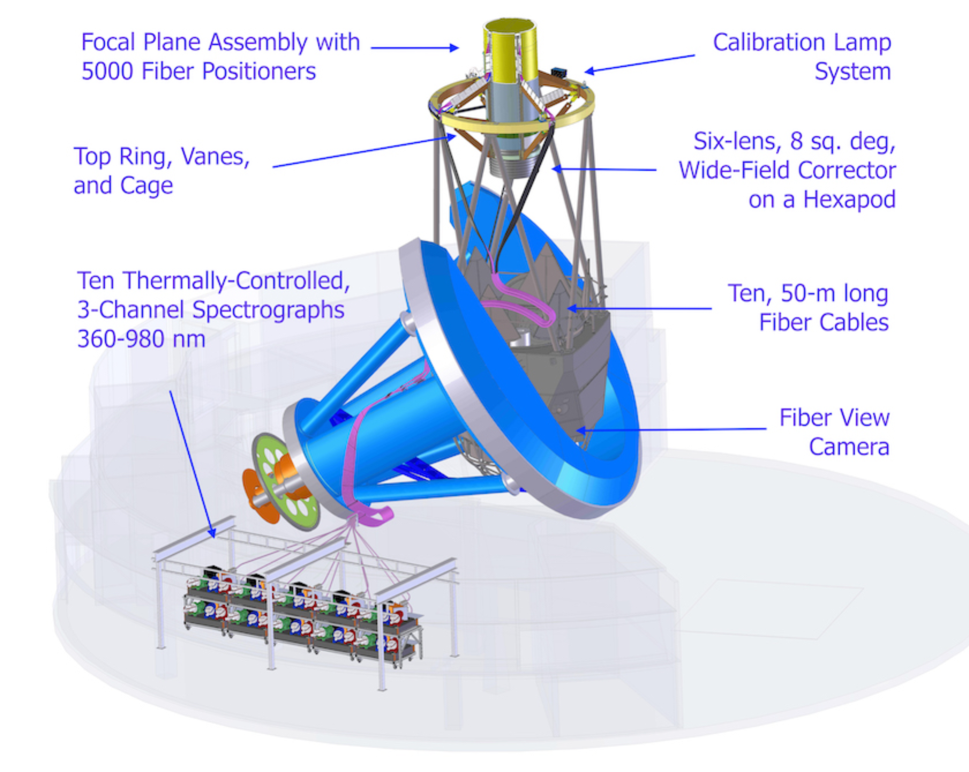
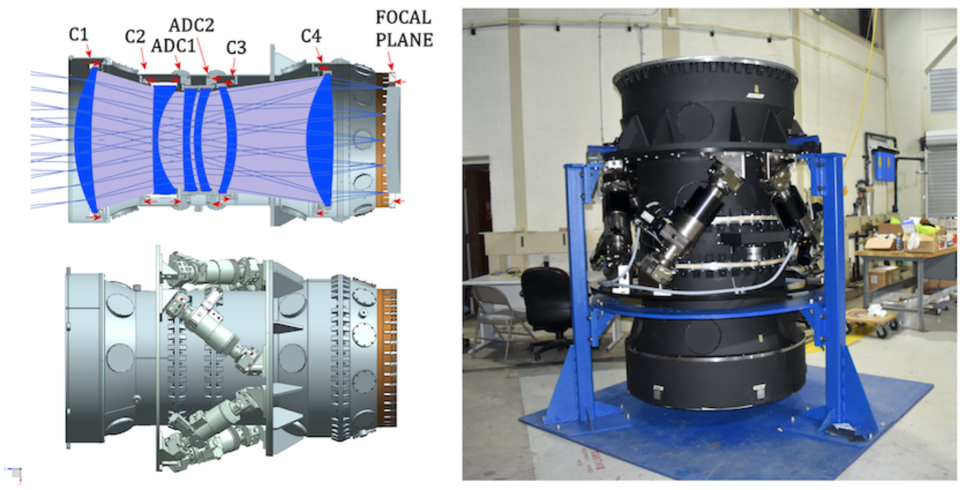
The Dark Energy Spectroscopic Instrument (DESI) has embarked on an ambitious five-year survey to explore the nature of dark energy with spectroscopy of 40 million galaxies and quasars. DESI will determine precise redshifts and employ the Baryon Acoustic Oscillation method to measure distances from the nearby universe to z > 3.5, as well as measure the growth of structure and probe potential modifications to general relativity. In this paper we describe the significant instrumentation we developed for the DESI survey. The new instrumentation includes a wide-field, 3.2-deg diameter prime-focus corrector that focuses the light onto 5020 robotic fiber positioners on the 0.812 m diameter, aspheric focal surface. The positioners and their fibers are divided among ten wedge-shaped petals. Each petal is connected to one of ten spectrographs via a contiguous, high-efficiency, nearly 50 m fiber cable bundle. The ten spectrographs each use a pair of dichroics to split the light into three channels that together record the light from 360 - 980 nm with a resolution of 2000 to 5000. We describe the science requirements, technical requirements on the instrumentation, and management of the project. DESI was installed at the 4-m Mayall telescope at Kitt Peak, and we also describe the facility upgrades to prepare for DESI and the installation and functional verification process. DESI has achieved all of its performance goals, and the DESI survey began in May 2021. Some performance highlights include RMS positioner accuracy better than 0.1", SNR per \sqrtÅ > 0.5 for a z > 2 quasar with flux 0.28e-17 erg/s/cm^2/A at 380 nm in 4000s, and median SNR = 7 of the [OII] doublet at 8e-17 erg/s/cm^2 in a 1000s exposure for emission line galaxies at z = 1.4 - 1.6. We conclude with highlights from the on-sky validation and commissioning of the instrument, key successes, and lessons learned. (abridged)
研究の動機と目的
- 宇宙の歴史を通じて2000万個の銀河的対象の赤方偏移を測定可能なマルチオブジェクトスペクトログラフの開発および展開を目的とする。
- 高精度な赤方偏移調査を通じて、宇宙膨張、ダークエネルギーの進化、ニュートリノ質量の精密な宇宙論的測定を可能にする。
- 高度な計器および制御システムを用いて、実スカイ効率を高め、天の赤経方向に1.6"/時間、赤緯方向に0.1"/時間の低スカイバックグラウンド誤差を達成する。
- 本調査フェーズの前段階として、調査検証期におけるターゲット選定アルゴリズムおよび機器性能の検証を目的とする。
- 将来の大規模天文学プロジェクトのための、プロジェクト管理、スケジュール、および予算意思決定に関する包括的な回顧録を提供すること。
提案手法
- マヤル望遠鏡に5000本のファイバーを備えたロボット式でファイバー駆動のスペクトログラフを設置し、1枚の露出で同時に5000対象の赤方偏移を測定可能とした。
- 高精度な位置決め装置およびロボット式位置決め装置を統合し、サブアーキセコンドの精度でファイバーをターゲット対象に正確に指向した。
- 波長、フラックス、フラットフィールドの3段階にわたるキャリブレーションシステムを採用し、スペクトログラフィック測定の正確性を確保した。
- 実スカイでのコンMISSIONINGを実施し、実観測条件下での全透過率および性能を検証した。
- 外部の調査(例:ガイヤ)からのマルチバンド光度測定およびアストロメトリーを用いて、自動化されたターゲット選定アルゴリズムを実装した。
- 赤方偏移測定、赤方偏移品質評価、赤方偏移誤差予算のための厳密なデータパイプラインを採用した。
実験結果
リサーチクエスチョン
- RQ1実スカイ運用におけるDESIの機器性能(透過率、スカイバックグラウンド、指向精度)はいかがなものか?
- RQ2DESIは、赤方偏移z = 0からz = 3.7の範囲で、銀河およびクェーサーの赤方偏移をどの程度正確に測定できるか?
- RQ3観測効率およびデータ品質の観点から、DESIはその調査目標をどの程度達成しているか?
- RQ4DESIがスケジュールと予算内で進捗を遂げられるようになった主な技術的および管理的意思決定は何か?
- RQ5DESIの赤方偏移測定は、ダークエネルギーの進化やニュートリノ質量といった宇宙論的パラメータをどの程度制約するか?
主な発見
- DESIは赤経方向に1.6"/時間、赤緯方向に0.1"/時間のスカイバックグラウンド誤差を達成し、きびしい指向精度要件を満たした。
- 本調査フェーズの初年度に、DESIは1500万個を超える銀河的赤方偏移を測定し、これまでで最大のスペクトログラフィック調査となった。
- DESIは、z = 0からz = 1.1の間で宇宙距離スケールを0.22%の精度で測定し、z = 1.1からz = 1.9では0.31%、z = 1.9からz = 3.7ではハッブル定数を0.84%の精度で測定する。
- 調査はニュートリノ質量の合計を著しく改善された上限で制約し、通常順序と逆順序のニュートリノ質量階層を区別できる可能性がある。
- DESIのデータは、非等方的クラスタリング測定を通じて、修正重力モデルに対する強い制約を提供する。
- 機器は最小限の技術的停止時間で高い実スカイ効率を示し、通常1晩で80,000個の銀河およびクェーサーを観測した。
より良い研究を、今すぐ始めましょう
論文の読解から最終レビューまで、研究時間を劇的に削減しましょう。
クレジットカード登録不要
このレビューはAIが作成し、人間の編集者が確認しました。