
[論文レビュー] Parameter Efficient Fine Tuning: A Comprehensive Analysis Across Applications
この調査はドメインを横断してParameter Efficient Fine-Tuning (PEFT) メソッドを分析し、LoRA、DoRA、LoReFT などの戦略を比較し、それらの適用とトレードオフを概観します。
The rise of deep learning has marked significant progress in fields such as computer vision, natural language processing, and medical imaging, primarily through the adaptation of pre-trained models for specific tasks. Traditional fine-tuning methods, involving adjustments to all parameters, face challenges due to high computational and memory demands. This has led to the development of Parameter Efficient Fine-Tuning (PEFT) techniques, which selectively update parameters to balance computational efficiency with performance. This review examines PEFT approaches, offering a detailed comparison of various strategies highlighting applications across different domains, including text generation, medical imaging, protein modeling, and speech synthesis. By assessing the effectiveness of PEFT methods in reducing computational load, speeding up training, and lowering memory usage, this paper contributes to making deep learning more accessible and adaptable, facilitating its wider application and encouraging innovation in model optimization. Ultimately, the paper aims to contribute towards insights into PEFT's evolving landscape, guiding researchers and practitioners in overcoming the limitations of conventional fine-tuning approaches.
研究の動機と目的
- Provide a comprehensive overview of recent advances in PEFT methods.
- Compare PEFT strategies in terms of efficiency, training speed, and memory usage.
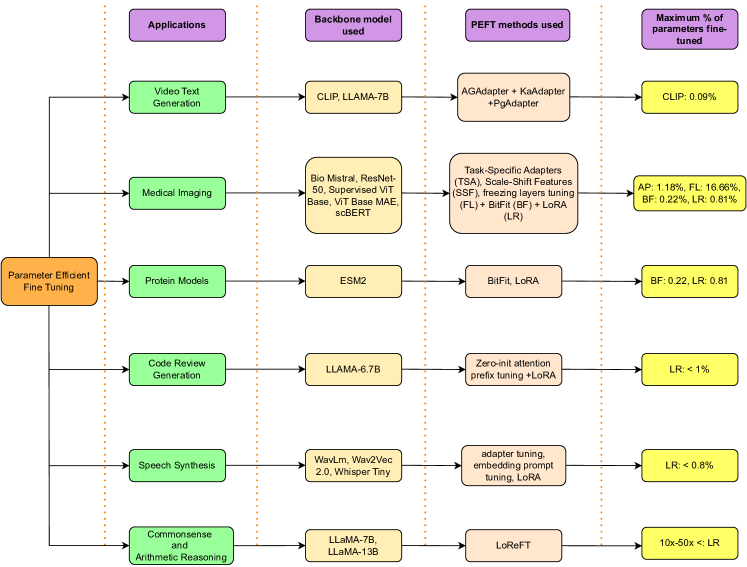
- Highlight applications across text, vision, biology, and speech domains.
- Identify challenges and future research directions to democratize deep learning via PEFT.
提案手法
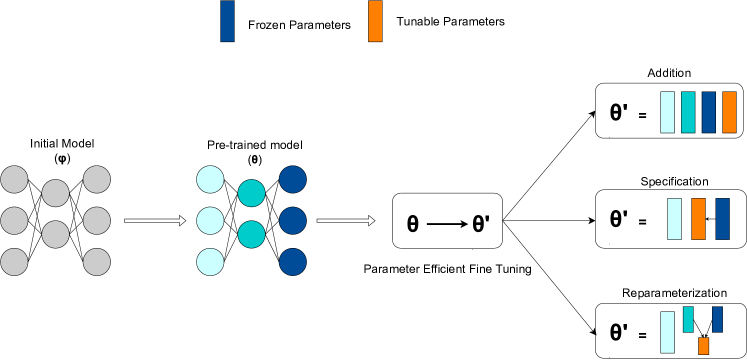
- Discuss foundational issues with full fine-tuning and the motivation for PEFT.
- Present a representative PEFT equation: DII(b,s,R)=b+R^{ ext{top}}(Rs-Rb) to guide hidden-state alignment.
- Compare a range of PEFT techniques (LoRA, DoRA, Prefix Tuning, BitFit, etc.) and their parameter reductions.
- Summarize performance and efficiency trade-offs across datasets and model sizes.
- Illustrate empirical findings through cross-domain applications and tables of results.
実験結果
リサーチクエスチョン
- RQ1How do PEFT methods compare in terms of parameter efficiency and performance across various tasks?
- RQ2What are the key trade-offs and limitations of PEFT approaches in different domains (NLP, vision, biology, audio)?
- RQ3Which PEFT techniques offer best practical balance between accuracy, training speed, and resource usage across applications?
主な発見
| Method | Parameter reduction (%) | Advantages | Disadvantages |
|---|---|---|---|
| フルファインチューニング (ViT-B/16, BARD) | 0 | Performant baseline | High memory footprint (33B parameters) |
| アダプター・モジュール(Tiny) | 85 | Flexible, modular design | Requires hyperparameter tuning |
| アダプター・モジュール(Small) | 75 | Flexible, modular design | Requires hyperparameter tuning |
| LoRA | 90 | Memory efficient (3.3B parameters) | Limited control over updates |
| LoReFT | 70-90 | Memory efficient, potentially interpretable | Efficiency depends on task and hyperparameters |
| Prefix Tuning(Learned) | 65 | Simple implementation | May not capture complex video features |
| Sparse Fine-Tuning (40% pruning) | 60 | Memory efficient (13.2B parameters) | Requires careful selection of parameters |
| Sparse Fine-Tuning (80% pruning) | 80 | Extremely memory efficient (6.6B parameters) | Significant accuracy drop at high pruning ratio |
| BitFit (8-bit) | 95 | Extremely memory efficient (1.65B parameters) | Limited performance gains in high-data regime |
- LoRA generally achieves strong parameter efficiency with notable performance gains.
- LoReFT can outperform several PEFT methods on commonsense reasoning with very small trainable parameter fractions.
- In arithmetic reasoning, LoRA and adapters often outperform LoReFT, indicating task-dependent effectiveness.
- Across applications, PEFT methods significantly reduce training resources while maintaining competitive performance.
- 3D and video-text tasks show notable gains with specialized adapters like AGAdapter and KAdaptation, confirming cross-domain effectiveness.
より良い研究を、今すぐ始めましょう
論文設計から論文執筆まで、研究時間を劇的に削減しましょう。
クレジットカード登録不要
このレビューはAIが作成し、人間の編集者が確認しました。