
[論文レビュー] Particle track reconstruction with noisy intermediate-scale quantum computers
この論文は、ノイジィな中規模量子(NISQ)コンピュータ上で、変分量子固有値求解器(VQE)を用いて粒子の軌跡再構成を二次無制約バイナリ最適化(QUBO)問題として解くための概念実証を示している。現在のハードウェアに適合するように、全QUBOを小さなサブ-QUBOに分割することで、CVaRコスト関数とL-VQEの改善を組み合わせたVQEは、理想的な条件下で32キュービットのサブ-QUBOにおいて最大70%の基底状態成分の忠実度を達成した。サブ-QUBOサイズが128〜512トリプレットの場合、性能は全QUBOの結果に近づく。
The reconstruction of trajectories of charged particles is a key computational challenge for current and future collider experiments. Considering the rapid progress in quantum computing, it is crucial to explore its potential for this and other problems in high-energy physics. The problem can be formulated as a quadratic unconstrained binary optimization (QUBO) and solved using the variational quantum eigensolver (VQE) algorithm. In this work the effects of dividing the QUBO into smaller sub-QUBOs that fit on the hardware available currently or in the near term are assessed. Then, the performance of the VQE on small sub-QUBOs is studied in an ideal simulation, using a noise model mimicking a quantum device and on IBM quantum computers. This work serves as a proof of principle that the VQE could be used for particle tracking and investigates modifications of the VQE to make it more suitable for combinatorial optimization.
研究の動機と目的
- NISQ時代の量子コンピュータを用いた高エネルギー物理学における粒子の軌跡再構成の可能性を探ること。
- 限られたキュービット数という課題に対処するため、大規模なQUBO問題を小規模でハードウェアに適合するサブ-QUBOに分解すること。
- 理想状態、ノイズあり状態、実際の量子ハードウェアの3つの条件下で、サブ-QUBOにおけるVQEの性能を評価すること。
- 特にCVaRコスト関数とL-VQEを含むVQEの改良策が、素粒子物理学における組み合わせ最適化問題において性能を向上させるかを調査すること。
- 現実のトラック密度のシナリオを用いて、全QUBO解法と比較して再構成されたトラックの効率性と純度をベンチマークすること。
提案手法
- トリプレットの品質係数 $ a_i $ とトリプレット間の適合性係数 $ b_{ij} $ を用いて、粒子の軌跡再構成をQUBO問題として定式化する。
- 空間的整合性を保つために、幾何的スライシングを適用し、16〜512トリプレットの重複するサブ-QUBOに全QUBOを分割する。
- 量子ハミルトニアンへのマッピングとして $ T_i \to (1 - Z_i)/2 $ を用い、VQEが最適解に対応する基底状態を探索できるようにする。
- パラメータ化された量子回路を用いた変分量子固有値求解器(VQE)を採用し、COBYLA最適化法と1イテレーションあたり1024回の測定を実施する。
- VQEの2つの改善手法を実装:$ \alpha = 0.1 $ および $ \alpha = 1 $ のCVaRコスト関数、および最大2層の追加エンタングル層を備えたL-VQE。
- Qiskitを用いて、理想シミュレーション、ノイズモデル(ibmq_kolkata)、実際のIBM量子ハードウェアの3つの設定で性能を評価する。

実験結果
リサーチクエスチョン
- RQ1全QUBOをサブ-QUBOに分解した場合、NISQデバイス上のVQEが十分な効率性と純度で粒子の軌跡を再構成できるか?
- RQ2サブ-QUBOサイズが、基底状態の忠実度、効率性、純度の観点でVQEの性能に与える影響は何か?
- RQ3ノイズ(シミュレートされたものも含む)が、粒子の軌跡再構成におけるVQEの性能に与える影響は何か?
- RQ4CVaRコスト関数と追加レイヤーを備えたL-VQEは、この文脈における収束性と解の品質を向上させるか?
- RQ5どの程度までサブ-QUBO分解が、現在および近い将来の量子ハードウェアにおける全QUBO解法の性能を保持できるか?
主な発見
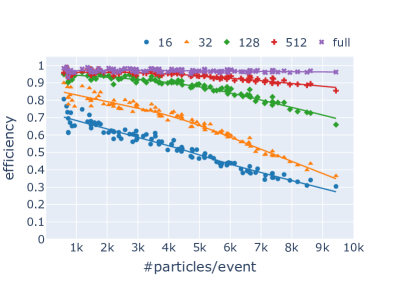
- サブ-QUBOサイズが128および512トリプレットの場合、効率性は0.9を超えており、1イベントあたり5,000個の粒子まで、全QUBO解法と同等の純度を維持する。
- 32キュービットのサブ-QUBOでは、理想状態のVQEシミュレーションで、最大70%のインスタンスが少なくとも1%の基底状態成分に到達しており、優れた解の忠実度を示している。
- CVaRコスト関数($ \alpha = 0.1 $)は、理想状態およびノイズありシミュレーションの両方で顕著に性能を向上させ、標準VQE($ \alpha = 1 $)を上回っている。
- L-VQEに1つの追加レイヤーを追加すると、20キュービットまでのノイズありシミュレーションで性能が向上するが、サイズが大きくなると効果が薄れる。
- 実際のIBM量子ハードウェア(ibmq_kolkata)からの結果は、古典的ノイズシミュレーションと整合しており、ノイズモデルの信頼性が裏付けられている。
- 16キュービットのサブ-QUBOでは、低トラック密度を超えると効率性が急激に低下するが、純度はほとんどの条件下で0.8以上を維持しており、誤検出に対して頑健であることが示された。
より良い研究を、今すぐ始めましょう
論文の読解から最終レビューまで、研究時間を劇的に削減しましょう。
クレジットカード登録不要
このレビューはAIが作成し、人間の編集者が確認しました。