
[論文レビュー] Peduncle Gripping and Cutting Force for Strawberry Harvesting Robotic End-effector Design
本研究では、ロボットトマト収穫エンドエフェクタのための臨床的機械的パラメータを実験的に決定し、果実の柄に10 Nの安全なグリップ力と、16.6°のウェッジ角を持つ刃の30°の方向をとった際の15 Nの必要な切断力が特定された。これらの値により、50 gのトマトを50 m/s²の加速度で操作する際、損傷を伴わず信頼性高くグリップおよび切断が可能となる。
Robotic harvesting of strawberries has gained much interest in the recent past. Although there are many innovations, they haven't yet reached a level that is comparable to an expert human picker. The end effector unit plays a major role in defining the efficiency of such a robotic harvesting system. Even though there are reports on various end effectors for strawberry harvesting, but there they lack a picture of certain parameters that the researchers can rely upon to develop new end effectors. These parameters include the limit of gripping force that can be applied on the peduncle for effective gripping, the force required to cut the strawberry peduncle, etc. These estimations would be helpful in the design cycle of the end effectors that target to grip and cut the strawberry peduncle during the harvesting action. This paper studies the estimation and analysis of these parameters experimentally. It has been estimated that the peduncle gripping force can be limited to 10 N. This enables an end effector to grip a strawberry of mass up to 50 grams with a manipulation acceleration of 50 m/s$^2$ without squeezing the peduncle. The study on peduncle cutting force reveals that a force of 15 N is sufficient to cut a strawberry peduncle using a blade with a wedge angle of 16.6 degrees at a 30-degree orientation.
研究の動機と目的
- 果実の柄に構造的損傷や潰れを引き起こさずに適用可能な最大安全グリップ力の特定。
- 所定のウェッジ角と方向を持つ刃を用いて柄を切断するために必要な最小切断力の測定。
- グリップおよび切断動作における力の限界に関する実証的データを提供することで、頑丈で果実に優しいエンドエフェクタの設計を支援。
- 刃の方向と柄の直径が2つのトマト品種(Katrina および Zara)の切断力要件に与える影響を評価。
提案手法
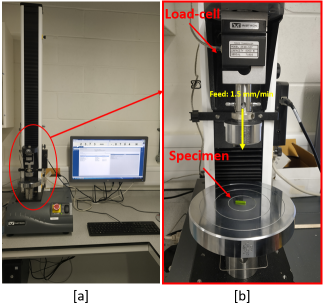
- 制御された条件下で2つの品種(Katrina および Zara)のトマトの柄に対して実験的力測定を実施。
- ロボット操作による変形を防ぐために、10 Nまで段階的にグリップ力を増加させ、構造的整合性を評価。
- 16.6°のウェッジ角を持つ刃を用い、複数の方向(0°, 10°, 20°, 30°)で切断試行を実施し、ピーク切断力を測定。
- 切断中の力プロファイルを記録・分析し、ピーク力(F_P1, F_P2)を特定するとともに、刃が柄の支持部に接触した瞬間を検出。
- 異なる直径および方向における標本ごとの平均切断力(F_PM)を計算し、設計に適した値を導出するために安全係数2を適用。
- 異なる刃の方向およびトマト品種間での切断力トレンドの比較に統計解析を用いた。
![Figure 1: Strawberry harvesting end effectors: [a]. Parallel jaw mechanism for simultaneous attachment and detachment [ 9 ] , [b].Suction head for attachment and blade action for detachment [ 2 ] , [c]. Suction head and two jaw fingers for attachment and bending action of end effector for detachment](https://ar5iv.labs.arxiv.org/html/2207.12552/assets/x1.jpg)
実験結果
リサーチクエスチョン
- RQ1果実の柄に構造的損傷や潰れを引き起こさずに適用可能な最大グリップ力は何か?
- RQ216.6°のウェッジ角を持つ刃を用いて柄を切断するために必要な最小切断力は何か、さまざまな方向でどうなるか?
- RQ3刃の方向(0°, 10°, 20°, 30°)は、トマトの柄を切断するために必要な力にどのように影響するか?
- RQ4柄の直径およびトマト品種(Katrina 対 Zara)は、測定されたグリップ力および切断力にどのように影響するか?
- RQ5安全係数を考慮した場合、30°の刃方向で15 Nの切断力が、異なる品種の柄を信頼性高く切断できるか?
主な発見
- 50 gのトマトをロボット操作で50 m/s²の加速度まで加速しても、柄を潰さずにしっかりと保持できるため、10 Nのグリップ力は安全かつ十分である。
- 刃の方向が30°のとき、柄を切断するためのピーク切断力が最小となり、この角度での平均値はZaraで4.13 N、Katrinaで5.00 Nであった。
- 安全係数2を適用して導出した15 Nの切断力は、両品種の30°方向の刃に対して、信頼性高く柄を切断できる。
- より急な刃の角度では切断力が増加し、Katrina品種では10°方向で最高の平均力(7.17 N)が記録された。
- 切断中の力プロファイルには、刃が柄の支持部に接触した際に、2つの明確なピークが現れ、その後急激に上昇する特徴があり、完全な切断の開始を確認できた。
- 本研究の結果は2つのトマト品種(Katrina および Zara)に限定されており、他の品種については未検証であるが、類似した傾向がわずかな許容範囲内で成り立つと想定される。
より良い研究を、今すぐ始めましょう
論文の読解から最終レビューまで、研究時間を劇的に削減しましょう。
クレジットカード登録不要
このレビューはAIが作成し、人間の編集者が確認しました。