
[論文レビュー] Peering inside the black box: Learning the relevance of many-body functions in Neural Network potentials
本論文は GNN-LRP を用いて粗粒子化分子系のニューラルネットポテンシャルが学習する多体相互作用を解釈し、メタン、水、NTL9 タンパク質における物理的に意味のある 2-body および 3-body の寄与を示す。
Machine learned potentials are becoming a popular tool to define an effective energy model for complex systems, either incorporating electronic structure effects at the atomistic resolution, or effectively renormalizing part of the atomistic degrees of freedom at a coarse-grained resolution. One of the main criticisms to machine learned potentials is that the energy inferred by the network is not as interpretable as in more traditional approaches where a simpler functional form is used. Here we address this problem by extending tools recently proposed in the nascent field of Explainable Artificial Intelligence (XAI) to coarse-grained potentials based on graph neural networks (GNN). We demonstrate the approach on three different coarse-grained systems including two fluids (methane and water) and the protein NTL9. On these examples, we show that the neural network potentials can be in practice decomposed in relevance contributions to different orders, that can be directly interpreted and provide physical insights on the systems of interest.
研究の動機と目的
- グラフニューラルネットワーク(GNN)に基づく粗粒子化ポテンシャルが解釈可能な多体相互作用を符号化していることを示す。
- 層別寄与伝播(LRP)をGNNに拡張し、ネットワークエネルギーを多体寄与に分解する。
- 簡単な流体に対して異なるGNNアーキテクチャを比較し、学習された項の物理的妥当性が一貫していることを示す。
- 解釈フレームワークをタンパク質モデル(NTL9)に適用し、安定化/不安定化相互作用を特定し、変異の影響を評価する。
提案手法
- 原子スケールデータから力整合(force-matching)を用いて熱力学的一貫性を確保し、2つの粗粒子化GNNエネルギーモデル(PaiNNとSO3Net)を訓練する。
- GNN-LRPを適用し、GNN内の歩行に基づいて予測をn-body寄与スコア(1- to (N_l+1)-body)に分解する。
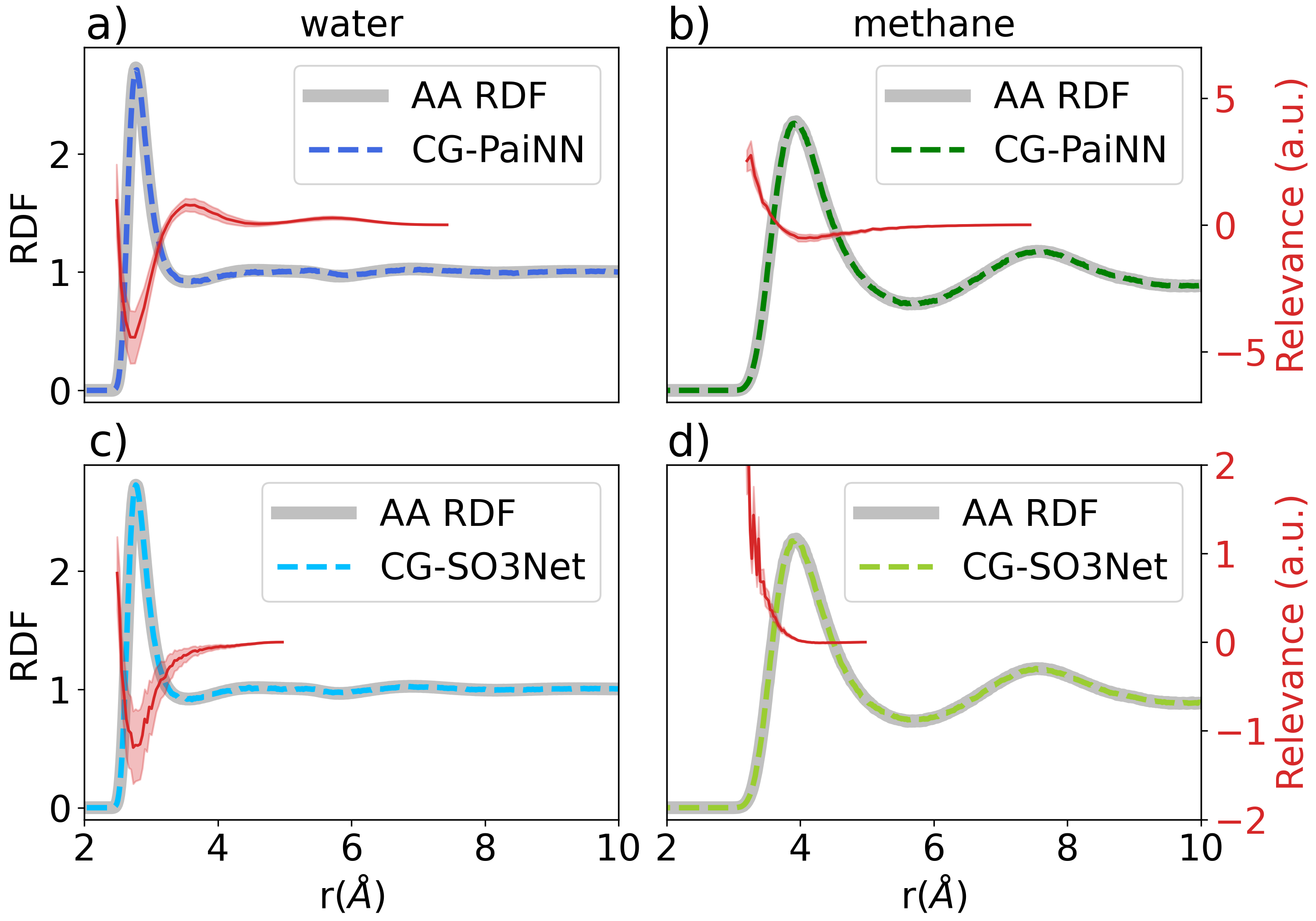
- 学習された相互作用を解釈するため、2-bodyおよび3-bodyの寄与をラジアル分布関数と角度分布と比較する。
- NTL9 CGモデルを解析し、残基対・トリプレットへの寄与マップを作成し、寄与パターンへの変異の効果を含めて評価する。

実験結果
リサーチクエスチョン
- RQ1GNNベースの粗粒子化ポテンシャルは、物理的相互作用に対応する解釈可能な多体寄与に分解できるか?
- RQ2同じ系に対して異なるGNNアーキテクチャは一貫した多体寄与パターンを生じさせるか?
- RQ3メタン、水、NTL9の構造特性の再現に最も寄与する2-bodyおよび3-body相互作用は何か?
- RQ4NTL9の変異は学習された寄与と構造モチーフの安定性にどのような影響を与えるか?
主な発見
- GNN-LRPはCGエネルギーを意味ある2-bodyおよび3-body寄与に分解し、物理的直感と一致する(例:水の第一 solvation shell 周りの安定化)。
- PaiNNとSO3Netは、角度表現とカットオフが異なるものの、定性的な多体寄与パターンが一貫しており、どちらも主要な構造的特徴を再現する。
より良い研究を、今すぐ始めましょう
論文設計から論文執筆まで、研究時間を劇的に削減しましょう。
クレジットカード登録不要
このレビューはAIが作成し、人間の編集者が確認しました。