
[論文レビュー] Point Cloud Matters: Rethinking the Impact of Different Observation Spaces on Robot Learning
本論文は、接触を伴う操作タスクにおけるロボット学習に与えるRGB、RGB-D、3Dポイントクラウドの観測モダリティの影響を調査する。ManiSkill2およびRLBenchの17のタスクにおいて、標準化されたAction Chunking Transformerポリシーを用い、ポイントクラウド観測がRGBおよびRGB-Dを常に上回ることを示した。成功確率が最も高く、視点、照明、ノイズ、背景の変化といったさまざまな変動に対し優れたゼロショット一般化性能を示した。
In robot learning, the observation space is crucial due to the distinct characteristics of different modalities, which can potentially become a bottleneck alongside policy design. In this study, we explore the influence of various observation spaces on robot learning, focusing on three predominant modalities: RGB, RGB-D, and point cloud. We introduce OBSBench, a benchmark comprising two simulators and 125 tasks, along with standardized pipelines for various encoders and policy baselines. Extensive experiments on diverse contact-rich manipulation tasks reveal a notable trend: point cloud-based methods, even those with the simplest designs, frequently outperform their RGB and RGB-D counterparts. This trend persists in both scenarios: training from scratch and utilizing pre-training. Furthermore, our findings demonstrate that point cloud observations often yield better policy performance and significantly stronger generalization capabilities across various geometric and visual conditions. These outcomes suggest that the 3D point cloud is a valuable observation modality for intricate robotic tasks. We also suggest that incorporating both appearance and coordinate information can enhance the performance of point cloud methods. We hope our work provides valuable insights and guidance for designing more generalizable and robust robotic models. Codes are available at https://github.com/HaoyiZhu/PointCloudMatters.
研究の動機と目的
- RGB、RGB-D、3Dポイントクラウドの観測モダリティがロボット学習に与える相対的な有効性を評価すること。
- 視点の変化、照明、ノイズ、背景の変化といった視覚的・幾何的摂動下で、ポイントクラウドがより優れたゼロショット一般化を提供するかどうかを調査すること。
- 異なるモダリティにおいて、最先端の事前学習済み視覚表現(PVRs)が性能向上に与える影響を評価すること。
- ドメイン固有の技術や複雑なアーキテクチャのトリックを用いない、公平で統一された比較フレームワークを確立すること。
- 3D空間的情報が、複雑な操作タスクにおいて2D外観ベースの観測よりもより頑健で効果的であるという実証的証拠を提供すること。
提案手法
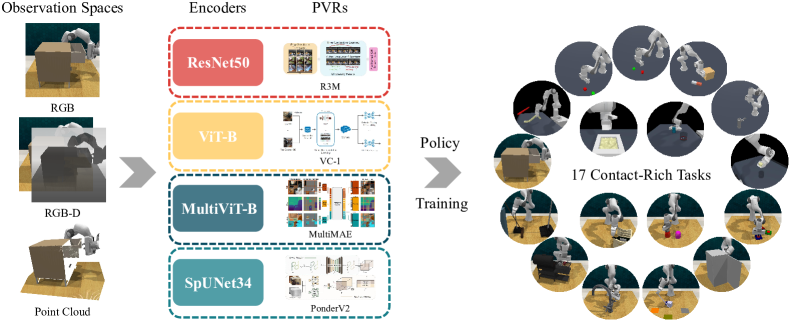
- すべての観測モダリティに同一のAction Chunking Transformer(ACT)ポリシー・ネットワークを用いて、一貫したポリシー・アーキテクチャを確保する。
- 各モダリティに一般的に採用されているシンプルなエンコーダーを用いる:ResNet50、ViT-B、MultiViT-B、SpUNet34、およびR3M、VC-1、MultiMAE、PonderV2などのPVRs。
- 2つのシミュレータを用いて、2つのベンチマーク(ManiSkill2およびRLBench)の17の接触を伴うタスクでパフォーマンスを評価し、耐久性を確認する。
- 学習から開始したモデルと事前学習済みモデルを比較することで、データの有効利用効率と一般化性能を評価する。
- カメラの視点、照明強度、レンダリングノイズレベル、背景色の変化といった変動に対するゼロショット一般化を測定する。
- 主な指標として、すべての評価で平均成功確率と平均ランクを用いる。
実験結果
リサーチクエスチョン
- RQ13Dポイントクラウド観測モダリティは、複雑で接触を伴うロボット操作タスクにおいて、RGBおよびRGB-Dを上回るパフォーマンスを達成するか?
- RQ2カメラの視点、照明、背景外観の変化に対して、ポイントクラウドベースのポリシーのゼロショット一般化能力は、RGBおよびRGB-Dと比べてどのように異なるか?
- RQ3事前学習済み視覚表現(PVRs)は、異なる観測モダリティにおいて、性能向上と一般化性能の向上にどの程度寄与するか?
- RQ4ポイントクラウドのパフォーマンス優位性は、学習から開始する設定と事前学習の両方で一貫しているか?
- RQ5限られたデータでのポリシー学習において、さまざまな観測モダリティのデータの有効利用効率はどのように変化するか?
主な発見
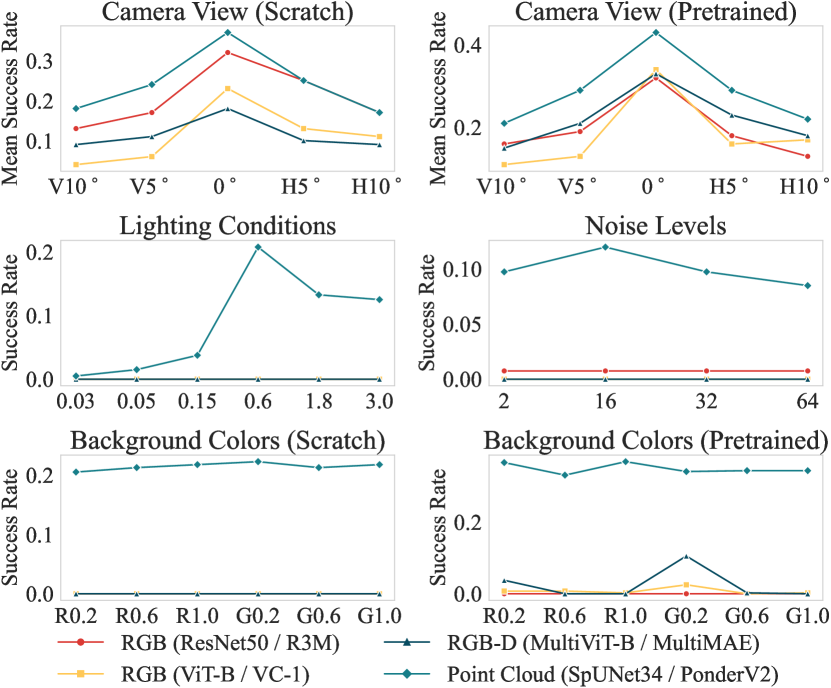
- ポイントクラウドベースの手法は、17のタスクにおいて平均成功確率(29%)と平均ランク(1.22)が最も高く、学習から開始した設定および事前学習設定の両方でRGBおよびRGB-Dを上回った。
- ポイントクラウドポリシーは、未学習のカメラ視点に対しても効果的に一般化され、ゼロショット評価で29%の成功確率を達成した。これに対してRGBは18%、RGB-Dは23%であった。
- 照明条件の変化下では、ポイントクラウドモデルが最大25.3%の成功確率(例:照明強度3.00)を達成し、極端な照明下でRGB(0.00%)およびRGB-D(0.00%)を大きく上回った。
- ノイズ耐性テストでは、高ノイズレベル(64)でもポイントクラウドモデルが21.0%の成功確率を維持したが、RGBおよびRGB-Dモデルは0.00%またはほぼ0.00%に低下した。
- 背景色の変更条件下では、ポイントクラウドモデルが36.8%の成功確率(R1.0, G1.0)を達成したのに対し、RGB(0.00%)およびRGB-D(0.00%)は同様の条件下で著しく劣った。
- 訓練データの10%のみを用いた場合、ポイントクラウドモデルは平均成功確率1.3%(PonderV2)を維持したが、RGBおよびRGB-Dモデルは0.00%またはほぼ0.00%に低下し、優れたデータの有効利用効率を示した。
より良い研究を、今すぐ始めましょう
論文の読解から最終レビューまで、研究時間を劇的に削減しましょう。
クレジットカード登録不要
このレビューはAIが作成し、人間の編集者が確認しました。