
[論文レビュー] Pre-optimizing variational quantum eigensolvers with tensor networks
本稿は VTNE を提案する。VTNE は VQE の古典的事前最適化であり、パラメータ化量子回路を行列積状態(MPS)として近似して良好な初期パラメータを見つけ、その後、1Dおよび2DのFermi-Hubbardモデルで量子ハードウェア上のVQEを初期化する。
The variational quantum eigensolver (VQE) is a promising algorithm for demonstrating quantum advantage in the noisy intermediate-scale quantum (NISQ) era. However, optimizing VQE from random initial starting parameters is challenging due to a variety of issues including barren plateaus, optimization in the presence of noise, and slow convergence. While simulating quantum circuits classically is generically difficult, classical computing methods have been developed extensively, and powerful tools now exist to approximately simulate quantum circuits. This opens up various strategies that limit the amount of optimization that needs to be performed on quantum hardware. Here we present and benchmark an approach where we find good starting parameters for parameterized quantum circuits by classically simulating VQE by approximating the parameterized quantum circuit (PQC) as a matrix product state (MPS) with a limited bond dimension. Calling this approach the variational tensor network eigensolver (VTNE), we apply it to the 1D and 2D Fermi-Hubbard model with system sizes that use up to 32 qubits. We find that in 1D, VTNE can find parameters for PQC whose energy error is within 0.5% relative to the ground state. In 2D, the parameters that VTNE finds have significantly lower energy than their starting configurations, and we show that starting VQE from these parameters requires non-trivially fewer operations to come down to a given energy. The higher the bond dimension we use in VTNE, the less work needs to be done in VQE. By generating classically optimized parameters as the initialization for the quantum circuit one can alleviate many of the challenges that plague VQE on quantum computers.
研究の動機と目的
- NISQデバイス上の VQE 最適化の課題に対処する(barren plateaus、ノイズ、収束の遅さ)。
- テンソルネットワークを用いてPQCsを古典的に事前最適化するVTNEを提案する。
- このアプローチを1Dおよび2DのFermi-Hubbardモデル(最大32量子ビット)で実証する。
- MPSの結合次元が古典的事前最適化と量子資源の節約に与える影響を定量化する。
提案手法
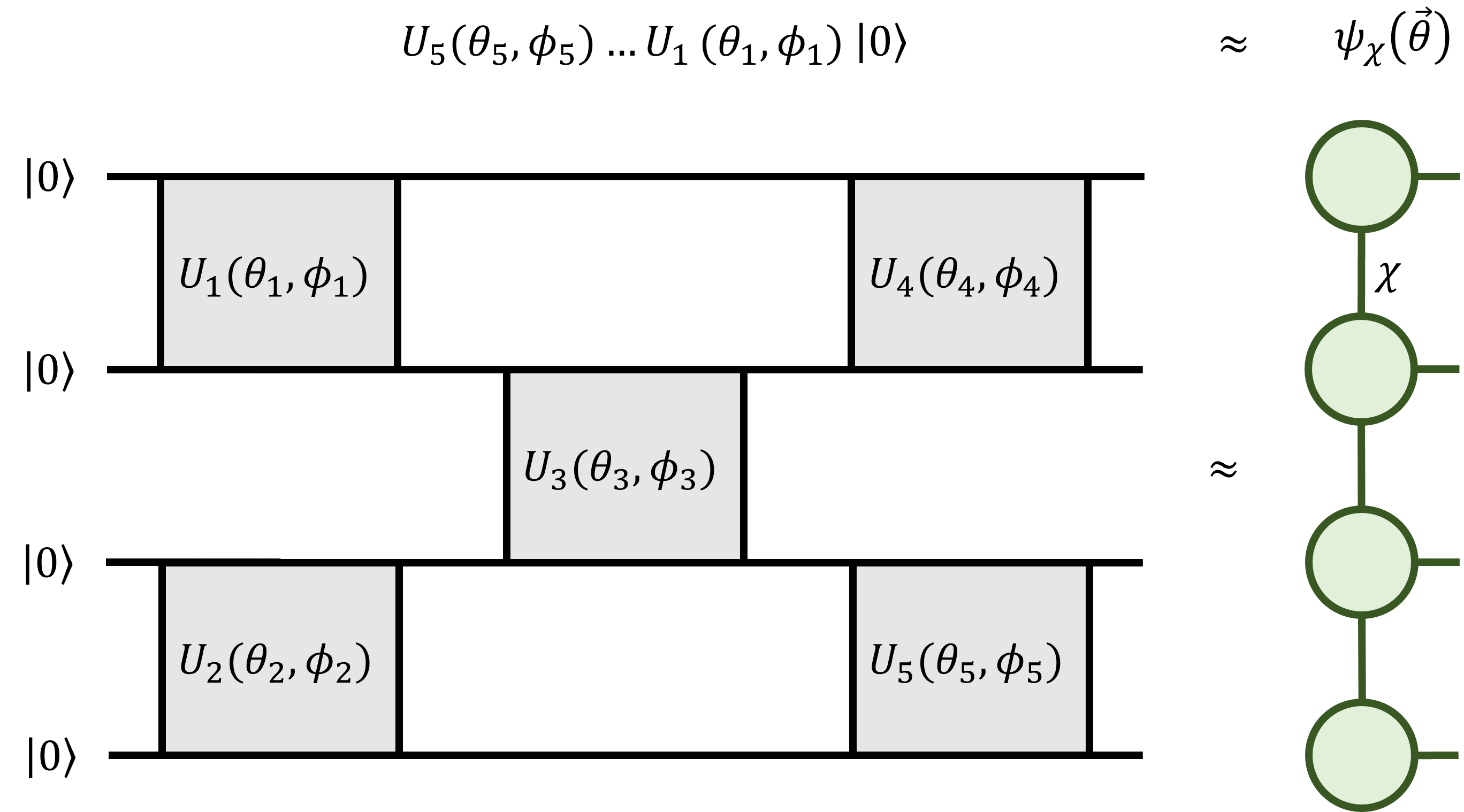
- TEBD収束を用いて、固定結合次元 chi のパラメータ化量子回路(PQC)を行列積状態(MPS)として表現する。
- ハミルトニアンには行列積作用素(MPO)を用いて、近似エネルギー E_chi(theta) = <psi_chi(theta)|H|psi_chi(theta)> を計算する。
- 2つの回路評価を用いてLとRのMPS因子を更新する経路(式7-11)により近似勾配を計算し、再帰中に結合次元 chi に切り詰める。
- 収束を助けるため、相互作用あり(U=2)の最適化を非相互作用(U=0)の最適化パラメータから初期化する。
- tensor network 計算を行うために ITensor を用いて実装する。
- PTNE事前最適化パラメータとランダム初期化を比較する、Adam最適化を用いたVQE。
実験結果
リサーチクエスチョン
- RQ1古典的VTNEの事前最適化は、量子ハードウェア上のVQEに対して高品質な初期パラメータを生み出せるか。
- RQ2MPS結合次元 chi が VTNE 事前計算パラメータの精度とその後の VQE エネルギーにどう影響するか。
- RQ3VTNEで初期化されたVQEは、目標エネルギーへ達するためにランダム初期化と比べて量子資源(ゲート)操作が少なくて済むか。
- RQ41Dと2DのFermi-Hubbardモデルで VTNE の性能はどのように異なるか。
- RQ5これらの系における VTNE の結果と、既存の古典的ベンチマーク(例:DMRG)との関係はどうか。
主な発見
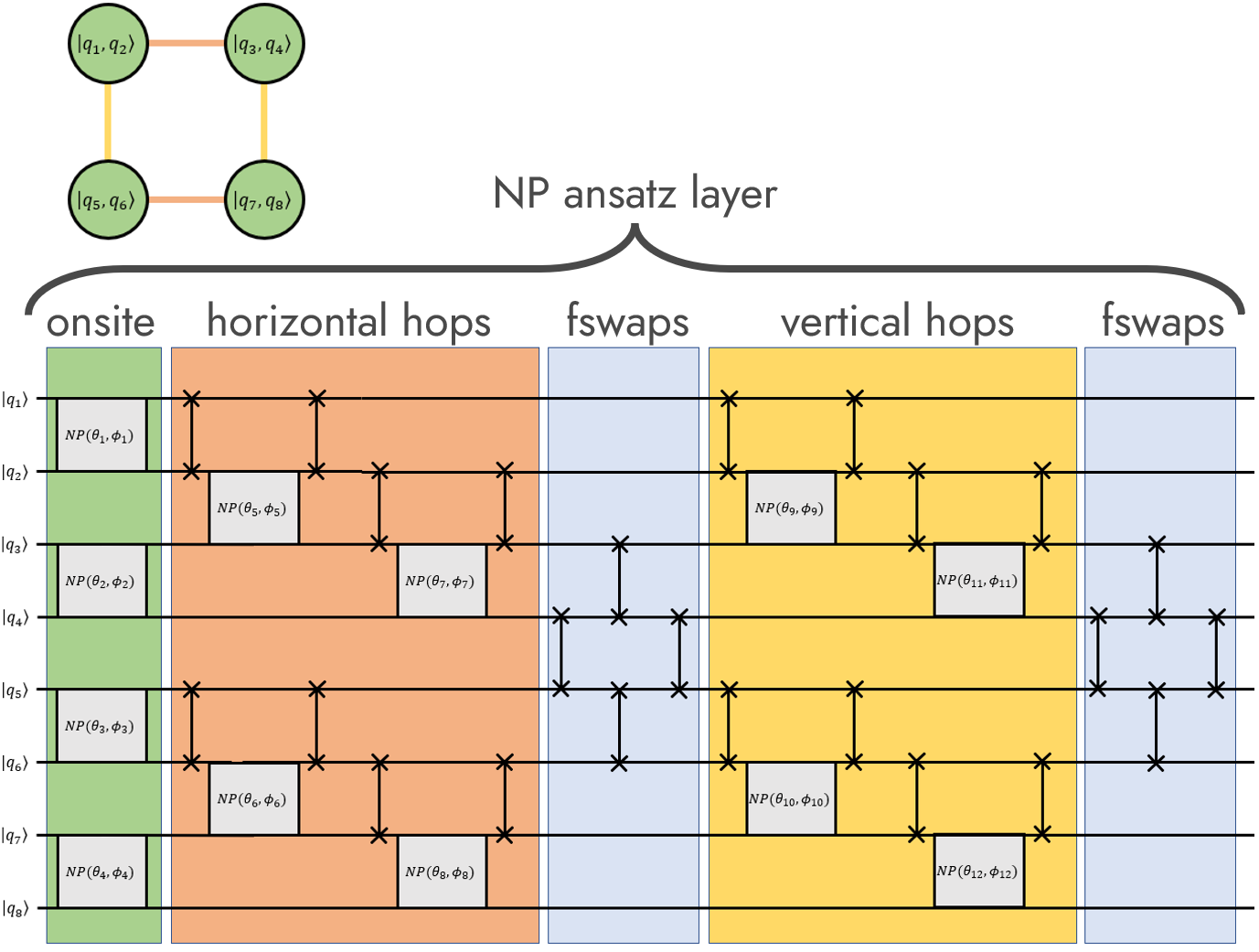
| n_x | n_y | 量子ビット | 層 |
|---|---|---|---|
| 4 | 1 | 8 | 4 |
| 8 | 1 | 16 | 7 |
| 12 | 1 | 24 | 11 |
| 16 | 1 | 32 | 14 |
| 4 | 2 | 8 | 10 |
| 4 | 3 | 24 | 17 |
| 4 | 4 | 32 | 24 |
- 1Dでは、適切なパラメータに対して VTNE は基底状態に対する相対誤差が0.5%以内になる。
- 2Dでは、VTNE由来パラメータはランダム初期化よりエネルギーが有意に低く、事前最適化はその後のVQEの労力を削減する。
- MPS結合次元 chi を増やすとエネルギー誤差とVQEで必要な勾配評価回数が減少する。
- 1D 系で最大32量子ビット、chi_b = 16 は相対エネルギー誤差≲3%を達成する。
- VTNEで初期化された VQE は、ランダムパラメータから始める場合より顕著に少ない勾配評価回数で済む(提示ケースでは約400〜1000ステップを節約)。
- VQE 実行時の収縮においてより大きな MPS 結合次元を用いると(chi_a > chi_b)、chi_bと同等かそれ以上のエネルギーとなり、ハードウェア実行時の潜在的利得を示唆する。
より良い研究を、今すぐ始めましょう
論文設計から論文執筆まで、研究時間を劇的に削減しましょう。
クレジットカード登録不要
このレビューはAIが作成し、人間の編集者が確認しました。