
[論文レビュー] Precise radial velocities of giant stars VIII. Testing for the presence of planets with CRIRES Infrared Radial Velocities
本研究では、リッケ・オブザーバトリの高精度な可視光RVと、VLTのCRIRES分光計による近赤外(Hバンド)RVを比較することで、20個の明るいGおよびK巨星の径速度(RV)信号の起源が惑星由来であるかを検証した。8つの主要な系において、両波長域でのRV振幅が一貫していることから、信号は星の活動や脈動ではなく、公転する惑星によるものである可能性が最も高いと結論された。
We have been monitoring 373 very bright (V < 6 mag) G and K giants with high precision optical Doppler spectroscopy for more than a decade at Lick Observatory. Our goal was to discover planetary companions around those stars and to better understand planet formation and evolution around intermediate-mass stars. However, in principle, long-term, g-mode nonradial stellar pulsations or rotating stellar features, such as spots, could effectively mimic a planetary signal in the radial velocity data. Our goal is to compare optical and infrared radial velocities for those stars with periodic radial velocity patterns and to test for consistency of their fitted radial velocity semiamplitudes. Thereby, we distinguish processes intrinsic to the star from orbiting companions as reason for the radial velocity periodicity observed in the optical. Stellar spectra with high spectral resolution have been taken in the H-band with the CRIRES near-infrared spectrograph at ESO's VLT for 20 stars of our Lick survey. Radial velocities are derived using many deep and stable telluric CO2 lines for precise wavelength calibration. We find that the optical and near-infrared radial velocities of the giant stars in our sample are consistent. We present detailed results for eight stars in our sample previously reported to have planets or brown dwarf companions. All eight stars passed the infrared test. We conclude that the planet hypothesis provides the best explanation for the periodic radial velocity patterns observed for these giant stars.
研究の動機と目的
- 進化したGおよびK巨星における周期的な径速度変動の原因が、惑星同伴か星の活動(スポット、脈動など)かを区別すること。
- 光学域で観測された同じ径速度信号が、星の活動効果が予想される弱い近赤外域でも一貫しているかを検証すること。
- 長期間にわたる光学監視で周期的なRV信号が検出された星に対して、惑星同伴の有無を確認または否定すること。
- 進化星周辺の系外惑星探査の信頼性を高めるために、赤外域の一貫性テストを適用すること。
- CRIRESが明るい巨星において高精度な近赤外径速度測定を実行可能であることを検証すること。
提案手法
- リッケ・オブザーバトリ調査の20個のGおよびK巨星に対して、VLTのCRIRES分光計を用いて高分解能のHバンドスペクトルを取得した。
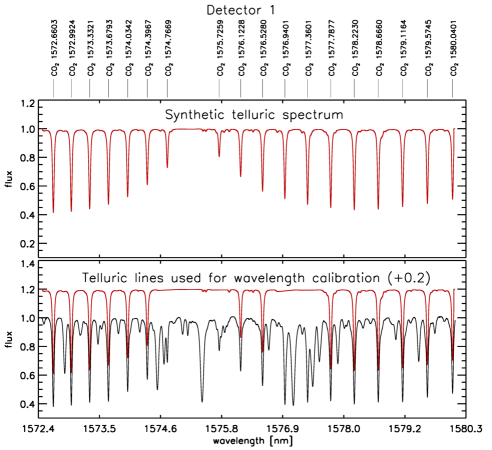
- Hバンドにおける深く安定した大気中のCO2吸収ラインを用いて、正確な波長校正を実施し、機器的および大気的系誤差を最小限に抑えた。
- LBLRTMコードおよびHITRANデータベースを用いて、リアルタイムの大気状態を組み込んだ合成大気スペクトルを構築し、大気汚染物質をモデル化・除去した。
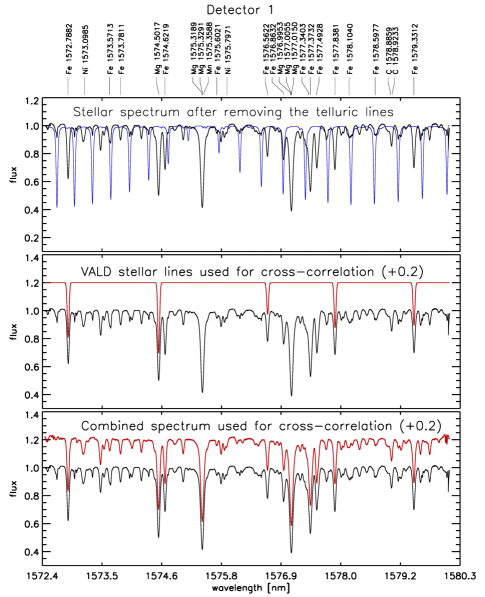
- 理論的VALD波長と観測された線幅プロファイルに基づいて作成したノイズのない星のマスクと、観測スペクトルを交差相関することで径速度を導出した。
- 遅いタイプのK巨星の場合、複数の観測エポックを統合して高SNRのマスタースター・テンプレートを作成し、RVの精度と信頼性を向上させた。
- 近赤外RV振幅とリッケ調査の光学RV振幅を比較し、一貫性を検証した;両データセットにケプラー運動モデルをフィットさせた。
実験結果
リサーチクエスチョン
- RQ1光学域で周期的であると示されたGおよびK巨星の径速度信号が、近赤外域でも同じ振幅を示すか?
- RQ2近赤外径速度測定は、スポットやgモード脈動のような星の活動と惑星同伴を区別できるか?
- RQ3惑星同伴が疑われる星において、光学域と近赤外域の径速度信号振幅が保存されているか?
- RQ4CRIRESは、明るい巨星に対して十分な径速度精度(≤35 m s⁻¹)を達成でき、信頼性のある一貫性テストを実施できるか?
- RQ5光学RV信号が曖昧な星において、近赤外データは惑星仮説を支持するか、あるいは否定するか?
主な発見
- CRIRESデータから得られた近赤外径速度は、20個の観測星すべてについてリッケ・オブザーバトリの可視光径速度と非常に良好に一致した。
- 既に惑星または褐色矮星を有すると報告済みの8つの星(HIP 5364(η Cet)、HIP 20889(ε Tau)、HIP 31592(7 CMa)、HIP 34693(τ Gem)、HIP 37826(β Gem)、HIP 60202(11 Com)、HIP 88048(ν Oph)、HIP 114855(91 Aqr))において、近赤外RV振幅が光学振幅と一貫していた。
- 近赤外と光学のRV振幅比(κ)は、全8つの星で1に近い値を示し、特にHIP 31592ではκ = 1.04 ± 0.24であった。これは信号強度の顕著な差がないことを示している。
- 光学と赤外のRV振幅に差が見られず、これは信号が星の活動由来である可能性を否定するものであった。
- 本手法は、G8 III–K1 III巨星においても、また標準的な交差相関が失敗する後期のK巨星(K2 III)においても、信頼できるRVを回復できた。
- 本研究では、進化星における周期的RV変動の最も妥当な説明として、惑星仮説が支持された。星の活動効果では、光学と赤外域で一貫した信号を生じさせることはできないだろう。
この論文を読む
Nubintのビューアで原文を開き、読みながら気になる箇所をすぐに質問できます。
Nubintでこの論文を読むこのレビューはAIが論文の原文をもとに作成しました。引用する前に原文をご確認ください。