
[論文レビュー] Primordial Black Holes from Supercooled Phase Transitions
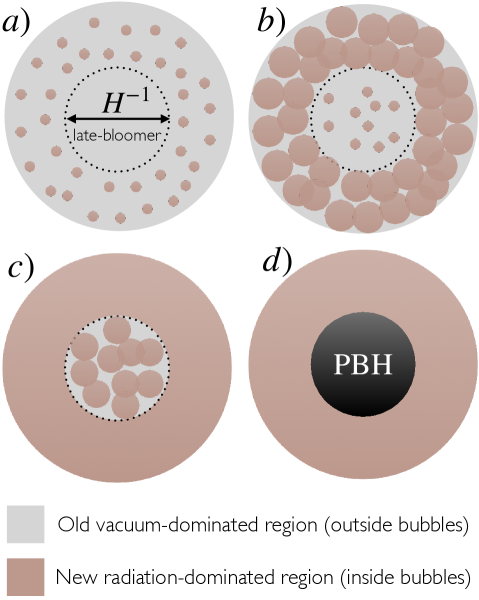
本稿では、初期宇宙における強力なスーパークーリングを伴う一次相転移の間に、因果的領域での遅延したバブル核生成が、長期間にわたる真空優位状態を引き起こし、密度対比が大きくなることから、原始ブラックホール(PBHs)が形成可能であると提唱する。主な結果として、相転移の持続時間がハッブル時間の12%を超える場合(β/H ≲ 8)、PBHの生成が著しく多くなることが判明し、生成度はスーパークーリング期間に依存しない。これはde Sitterのノーヘア予想と整合的である。
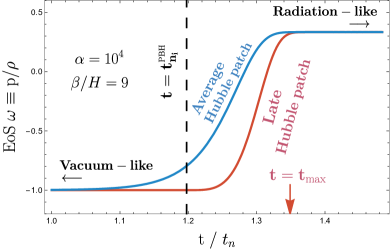
Cosmological first-order phase transitions (1stOPTs) are said to be strongly supercooled when the nucleation temperature is much smaller than the critical temperature. These are often encountered in theories that admit a nearly scale-invariant potential, for which the bounce action decreases only logarithmically with temperature. During supercooled 1stOPTs the equation of state of the universe undergoes a rapid and drastic change, transitioning from vacuum-domination to radiation-domination. The statistical variations in bubble nucleation histories imply that distinct causal patches percolate at slightly different times. Patches which percolate the latest undergo the longest vacuum-domination stage and as a consequence develop large over-densities triggering their collapse into primordial black holes (PBHs). We derive an analytical approximation for the probability of a patch to collapse into a PBH as a function of the 1stOPT duration, $β^{-1}$, and deduce the expected PBH abundance. We find that 1stOPTs which take more than $12\%$ of a Hubble time to complete ($β/H \lesssim 8$) produce observable PBHs. Their abundance is independent of the duration of the supercooling phase, in agreement with the de Sitter no hair conjecture.
研究の動機と目的
- 遅延核生成を伴うスーパークーリングを伴う一次相転移(1stOPTs)における原始ブラックホール(PBHs)の形成を調査すること。
- 相転移持続時間β⁻¹の関数としてPBH形成の確率を定量化すること。
- 宇宙論的・天体物理学的制約に基づき、観測可能なPBH生成の閾値を特定すること。
- 数値シミュレーションと一致する解析的近似式を導出すること。
提案手法
- 宇宙を真空エネルギー(ρ_V)と放射(ρ_R)の混合系としてモデル化し、スーパークーリング中は状態方程式ω = -1とする。
- 単位体積あたりのバブル核生成率を指数関数的に仮定し、Γ_V(t) = Γ₀e^{βt}とする。βは核生成温度付近のバウンス作用量から導出される。
- 指数的膨張下で因果的体積近似を適用し、後期に核生成された領域の生存確率を計算する。
- 初期核生成のない領域の生存確率を用いて、収縮確率P_collをβ/H_n、δ_c、およびハッブル率の関数として導出する。
- 数値結果に適合するための半解析的公式P_coll ≈ exp[−a(β/H_n)^b(1+δ_c)^{cβ/H_n}]をフィッティングし、パラメータa≈0.5646、b≈1.266、c≈0.6639を得た。
- 数値計算との整合性を検証し、因果的体積とトンネル率に基づく解析的近似と比較した。
実験結果
リサーチクエスチョン
- RQ1遅延したバブル核生成を伴う因果的領域が、スーパークーリングを伴う一次相転移中に原始ブラックホールに収縮する確率は何か?
- RQ2相転移持続時間(β⁻¹)は、このメカニズムによるPBH生成度にどのように影響するか?
- RQ3PBH生成度が観測的に有意義になる閾値は何か?また、スーパークーリング期間に依存するか?
- RQ4収縮確率は、密度対比閾値δ_cおよび相転移中のハッブル率にどのように依存するか?
- RQ5このPBH形成メカニズムにおいて、de Sitterのノーヘア予想はどの程度成立するか?
主な発見
- 相転移持続時間がハッブル時間の12%を超える場合(β/H ≲ 8)、PBHが著しく多く生成される。
- PBH生成度はスーパークーリング期間の長さに依存せず、de Sitterのノーヘア予想と整合的である。
- 収縮確率は、半解析的公式P_coll ≈ exp[−a(β/H_n)^b(1+δ_c)^{cβ/H_n}]でよく近似され、パラメータa≈0.5646、b≈1.266、c≈0.6639がフィッティングされた。
- 数値結果は、因果的体積と指数的レートに基づく解析的近似よりも、フィッティングされた公式との一致が良好である。
- このメカニズムは、相転移時の音速領域の大きさに応じたPBH質量を予測し、CMB、微小レンズ効果、重力波からの制約と整合する。
- バウンス作用量が温度とともに緩やかに減少する、ほぼスケール不変なポテンシャルを持つ理論において、長期間のスーパークーリング状態が可能になるため、PBH形成を説明できる。
より良い研究を、今すぐ始めましょう
論文の読解から最終レビューまで、研究時間を劇的に削減しましょう。
クレジットカード登録不要
このレビューはAIが作成し、人間の編集者が確認しました。