
[論文レビュー] Progress in Direct Measurements of the Hubble Constant
H0の局所直接測定を20年間にわたりレビューしたもので、Cepheids、TRGB、JAGB に焦点を当て、JWST の結果と系統的不確実性を取り上げ、H0の張力を解決することを目指す。
One of the most exciting and pressing issues in cosmology today is the discrepancy between some measurements of the local Hubble constant and other values of the expansion rate inferred from the cosmic microwave background (CMB) radiation. Resolving these differences holds the potential for the discovery of new physics beyond the standard model of cosmology: Lambda Cold Dark Matter (LCDM), a successful model that has been in place for more than 20 years. Given both the fundamental significance of this outstanding discrepancy, and the many-decades-long effort to increase the accuracy of the extragalactic distance scale, it is critical to demonstrate that the local measurements are convincingly free from residual systematic errors. We review the progress over the past quarter century in measurements of the local value of the Hubble constant, and discuss remaining challenges. Particularly exciting are new data from the James Webb Space Telescope (JWST). JWST is delivering high-resolution near-infrared imaging data to both test for and to address directly several of the systematic uncertainties that have historically limited the accuracy of the extragalactic distance scale. We present an overview of our new JWST program to observe Cepheids, TRGB and JAGB stars. For the first galaxy in our program, NGC 7250, the high-resolution JWST images demonstrate that many of the Cepheids observed with the Hubble Space Telescope (HST) are significantly crowded by nearby neighbors. Avoiding the more significantly crowded variables, the scatter in the JWST near-infrared (NIR) Cepheid period-luminosity relation is decreased by a factor of two compared to those from HST, illustrating the power of JWST for improvements to local measurements of Ho. Ultimately, these data will either confirm the standard model, or provide robust evidence for the inclusion of additional new physics.
研究の動機と目的
- 局所 H0 測定の歴史的および現状とその精度を評価する。
- Cepheid および TRGB に基づく距離に影響を与える主要な系統誤差を特定・評価する。
- JWST データの出現と、混雑と塵に関連する不確実性の削減への影響を要約する。
- 代替距離指標(JAGB)と距離尺度への独立したアンカーについて論じる。
- H0 のパーセントレベルの精度達成に向けた見通しと残る課題を概説する。
提案手法
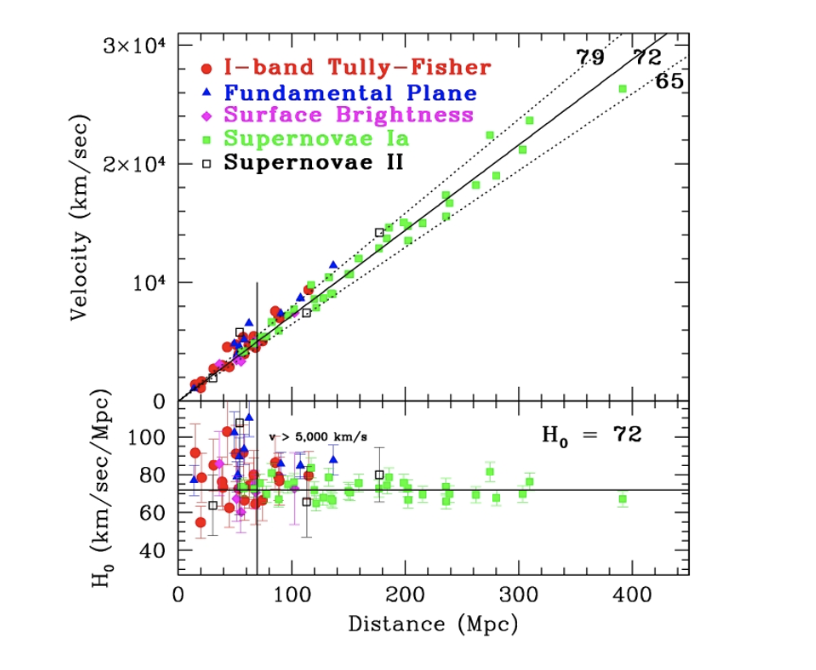
- Hubble Key Project とその総合不確実性10%の目標をレビューする。
- 局所法として最も高精度な2つの方法であるCepheidとTRGBの距離尺度を論じる。
- 距離尺度へのアンカー(LMC、MW parallaxes、NGC 4258)の評価とそれらがH0に与える影響を検討する。
- SN Iaの較正とH0のための SHoES、CCHP、CSP、Pantheon+ の取り組みを要約する。
- 混雑と赤化(reddening)に対処するための JWST の能力と初期結果(例: NGC 7250)を提示する。
実験結果
リサーチクエスチョン
- RQ1現在の局所直接測定によるH0の状況と精度はどうなっているか?
- RQ2CepheidとTRGB距離尺度での主要な系統的不確実性は何か、そしてそれらはどのように緩和されてきたか?
- RQ3独立したキャリブレーション(アンカー)は算出されたH0と不確実性にどのように影響するか?
- RQ4JWSTデータは既知の系統誤差をどの程度削減し、H0をさらに制約できるか?
- RQ5代替距離指標は Cepheid/TRGBスケールと一致するか、そしてそれがH0に与える影響は何か?
主な発見
- Cepheidベースの較正は約73 km s-1 Mpc-1のH0を与え、TRGBベースの較正はやや低く(約70 km s-1 Mpc-1)傾向。
- JWSTの近赤外撮像はCepheidの混雑を低減し、最初のJWST結果ではHSTと比較してCepheid PL関係の散乱を半減。
- 独立したアンカー(NGC 4258、LMC、SMC)を用いたTRGB較正は、メーサー観測とハローTRGB測定と整合性を示し、頑健な距離尺度を支持。
- アンカー(LMCの距離モジュール、MW parallaxes、NGC 4258のメーサー)は現在の系統的誤差の大部分を占め、グローバルなH0の精度を支配している。
- CCHPとSHoESプログラムは、赤外 Cepheids、 reddening の補正、そして parallaxes のベースラインを強調し、2%未満の系統的不確実性を目指す。
- JAGBは、金属量と reddening に対する感度が小さい競争力のある標準燭星として浮上しており、独立したクロスチェックを提供する。
![Figure 2 : A sampling of reddening-free near-IR Wesenheit magnitude PL relations adapted from [ 8 ] . Note the four-times larger scatter seen in virtually all of the SHoES galaxies compared to the fiducial scatter seen in the LMC and M31 (top row).](https://ar5iv.labs.arxiv.org/html/2309.05618/assets/Riess.png)
より良い研究を、今すぐ始めましょう
論文設計から論文執筆まで、研究時間を劇的に削減しましょう。
クレジットカード登録不要
このレビューはAIが作成し、人間の編集者が確認しました。