
[論文レビュー] Pure Spectroscopic Constraints on UV Luminosity Functions and Cosmic Star Formation History From 25 Galaxies at $z_\mathrm{spec}=8.61-13.20$ Confirmed with JWST/NIRSpec
本論文は、JWST/NIRSpec を用いて高赤方偏移域 ($z_{ m spec}=8.61-13.20$) でスペクトロスコピーで確認された 25 の銀河から UV 光度関数と宇宙規模の星形成率密度を導出し、純粋なスペクトロスコピー制約と下限を提供して、特定の急速進化モデルに挑戦する。
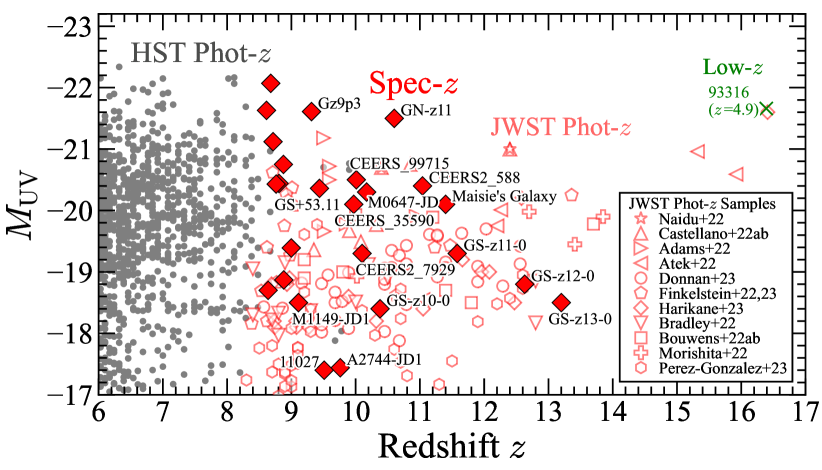
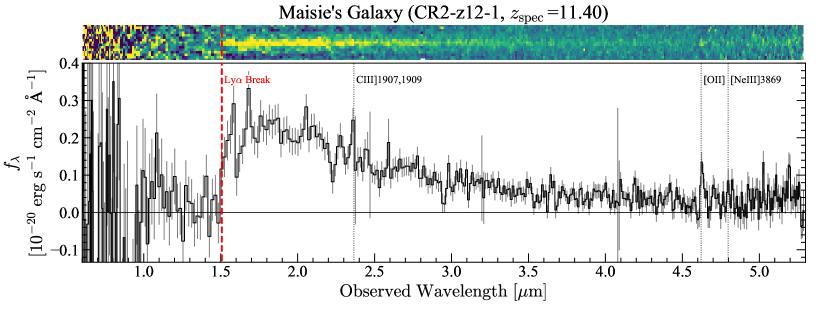
We present pure spectroscopic constraints on the UV luminosity functions and cosmic star formation rate (SFR) densities from 25 galaxies at $z_\mathrm{spec}=8.61-13.20$. By reducing the JWST/NIRSpec spectra taken in multiple programs of ERO, ERS, GO, and DDT with our analysis technique, we independently confirm 16 galaxies at $z_\mathrm{spec}=8.61-11.40$ including new redshift determinations, and a bright interloper at $z_\mathrm{spec}=4.91$ that was claimed as a photometric candidate at z~16. In conjunction with nine galaxies at redshifts up to $z_\mathrm{spec}=13.20$ in the literature, we make a sample of 25 spectroscopically-confirmed galaxies in total and carefully derive the best estimates and lower limits of the UV luminosity functions. These UV luminosity function constraints are consistent with the previous photometric estimates within the uncertainties and indicate mild redshift evolution towards z~12 showing tensions with some theoretical models of rapid evolution. With these spectroscopic constraints, we obtain firm lower limits of the cosmic SFR densities and spectroscopically confirm a high SFR density at z~12 beyond the constant star-formation efficiency models, which supports earlier claims from the photometric studies. While there are no spectroscopically-confirmed galaxies with very large stellar masses violating the $Λ$CDM model due to the removal of the bright interloper, we confirm star-forming galaxies at $z_\mathrm{spec}=11-13$ with stellar masses much higher than model predictions. Our results indicate possibilities of high star-formation efficiency (>5%), hidden AGN, top-heavy initial mass function (possibly with Pop-III), and large scatter/variance. Having these successful and unsuccessful spectroscopy results, we suggest observational strategies for efficiently removing low redshift interlopers for future JWST programs.
研究の動機と目的
- 高赤方偏移 $z>8$ での堅牢なスペクトロスコピー赤shifts を通じて初期銀河形成の理解を促進する。
- $z\,\sim\,9-12$ でのUV光度関数のきれいな測定とSFR密度の下限を提供する。
- 赤方偏移とともにUV LFの進化を評価し、急速進化モデルと比較する。
- 高-z サンプルにおける星形成効率、IMF、AGN 活動、および低赤色間違い混入の影響を探る。
提案手法
- ERO, ERS, GO, および DDT プログラムからの JWST/NIRSpec スペクトルを収集・再分析して確固たる赤shifts を得る。
- 文献からのスペクトロスコピーで確認された銀河を補完して $z_{\rm spec}=8.61-13.20$ の 25 個の対象サンプルを構築する。
- 2 つの有効体積推定法を用いて、3 つの赤方偏移ビン ($z\sim9$, $z\sim10$, $z\sim12$) および $z\sim16$ の上限で UV 光度関数を計算する。
- 公開された有効体積を用いて、選択効果を考慮するために保守的に NIRSpec 観測領域の体積を推定する。
- スペクトロスコピーサンプルから宇宙規模の SFR 密度を推定し、下限を含めてモデルと比較する。
- 将来の JWST 調査で低赤方間違い混入を特定・除去する戦略を検討する。
実験結果
リサーチクエスチョン
- RQ1スペクトロスコピーで確認された銀河に基づく $z\sim9$, $z\sim10$, $z\sim12$ でのUV 光度関数の制約は何か?
- RQ2スペクトロスコピーの制約は $z\sim12$ に向けた UV LF の穏やかな redshift evolution を示唆しているか?
- RQ3$z\sim9-12$ での宇宙規模の星形成率密度の下限はどれほどか、そしてそれらは一定星形成効率モデルとどう比較されるか?
- RQ4データは標準の ΛCDM 予測に挑戦するような高い星形成効率や他の署名(例:高い星形成効率、隠れた AGN、トップヘビー IMF)を示しているか?
- RQ5$>10$ の銀河を狙う JWST 調査で低赤方間違い混入を最小化する観測戦略は何か?
主な発見
- 25 のスペクトロスコピーで確認された銀河からの UV 光度関数の制約は、以前の光度計測と不確かさの範囲内で一致し、 $z\sim12$ に向けた緩やかな進化を示している。
- 宇宙規模の SFR 密度の確固たる下限があり、データは一定の星形成効率モデルを超える $z\sim12$ で高い SFR 密度を支持する。
- $z\sim11-13$ のいくつかのスペクトロスコピー確認済み銀河は、モデル予測よりも大きな恒星質量を示しており、高い星形成効率や別の過程を示唆する。
- $z_{spec}=4.91$ の明るい混入体を除去することで、$z\sim>10$ 銀河の明るさに関する CDM 予測との緊張感は緩和されるが、恒星質量と SFR の含意には依然とした緊張が残る。
- 本研究は高効率の星形成、隠れたAGN 活動、トップヘビー IMF、そして高赤方の銀河特性の大きな散布の役割を示唆し、将来の JWST プログラムで低赤方間違い混入を避ける戦略を検討する。
より良い研究を、今すぐ始めましょう
論文設計から論文執筆まで、研究時間を劇的に削減しましょう。
クレジットカード登録不要
このレビューはAIが作成し、人間の編集者が確認しました。