
[論文レビュー] Quantum Alternating Operator Ansatz (QAOA) beyond low depth with gradually changing unitaries
本論文は、浅い回路を超えて、徐々に変化するパラメータを伴う量子交互作用演算子アンザッツ(QAOA)を分析するための離散断熱定理フレームワークを導入する。パラメータが大きい場合の性能低下は、ユニタリ固有値の巻き込みに起因する固有状態の接続性の変化によるものであり、これは浅い回路が深い回路を上回ることもあり、さまざまな問題において普遍的な定性的な特徴を示す性能図を明らかにする。
The Quantum Approximate Optimization Algorithm and its generalization to Quantum Alternating Operator Ansatz (QAOA) is a promising approach for applying quantum computers to challenging problems such as combinatorial optimization and computational chemistry. In this paper, we study the underlying mechanisms governing the behavior of QAOA circuits beyond shallow depth in the practically relevant setting of gradually varying unitaries. We use the discrete adiabatic theorem, which complements and generalizes the insights obtained from the continuous-time adiabatic theorem primarily considered in prior work. Our analysis explains some general properties that are conspicuously depicted in the recently introduced QAOA performance diagrams. For parameter sequences derived from continuous schedules (e.g. linear ramps), these diagrams capture the algorithm's performance over different parameter sizes and circuit depths. Surprisingly, they have been observed to be qualitatively similar across different performance metrics and application domains. Our analysis explains this behavior as well as entails some unexpected results, such as connections between the eigenstates of the cost and mixer QAOA Hamiltonians changing based on parameter size and the possibility of reducing circuit depth without sacrificing performance.
研究の動機と目的
- 徐々に変化するパラメータを伴うQAOAの浅い深さを超えた挙動を理解すること。
- 最適化問題および量子化学的問題の両方において、最近のQAOA性能図に観察される普遍的な定性的特徴を説明すること。
- 特に固有状態の接続性の変化が果たす役割を含め、大きなパラメータ値における性能低下のメカニズムを調査すること。
- 連続的断熱定理を離散的でユニタリに基づくQAOA時間発展に一般化する理論的枠組みを提供すること。
- 回路の深さを性能を損なわずに減らせる条件を特定することで、パラメータスケジュールの改善を可能にすること。
提案手法
- 連続的ハミルトニアン時間発展ではなく、徐々に変化するユニタリの系列としてQAOA時間発展をモデル化するために、離散断熱定理を適用する。
- ホロノミー理論と複素単位円上の固有値の巻き込みの数学的構造を用いて、非断熱遷移を説明する。
- ギャップが小さい場合の失敗確率を推定するために、離散化されたランダウ=ジーナー式を用いて断熱的でない遷移を特徴付ける。
- 摂動論を用いて、パラメータが増大するに従い、特に臨界角度付近での固有状態の接続性の変化を分析する。
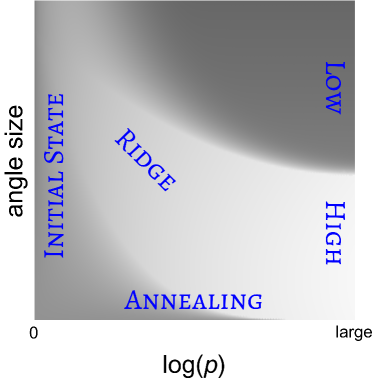
- パラメータ空間を、挙動が著しく異なる領域(例:断熱的、リッジ、高、低)にマッピングすることで、性能図を導出する。
- 数値的および解析的ツールを用いて、深さのあるQAOA回路における固有状態の時間発展と性能傾向の予測を検証する。
実験結果
リサーチクエスチョン
- RQ1なぜ、さまざまな問題や性能指標に対しても、QAOA性能図の構造が大まかに類似しているのか、特に深さが大きい場合でもそうなのか?
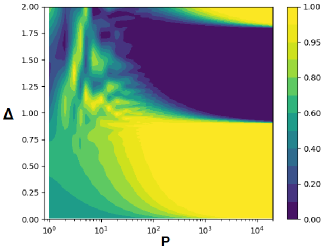
- RQ2大きなパラメータ値におけるQAOA性能図の右上領域で観察される性能の急激な低下は、何によって引き起こされるのか?
- RQ3深さのあるQAOA回路において、ユニタリ固有値の巻き込みによって、コストハミルトニアンとミキサーのハミルトニアンの間の固有状態の接続性はどのように変化するのか?
- RQ4非断熱効果により、浅いQAOA回路が深い回路を上回ることはあるのか、その条件は何か?
- RQ5性能を劣化させずに、回路の深さを減らすことでパラメータサイズを増大させられる範囲はどの程度か?また、「リッジ」領域における性能の限界は、何によって決定されるのか?
主な発見
- QAOA図の右上領域における性能低下は、ユニタリ時間発展における固有値の巻き込みに起因し、これにより固有状態の接続性が再構成され、最終状態がコストハミルトニアンの高エネルギー励起状態に結合するためである。
- 非断熱効果により、大きなパラメータ値において浅い回路が深い回路を上回ることがあり、これは深さが大きいほど常に良いという仮定に反する。
- 離散断熱定理は、QAOA性能図に観察される普遍的な定性的な挙動を説明でき、特に中間パラメータで高い性能を示す「リッジ」領域の存在を説明する。
- リッジ領域の性能は、固有値の巻き込みによって生じる最小ギャップに根本的に制限されており、特に全体の最小ギャップが f=1 に位置する場合(量子化学的問題でよく観察される)に顕著である。
- 多くの場合、パラメータサイズ Δ を増大させながら回路の深さ p を減らすことで、性能の損失は最小限に抑えられ、実用的な最適化戦略が得られる。
- このフレームワークにより、固有状態のスイッチングを避けるために大きなステップを用いる、またはギャップを通り抜けるために小さなステップを用いるなど、断熱への短絡的戦略を含む、QAOAスケジュールの新たな設計戦略が可能になる。
より良い研究を、今すぐ始めましょう
論文の読解から最終レビューまで、研究時間を劇的に削減しましょう。
クレジットカード登録不要
このレビューはAIが作成し、人間の編集者が確認しました。