
[論文レビュー] Quantum anomaly detection in the latent space of proton collision events at the LHC
論文は、クラシカルオートエンコーダを潜在空間へ変換した後、量子カーネル機械と量子クラスタリングを用いたLHCデータの異常検知のための教師なし量子機械学習パイプラインを提案し、特定のレジームで一貫した量子優位性を報告し、ハードウェアデモンストレーションを含む。
The ongoing quest to discover new phenomena at the LHC necessitates the continuous development of algorithms and technologies. Established approaches like machine learning, along with emerging technologies such as quantum computing show promise in the enhancement of experimental capabilities. In this work, we propose a strategy for anomaly detection tasks at the LHC based on unsupervised quantum machine learning, and demonstrate its effectiveness in identifying new phenomena. The designed quantum models, an unsupervised kernel machine and two clustering algorithms, are trained to detect new-physics events using a latent representation of LHC data, generated by an autoencoder designed to accommodate current quantum hardware limitations on problem size. For kernel-based anomaly detection, we implement an instance of the model on a quantum computer, and we identify a regime where it significantly outperforms its classical counterparts. We show that the observed performance enhancement is related to the quantum resources utilised by the model.
研究の動機と目的
- LHCで新しい物理をバイアスを最小限に抑えて異常検知の動機づけを行う。
- LHCデータの潜在表現上で動作する量子支援異常検知パイプラインを開発する。
- 複数のBSMシナリオに対して、古典的な対になるものと比較して量子手法をベンチマークする。
- 潜在空間の次元と学習データサイズが量子と古典の性能に与える影響を探る。
提案手法
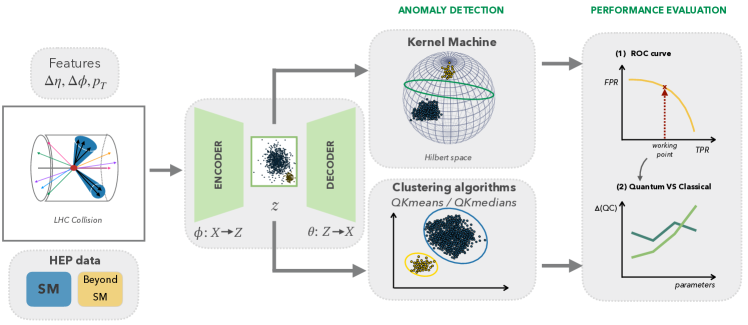
- QCDサイドバンドデータで訓練した畳み込みオートエンコーダを用いて高次元のLHCイベントデータを低次元潜在空間に写像する。
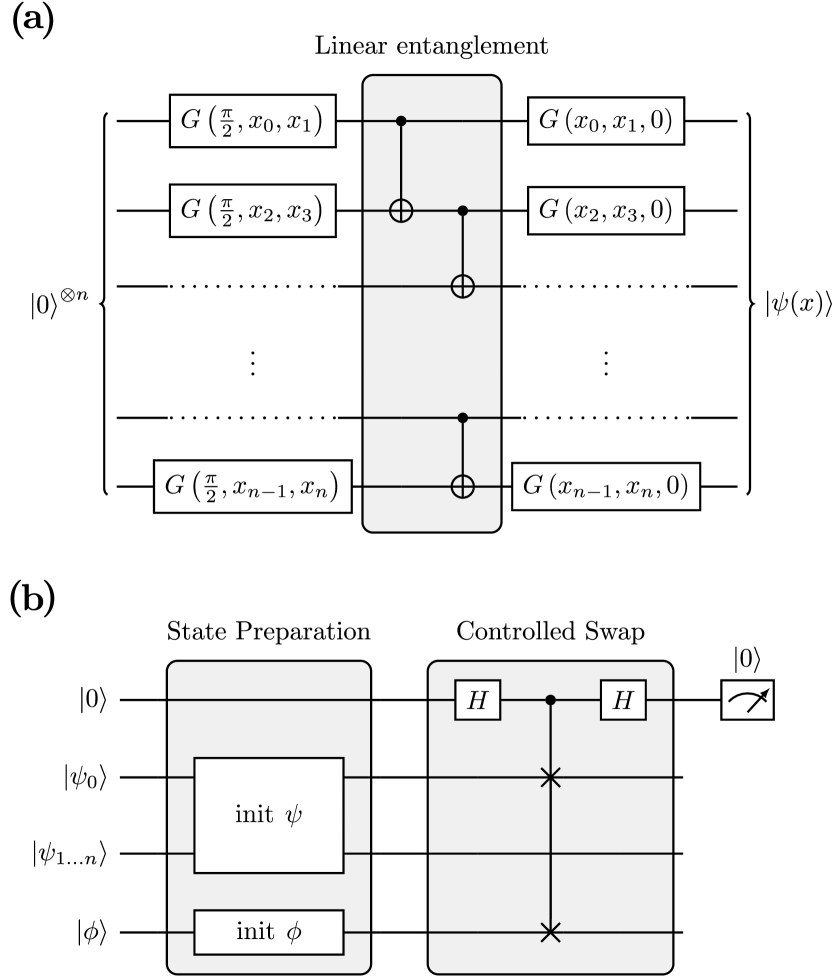
- 未知のデータエンコード回路を用いて入力を量子特徴空間に写像する教師なしの量子カーネル機械を実装する。
- 振幅でエンコードされた量子状態上でクラスタラベルを割り当てるように動作する2つの量子クラスタリングアルゴリズム(QK-meansとQK-medians)を開発する。
- ROC指標と信号効率を固定した背景 rejectionを用いて、量子と古典のベンチマークを比較し、異常検知性能を評価する。
- IBM量子プロセッサ上で量子カーネル機械のハードウェア対応インスタンスを実演し、量子特徴の実現可能性と品質を評価する。
実験結果
リサーチクエスチョン
- RQ1オートエンコードされたLHCデータの潜在空間における教師なし量子異常検知は、代表的なBSMシナリオで古典的手法を上回ることができるのか。
- RQ2潜在空間の次元と訓練サンプルサイズが量子と古典の異常検知性能にどのような影響を及ぼすのか。
- RQ3量子特徴写像と回路の性質(エンタングルメント、表現力)が、有意な量子優位性を生む特定のレジームは存在するのか。
- RQ4現実的なハードウェア実装を現在の量子デバイスで実行しつつ、意味のある識別性を保てるのか。
主な発見
- 教師なしの量子カーネル機械は、定義されたパラメータ領域で最高性能の古典カーネルベースラインに対して一貫した性能優位を示す。
- 量子の性能向上は、データエンコード回路のエンタングルメントや表現力といった回路の内在的特性と相関し、使用するキュービット数に敏感である。
- クラスタリングベースの量子法(QK-meansとQK-medians)も、特に訓練データセットが小さい設定で改善を示す。
- 潜在空間の次元を増やすと一般的に量子モデルの性能が向上し、いくつかのテストで潜在次元8付近で最良の結果が観察される。
- IBMQでのハードウェアデモンストレーションは、量子カーネルアプローチの近似的な実行可能性を現実のデバイス上で確認するものの、ノイズと検証統計による制約がある。
- 結果は、量子モデルが固定信号効率でより多くの背景イベントを棄却できることを示しており(いくつかの比較で最大5倍)、その優位性はエンコード回路の量子特有の性質に結びついていることを示唆する。
より良い研究を、今すぐ始めましょう
論文設計から論文執筆まで、研究時間を劇的に削減しましょう。
クレジットカード登録不要
このレビューはAIが作成し、人間の編集者が確認しました。