
[論文レビュー] Quantum Computing-Enhanced Algorithm Unveils Novel Inhibitors for KRAS
ハイブリッド量子-classical generative model(QCBM-LSTM)を量子ハードウェア/設計でKRAS阻害剤を訓練;二つの化合物が実験活性を示し、パン-KRAS阻害剤を含む。
The discovery of small molecules with therapeutic potential is a long-standing challenge in chemistry and biology. Researchers have increasingly leveraged novel computational techniques to streamline the drug development process to increase hit rates and reduce the costs associated with bringing a drug to market. To this end, we introduce a quantum-classical generative model that seamlessly integrates the computational power of quantum algorithms trained on a 16-qubit IBM quantum computer with the established reliability of classical methods for designing small molecules. Our hybrid generative model was applied to designing new KRAS inhibitors, a crucial target in cancer therapy. We synthesized 15 promising molecules during our investigation and subjected them to experimental testing to assess their ability to engage with the target. Notably, among these candidates, two molecules, ISM061-018-2 and ISM061-22, each featuring unique scaffolds, stood out by demonstrating effective engagement with KRAS. ISM061-018-2 was identified as a broad-spectrum KRAS inhibitor, exhibiting a binding affinity to KRAS-G12D at $1.4 μM$. Concurrently, ISM061-22 exhibited specific mutant selectivity, displaying heightened activity against KRAS G12R and Q61H mutants. To our knowledge, this work shows for the first time the use of a quantum-generative model to yield experimentally confirmed biological hits, showcasing the practical potential of quantum-assisted drug discovery to produce viable therapeutics. Moreover, our findings reveal that the efficacy of distribution learning correlates with the number of qubits utilized, underlining the scalability potential of quantum computing resources. Overall, we anticipate our results to be a stepping stone towards developing more advanced quantum generative models in drug discovery.
研究の動機と目的
- 量子強化生成モデリングを用いて小分子設計を加速させる動機付けと実証。
- QCBM-priorをLSTM生成器と統合したリガンド設計用のハイブリッド量子-古典フレームワークを開発。
- 大規模で多様なKRAS阻害剤データセットを整理し、合成可能で薬物様な分子を生成するモデルを訓練。
- 上位候補を実験的に合成・評価し、KRASターゲットに対する予測を検証。
提案手法
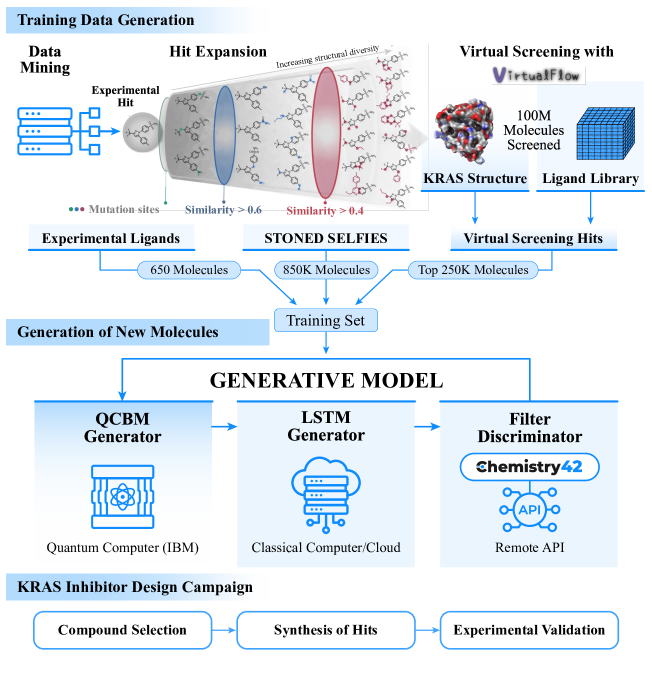
- 約650件の既知KRAS阻害剤から学習データセットを作成し、STONED-SELFIESと仮想スクリーニング(REAL library)を用いて約100万分子に拡張。
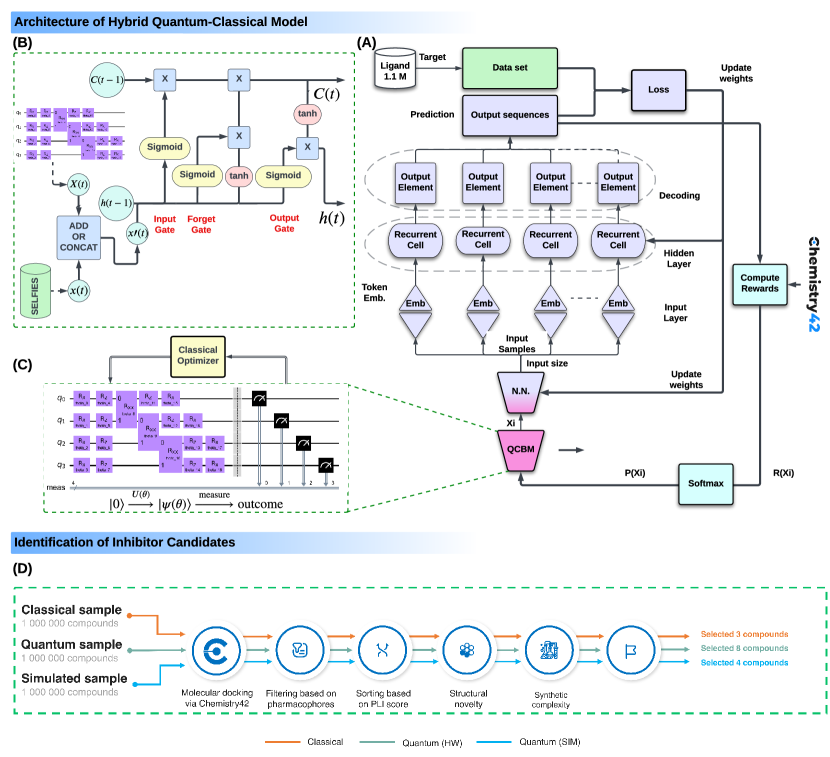
- 16量子ビットQCBMをpriorとし、LSTMベースの古典モデルを用いたハイブリッド生成器を実装し、Chemistry43を報酬信号として使用。
- ハードウェアからサンプリングされた量子priorsを用いて反復的にモデルを訓練し、次に量子情報と分子情報を統合してLSTM入力とする。
- Tartarus局所フィルタとChemistry42スコアリングを用いて生成分子を評価し、有望な候補15件を合成して実験的試験を行う。
- SPRとMaMTH-DSアッセイを用いて結合と機能活性を実験的に検証し、KRAS変異体全体で構造-活性を解析。
実験結果
リサーチクエスチョン
- RQ1古典的ベースラインと比較して量子priorを統合することは、生成されたKRAS阻害剤の品質と多様性を向上させるか?
- RQ2量子priorの量子ビット数が分布学習と分子品質にどう影響するか?
- RQ3量子強化生成モデルは実験的に検証可能なKRAS阻害剤を生み出せるか?
- RQ4ドッキングスコア、合成可能性、ターゲットエンゲージメントにおいて、量子生成候補は古典法とどう比較されるか?
主な発見
- 合成された2化合物、ISM061-018-2とISM061-22はKRASとの実験的エンゲージメントを示した。
- ISM061-018-2はKRAS-G12Dと1.4 μM親和性で結合し、パン-KRAS阻害剤として機能する。
- ISM061-22は変異体選択的活性を示し、特にKRAS G12RおよびQ61H変異体に対して有意で、G12D結合は限られる。
- 量子 priorsはTartarusベンチマーク試験で分布学習と分子品質を改善した。
- 成功率は量子priorに使用した量子ビット数とほぼ直線的に相関する。
- 本研究は創薬における量子アルゴリズムに起因する実験的に確認されたヒットを初めて報告する。
より良い研究を、今すぐ始めましょう
論文設計から論文執筆まで、研究時間を劇的に削減しましょう。
クレジットカード登録不要
このレビューはAIが作成し、人間の編集者が確認しました。