
[論文レビュー] Quantum Data Center Infrastructures: A Scalable Architectural Design Perspective
この論文は、光スイッチを用いて複数のQPUsを相互接続するスケーラブルな量子データセンター網を設計し、スイッチ中心型とサーバー中心型のトポロジー、エンタングルメント生成プロトコル、ネットワーク対応オーケストレータとシミュレーションベンチマークを導入する。
This paper presents the design of scalable quantum networks that utilize optical switches to interconnect multiple quantum processors, facilitating large-scale quantum computing. By leveraging these novel architectures, we aim to address the limitations of current quantum processors and explore the potential of quantum data centers. We provide an in-depth analysis of these architectures through the development of simulation tools and performance metrics, offering a detailed comparison of their advantages and trade-offs. We hope this work serves as a foundation for the development of efficient and resilient quantum networks, designed to meet the evolving demands of future quantum computing applications.
研究の動機と目的
- Motivate the need for scalable, networked quantum data centers to overcome the qubit count limits of individual QPUs.
- Propose scalable network architectures (switch-centric and server-centric) inspired by classical data center designs.
- Develop physical-layer models and entanglement generation protocols compatible with QDCs.
- Introduce a network-aware quantum orchestrator to translate circuit-level jobs into optical-switch configurations.
- Provide simulation benchmarks to evaluate latency and fidelity across architectures.
提案手法
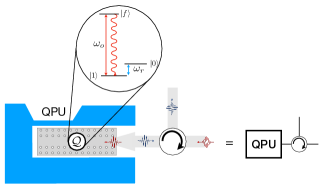
- Develop physical-layer models for entanglement generation protocols (emitter-emitter, emitter-scatterer, scatterer-scatterer) with spin-photon interfaces.
- Analyze three entanglement protocols under different encodings (Fock-space, polarization, time-bin) and quantify fidelity and generation rate.
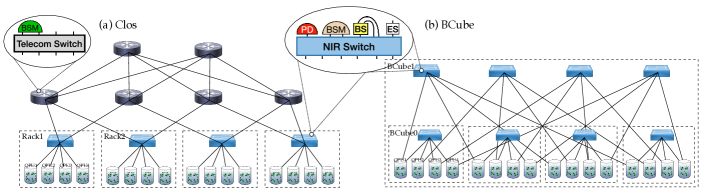
- Propose switch-centric (e.g., Clos) and server-centric (e.g., BCube) QDC network topologies and map intra-rack vs inter-rack operation to NIR and telecom wavelengths.
- Introduce a network-aware quantum orchestrator that precompiles instructions for optical switches and quantum hardware based on circuit descriptions and topology.
- Incorporate simulation and benchmarking of random quantum circuits on a Clos topology to assess end-to-end performance.]
- 研究課題(research_questions):
- How can quantum data centers achieve on-demand, all-to-all connectivity while minimizing expensive quantum hardware?
- What network architectures (switch-centric vs server-centric) best balance scalability, fidelity, and entanglement distribution efficiency for large QDCs?
- How do different ebit generation protocols and encodings impact end-to-end entanglement rates and fidelities in practice?
- What role does a network-aware orchestrator play in translating quantum circuits into network configurations?
- How do architectural choices affect end-to-end latency and fidelity in simulated quantum workloads?
実験結果
リサーチクエスチョン
- RQ1How can quantum data centers achieve on-demand, all-to-all connectivity while minimizing expensive quantum hardware?
- RQ2What network architectures (switch-centric vs server-centric) best balance scalability, fidelity, and entanglement distribution efficiency for large QDCs?
- RQ3How do different ebit generation protocols and encodings impact end-to-end entanglement rates and fidelities in practice?
- RQ4What role does a network-aware orchestrator play in translating quantum circuits into network configurations?
- RQ5How do architectural choices affect end-to-end latency and fidelity in simulated quantum workloads?
主な発見
- The paper proposes two architectural categories—switch-centric and server-centric—based on classical data-center networking principles to enable scalable QDC interconnects.
- It analyzes three entanglement generation protocols (emitter-emitter, emitter-scatterer, scatterer-scatterer) across encodings, deriving expressions for end-to-end generation rates and fidelities under loss.
- Switch-centric layouts use non-blocking photonic interconnects with optical switches to enable near all-to-all connectivity, while server-centric designs rely on modular entanglement distribution with dedicated hardware.
- Intra-rack communications operate at near-infrared frequencies while inter-rack communications use telecom wavelengths, with non-degenerate entanglement sources and quantum frequency conversion as needed.
- A network-aware orchestrator is introduced to translate circuit-level quantum jobs and topology into precompiled control instructions for optical switches and hardware, enabling coordinated distributed quantum computation.
- Performance benchmarking on a Clos topology with random quantum circuits is conducted to evaluate average network latency and quantum fidelity.
より良い研究を、今すぐ始めましょう
論文設計から論文執筆まで、研究時間を劇的に削減しましょう。
クレジットカード登録不要
このレビューはAIが作成し、人間の編集者が確認しました。