
[論文レビュー] QUEST-DMC superfluid $^3$He detector for sub-GeV dark matter
本論文は、ナノメカニカルレゾネータを備えたボロメータを用いて、超流動 $^3$Heを用いて、sub-GeV/$c^2$ 未満のダークマターを準粒子検出によって探索する新規なダークマターディテクタであるQUEST-DMCを提案する。sub-eVの核反発エネルギー感度を予測し、軽いダークマターのスピン非依存およびスピン依存相互作用の両方において競争力のある探査能力を有する。さらに、マルチワイヤNEMSと高度な温度測定技術を用いることで、さらなる性能向上が可能である。
The focus of dark matter searches to date has been on Weakly Interacting Massive Particles (WIMPs) in the GeV/$c^2$-TeV/$c^2$ mass range. The direct, indirect and collider searches in this mass range have been extensive but ultimately unsuccessful, providing a strong motivation for widening the search outside this range. Here we describe a new concept for a dark matter experiment, employing superfluid $^3$He as a detector for dark matter that is close to the mass of the proton, of order 1 GeV/$c^2$. The QUEST-DMC detector concept is based on quasiparticle detection in a bolometer cell by a nanomechanical resonator. In this paper we develop the energy measurement methodology and detector response model, simulate candidate dark matter signals and expected background interactions, and calculate the sensitivity of such a detector. We project that such a detector can reach sub-eV nuclear recoil energy threshold, opening up new windows on the parameter space of both spin-dependent and spin-independent interactions of light dark matter candidates.
研究の動機と目的
- sub-GeV/$c^2$ 未満のダークマターの新しい検出概念の開発、特にスピン非依存およびスピン依存相互作用に焦点を当てる。
- 従来のWIMP中心の実験では未だ未探査のままの軽量ダークマターキャンディデートの感度ギャップを埋める。
- 低温安定性と準粒子感受性に優れた超流動 $^3$Heの特徴を活用し、超低エネルギー閾値検出を実現する。
- シミュレーションとモデル化を通じて、検出器の応答、信号、バックグラウンド相互作用を評価し、sub-eV領域における感度を予測する。
- 将来の実験的実現および超流動相転移の基礎的研究の基盤を築く。
提案手法

- 検出器は、100 $\mu$K に冷却された $\sim$1 cm$^3$ の超流動 $^3$Heボロメータセルを用い、希釈冷媒と銅磁気冷却段階を用いて冷却される。
- ナノメカニカルレゾネータ(NEMS)は、ダークマター-$^3$He散乱事象で生成される準粒子励起からの熱エネルギーを検出する。
- これらの温度帯で初めてSQUIDベースのリードアウトを実装し、準粒子生成の高分解能エネルギー測定を達成する。
- 核反発からのエネルギー付加は、準粒子生成と熱平衡化を考慮した詳細な検出器応答関数を用いてモデル化される。
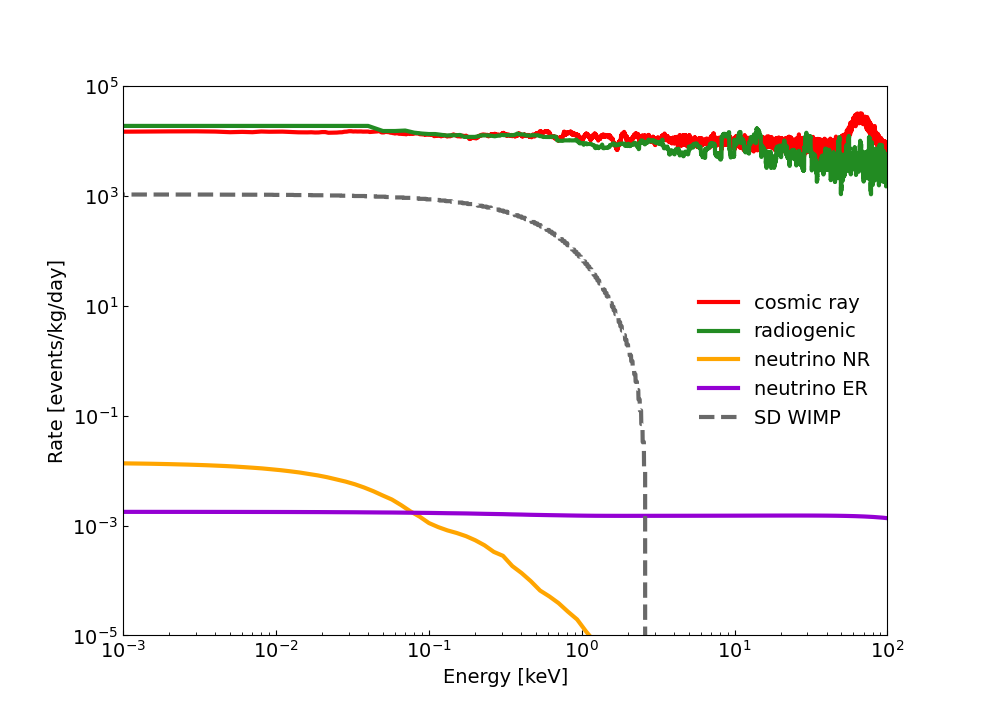
- モンテカルロシミュレーションを用いて、候補ダークマター信号およびバックグラウンド相互作用(電子反発および宇宙線を含む)をモデル化する。
- エネルギー閾値、信号効率、バックグラウンド抑制を含むフルシミュレーションフレームワークを用いて感度を予測する。
実験結果
リサーチクエスチョン
- RQ1超流動 $^3$Heベースのボロメータにナノメカニカルレゾネータを組み合わせることで、核反発に対してsub-eVのエネルギー分解能を達成できるか?
- RQ2このような検出器が、sub-GeV/$c^2$ 未満のダークマターのスピン非依存およびスピン依存相互作用に対してどの程度の感度を有するか?
- RQ3準粒子ショットノイズとレゾネータ設計は、エネルギー閾値および感度にどのように影響するか?
- RQ4sub-eV領域における主要なバックグラウンド源は何か、そしてそれらはどのように低減可能か?
- RQ5この検出器概念は、均一な一次相転移といった基礎的超流動現象を調べるのにも拡張可能か?
主な発見
- QUEST-DMC検出器概念は、sub-eVの核反発エネルギー閾値を予測し、軽量ダークマターのパラメータ空間においてこれまで未開拓の領域にアクセス可能である。
- この検出器は、$^3$He核とのダークマターのスピン非依存およびスピン依存相互作用に感受性を示し、現在の希土類ガスベース実験とは補完的である。
- 感度予測では、特に現在の実験であまり探査されていないスピン依存相互作用において、sub-GeV/$c^2$ の質量範囲で競争力のある探査能力を示す。
- 複数の独立したナノワイヤオシレータを用いることで、エネルギー分解能が $\sqrt{N}$ 倍向上し、感度が顕著に向上する。
- 膜に接続されたレゾネータや非局所的温度測定(例:磁気子BEC緩和)といった代替戦略を用いることで、ノイズをさらに低減し、1 eV未満の感度を拡張可能である。
- シミュレーションフレームワークは、エネルギー閾値とイベントトポロジーによるバックグラウンド抑制が可能であることを示しており、発見への実現可能性のある道筋を支持する。
より良い研究を、今すぐ始めましょう
論文の読解から最終レビューまで、研究時間を劇的に削減しましょう。
クレジットカード登録不要
このレビューはAIが作成し、人間の編集者が確認しました。