
[論文レビュー] Quiescent or dusty? Unveiling the nature of extremely red galaxies at $z>3$
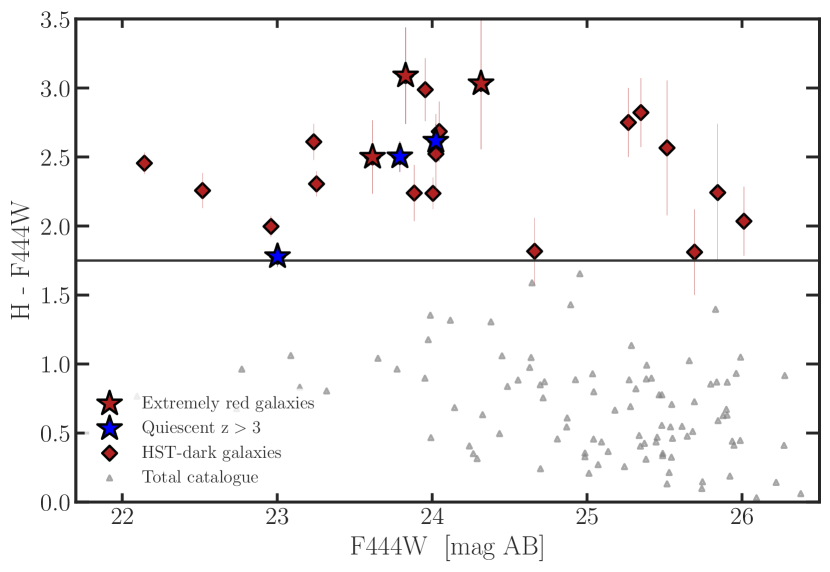
本論文は JWST/NIRSpec PRISM 分光法を用いて23個の HST-dark 銀河(H-F444W>1.75)を観測し、ほとんどが塵に覆われた性質であり、かなりの割合が準静止していること、正確な赤方偏移と塵の測定を得たことを示す;1つの準静止源には AGN 活性が見られる。
The advent of the JWST has revolutionised our understanding of high-redshift galaxies. In particular, the NIRCam instrument on-board JWST has revealed a population of Hubble Space Telescope (HST)-dark galaxies that had previously evaded optical detection, potentially due to significant dust obscuration, quiescence, or simply extreme redshift. Here, we present the first NIRSpec spectra of 23 HST-dark galaxies ($\mathrm{H-F444W>1.75}$), unveiling their nature and physical properties. This sample includes both dusty and quiescent galaxies with spectroscopic data from NIRSpec/PRISM, providing accurate spectroscopic redshifts with $\mathrm{\overline{z}_{spec} = 4.1 \pm 0.7}$. The spectral features demonstrate that, while the majority of HST-dark galaxies are dusty, a substantial fraction, $\mathrm{13^{+9}_{-6} \%}$, are quiescent. For the dusty galaxies, we have quantified the dust attenuation using the Balmer decrement ($\mathrm{Hα/ Hβ}$), finding attenuations $\mathrm{A_{V} > 2\ mag}$. We find that HST-dark dusty galaxies are $\mathrm{Hα}$ emitters with equivalent widths spanning the range $\mathrm{ 68 A < EW_{Hα} < 550 A }$, indicative of a wide range of recent star-formation activity. Whether dusty or quiescent, we find that HST-dark galaxies are predominantly massive, with 85\% of the galaxies in the sample having masses $\mathrm{log(M_{*}/M_{\odot}) > 9.8}$. This pilot NIRSpec program reveals the diverse nature of HST-dark galaxies and highlights the effectiveness of NIRSpec/PRISM spectroscopic follow-up in distinguishing between dusty and quiescent galaxies and properly quantifying their physical properties. Upcoming research utilising higher-resolution NIRSpec data and combining JWST with ALMA observations will enhance our understanding of these enigmatic and challenging sources.
研究の動機と目的
- HST-dark 銀河(z>3)の赤方偏移分布を NIRSpec PRISM 分光で特定する。
- 分光的特徴を通じて dusty と quiescent の HST-dark 銀河を区別する。
- サンプルの塵減衰と基本的物理量(質量、SFR)を見積もる。
- HST-dark 銀河の AGN 活動の有無を評価する。
- 高赤方偏移領域での JWST+ALMA 研究の将来の基準を提供する。
提案手法
- NIRCam 撮影から選択した23 銀河に対して低分解能 (R~100) の NIRSpec PRISM 分光 (1–5 μm) を取得する。
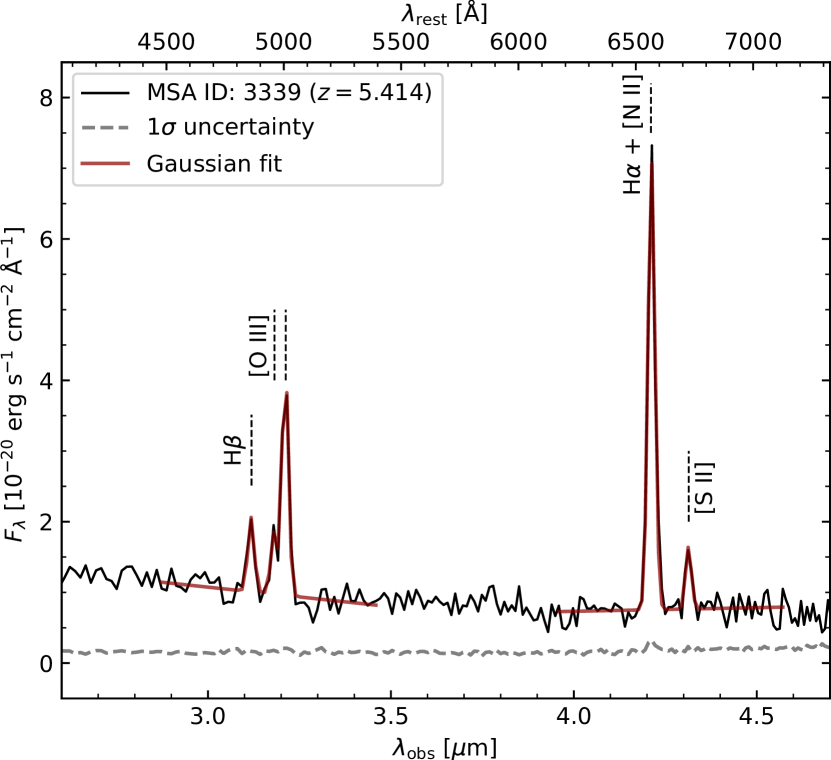
- Hβ、[OIII]、Hα、[NII]、[SII] の発光線と連続を抽出し、線フラックスと Balmer 律を測定する。
- 発光線と Balmer ブreak の特徴に基づいて、銀河を dusty または quiescent に分類する。
- 分光赤方偏移と多バンド光度データを用いた BAGPIPES による SED fitting を実施し、M*、SFR、A_V を導出する。
- Balmer 律 (Hα/Hβ) を用いて Calzetti 減衰を介して A_V を導出し、Hα の光度と [NII] の混合を Hα 光度測定で考慮する。
- SED 分析には、遅延型 SFH モデルを wide τ 範囲、金属licity 0.2–2.5 Z⊙、 CLOUDY Nebular emission を組み込む。
実験結果
リサーチクエスチョン
- RQ1JWST/NIRSpec PRISM で観測した場合、HST-dark 銀河の赤方偏移分布はどうなるか。
- RQ2z>3 の HST-dark 銀河のうち、分光データに基づく dusty と quiescent の割合はどの程度か。
- RQ3これらの銀河における Balmer 律による塵減衰と、SED fitting で得られる連続体ベースの減衰はどう比較されるか。
- RQ4発光線プロファイルから dusty HST-dark 銀河の中に AGN 活動が見られるか。
- RQ5これらの銀河の stellar masses や Hα の EW はどの程度で、分類とどう関係するか。
主な発見
| ID | RA | Dec | F_Hα (10^-20 erg/s/cm^2) | F_Hβ (10^-20 erg/s/cm^2) | A_V | EW_Hα (Å) | zspec |
|---|---|---|---|---|---|---|---|
| 1260 | 53.0748575 | -27.875898 | 290 ± 82 | <68 | >1.40 | 68 ± 26 | 4.44 |
| 1548 | 53.1347898 | -27.907492 | 463 ± 44 | <72 | >2.77 | 70 ± 9 | 4.43 |
| 1616 | 53.0766784 | -27.8734698 | 3553 ± 104 | <452 | >3.49 | 331 ± 17 | 3.46 |
| 3012 | 53.0767591 | -27.8641199 | 414 ± 50 | <115 | >0.80 | 149 ± 44 | 3.47 |
| 3339 | 53.1147448 | -27.8904202 | 1495 ± 50 | 230 ± 31 | 2.83 | 304 ± 59 | 5.41 |
| 3640 | 53.0821208 | -27.8598697 | 720 ± 94 | <78 | >4.03 | 146 ± 31 | 3.65 |
| 4307 | 53.1406347 | -27.8813756 | 1137 ± 55 | 83 ± 26 | 5.40 | 375 ± 231 | 5.52 |
| 4490 | 53.0410546 | -27.8544706 | 1829 ± 72 | 290 ± 42 | 2.74 | 484 ± 81 | 3.70 |
| 4820 | 53.034904 | -27.8521791 | 1966 ± 46 | 225 ± 36 | 3.85 | 545 ± 103 | 3.79 |
| 5446 | 53.0279874 | -27.8470862 | 1261 ± 51 | <209 | >2.58 | 267 ± 24 | 2.71 |
| 5510 | 53.1783286 | -27.8702734 | 1369 ± 49 | <264 | >2.06 | 134 ± 6 | 3.47 |
| 5607 | 53.1233683 | -27.8705379 | 434 ± 28 | 72 ± 28 | 2.58 | 346 ± 38 | 3.59 |
| 6151 | 53.0420756 | -27.8426437 | 316 ± 36 | <51 | >2.65 | 2025 ± 176 | 4.38 |
| 12469 | 53.0446935 | -27.8136318 | 2177 ± 50 | 323 ± 63 | 2.96 | 280 ± 17 | 3.55 |
| 12577 | 53.0484576 | -27.8151421 | 1799 ± 66 | 146 ± 19 | 5.05 | 977 ± 67 | 5.23 |
| 7151 | 53.05672 | -27.836383 | 1427 ± 67 | <119 | >4.8 | 2647 ± 93 | 3.79 |
- Median z_spec = 4.1 ± 0.7; all sources lie at z ≳ 3, with a peak around z ≈ 4.
- 13^{+9}_{-6}% (3/23) of the HST-dark sample are quiescent at z>3.
- Dusty HST-dark galaxies show A_V values from Balmer decrement typically >2.6 mag, with some cases exceeding A_V ≈ 5 mag.
- Dust attenuation derived from Balmer decrement is higher than continuum-based A_V from SED fitting, illustrating differential extinction between nebular and stellar regions.
- All dusty HST-dark galaxies are Hα emitters with rest-frame EWs ranging from ~68 Å to ~550 Å (except one AGN-dominated case with ~1000 Å).
- One quiescent galaxy (ID=8777, z=4.7) shows broad Hα indicating AGN activity; overall, AGN signatures are rare in the sample.
より良い研究を、今すぐ始めましょう
論文設計から論文執筆まで、研究時間を劇的に削減しましょう。
クレジットカード登録不要
このレビューはAIが作成し、人間の編集者が確認しました。