
[論文レビュー] Rapid Flood Inundation Forecast Using Fourier Neural Operator
本論文は、水理的シミュレーションからのマッピングを学習することで、迅速かつリアルタイムの洪水浸水予測を実現するフォーリエニューラルオペレータ(FNO)ベースのサーヴィエイトモデルを提案する。ヒューストンの6件の過去の暴風雨イベントで訓練されたFNOモデルは、U-Netベースラインを上回る優れた性能を示し、3時間のリードタイムで高い正確性(CSI > 0.93)を維持するとともに、微調整なしに新しい場所へも良好な一般化性能を示している。
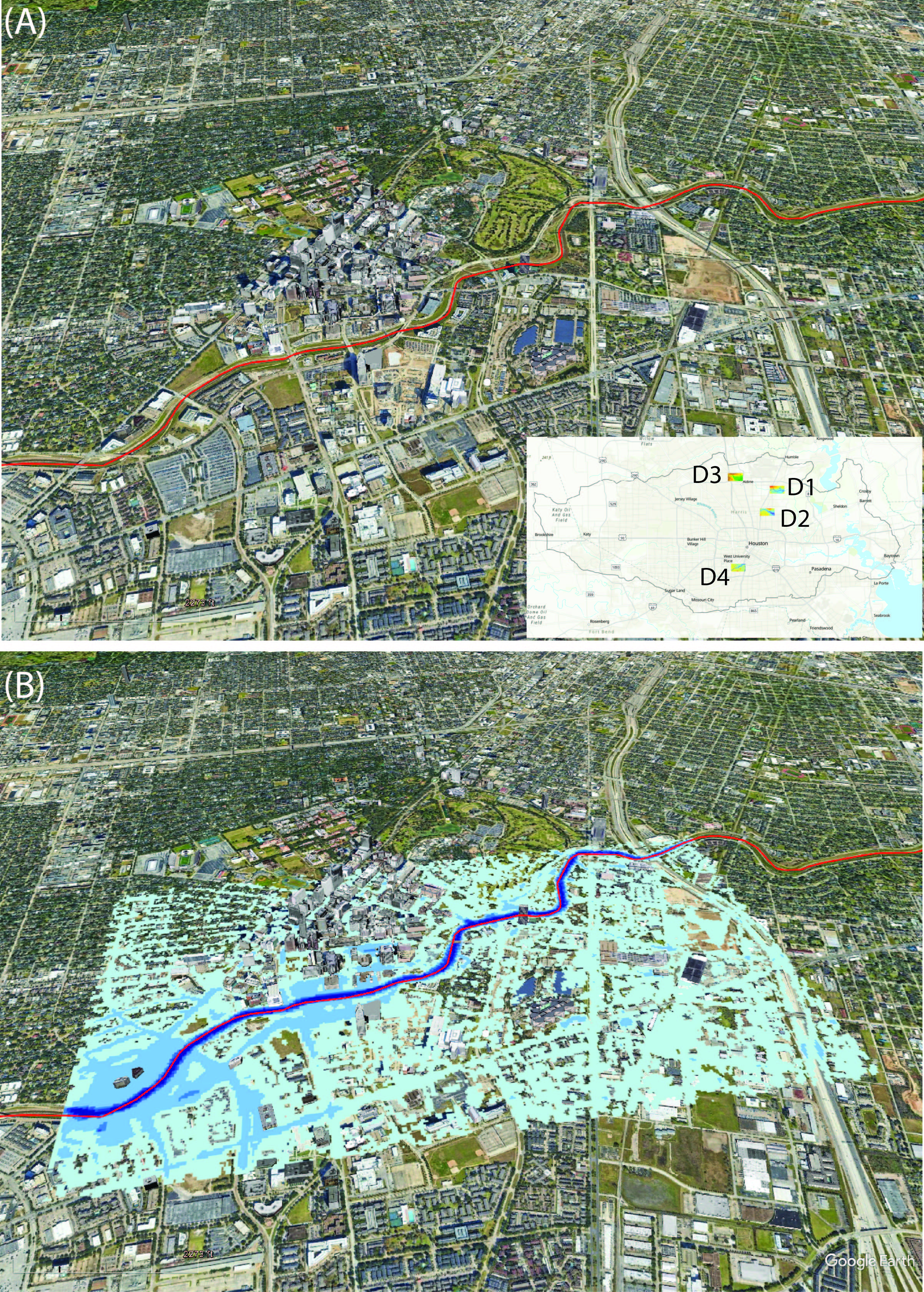
Flood inundation forecast provides critical information for emergency planning before and during flood events. Real time flood inundation forecast tools are still lacking. High-resolution hydrodynamic modeling has become more accessible in recent years, however, predicting flood extents at the street and building levels in real-time is still computationally demanding. Here we present a hybrid process-based and data-driven machine learning (ML) approach for flood extent and inundation depth prediction. We used the Fourier neural operator (FNO), a highly efficient ML method, for surrogate modeling. The FNO model is demonstrated over an urban area in Houston (Texas, U.S.) by training using simulated water depths (in 15-min intervals) from six historical storm events and then tested over two holdout events. Results show FNO outperforms the baseline U-Net model. It maintains high predictability at all lead times tested (up to 3 hrs) and performs well when applying to new sites, suggesting strong generalization skill.
研究の動機と目的
- 緊急対応計画およびリスク軽減を支援するため、リアルタイムかつ高解像度の洪水浸水予測の重要なニーズに対応する。
- 都市部における高解像度水理的モデル(例:2次元浅水域方程式)の計算ボトル neck を克服する。
- 物理的整合性を保持し、異なる暴風雨イベントおよび場所に一般化可能なデータ駆動型サーヴィエイトモデルを開発する。
- フォーリエニューラルオペレータ(FNO)を用いたマルチリードタイムの浸水範囲および水深予測の可能性を実証する。
- FNOモデルの性能をU-Netベースラインと比較し、微調整なしに新しいドメインへ適用可能な能力を評価する。
提案手法
- ヒューストンの6件の過去の暴風雨イベントから得た15分間隔の水深シーケンスを用いてFNOモデルを訓練する。
- 水深と空間勾配の両方の誤差をペナルティとして課す物理的制約付き損失関数を用い、物理的整合性を組み込む。
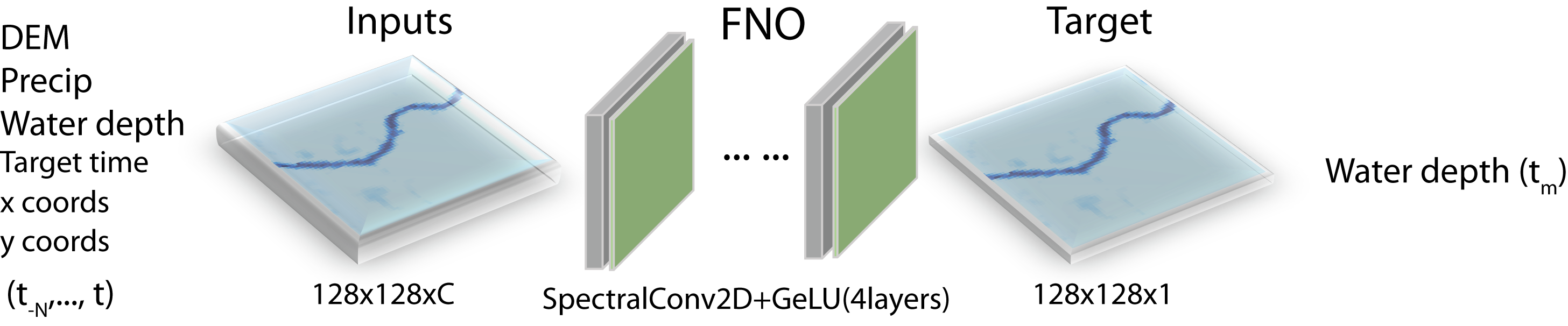
- 静的地理空間特徴(例:デジタルエレベーションモデル)と動的入力(例:降雨量、河川流量)をマルチチャネル入力として統合する。
- フーリエ変換を用いたスペクトル畳み込みにより、無限次元関数空間間のマッピングを効率的に学習する。
- 時間的文脈を確保するため12フレーム(180分)の履歴窓を用い、より長い履歴(24フレーム)および降水量のみの入力についてのアブレーションスタディを実施する。
- 複数のドメイン(D1–D3)で事前学習し、新しいドメイン(D4)に微調整なしに転移することで、ゼロショット一般化能力を評価する。
実験結果
リサーチクエスチョン
- RQ1FNOベースのサーヴィエイトモデルは、ストリートレベル解像度とマルチリードタイム予測を実現する高精度なリアルタイム洪水浸水予測を達成できるか?
- RQ2FNOモデルはU-Netベースラインと比較して、予測精度および推論効率の点でどのように異なるか?
- RQ3物理的制約付き損失関数は、モデルの一般化性能および物理的妥当性をどの程度向上させるか?
- RQ4類似したドメインで事前学習されたFNOモデルは、未観測の都市部に微調整なしに効果的に転移可能か?
- RQ5入力に先行水深を含めるか、降水量のみとするかの違いが、モデル性能にどのような影響を及えるか?
主な発見
- 2019/05/08のイベントにおいて、FNOモデルは15分リードタイムでCSI 0.9808、MAE 0.0044を達成し、U-Netベースライン(CSI: 0.9752、MAE: 0.0056)を上回った。
- 3時間リードタイムでは、FNOモデルはCSI 0.9324、MAE 0.0153を維持し、長時間リードタイムにおいても一貫した性能を示した。
- 24フレーム履歴(6時間)を用いたFNOモデルでは性能向上が見られず、この文脈ではより長い記憶の利点が限定的であることが示された。
- 降水量のみを入力とするFNOバージョン(FNO-12P)は著しく性能が低下した(15分時CSI: 0.4861)、先行水深の重要性を強調した。
- 複数ドメインFNO(FNO-MD)はD1–D3で事前学習し、D4に微調整なしに適用した結果、15分時でCSI 0.9659、180分時でCSI 0.9032を達成し、強力なゼロショット一般化性能を示した。
- FNOモデルの推論時間は1サンプルあたりたった0.002秒であり、リアルタイム導入が可能であった。一方、1エポックあたりの学習時間はRTX 3090 GPUで72秒であった。
より良い研究を、今すぐ始めましょう
論文の読解から最終レビューまで、研究時間を劇的に削減しましょう。
クレジットカード登録不要
このレビューはAIが作成し、人間の編集者が確認しました。