
[論文レビュー] Real-time Trust Prediction in Conditionally Automated Driving Using Physiological Measures
本研究では、生理的指標と機械学習を用いて、条件付き自動運転車のリアルタイム信頼予測システムを提案する。模擬的な運転継承シナリオにおいて、電気皮膚反応(GSR)、心拍変動(HRV)、および眼球追跡データを分析した結果、XGBoostモデルは動的信頼を予測する際、89.1%のF1スコアを達成し、他のモデルを上回り、車内での信頼補正システムの基盤を提供する。
Trust calibration presents a main challenge during the interaction between drivers and automated vehicles (AVs). In order to calibrate trust, it is important to measure drivers' trust in real time. One possible method is through modeling its dynamic changes using machine learning models and physiological measures. In this paper, we proposed a technique based on machine learning models to predict drivers' dynamic trust in conditional AVs using physiological measurements in real time. We conducted the study in a driving simulator where participants were requested to take over control from automated driving in three conditions that included a control condition, a false alarm condition, a miss condition with eight takeover requests (TORs) in different scenarios. Drivers' physiological measures were recorded during the experiment, including galvanic skin response (GSR), heart rate (HR) indices, and eye-tracking metrics. Using five machine learning models, we found that eXtreme Gradient Boosting (XGBoost) performed the best and was able to predict drivers' trust in real time with an f1-score of 89.1%. Our findings provide good implications on how to design an in-vehicle trust monitoring system to calibrate drivers' trust to facilitate interaction between the driver and the AV in real time.
研究の動機と目的
- 条件付き自動運転車における動的信頼を、生理的指標を用いてリアルタイムで予測する方法を開発すること。
- 運転継承シナリオにおける行動的・生理的測定値に基づき、機械学習モデルの信頼予測効果を評価すること。
- 自動運転環境における信頼推定に最も予測力のある生理的特徴を同定すること。
- ドライバーとAVのインタラクションおよび安全性を向上させる車内信頼補正システムの設計を支援すること。
提案手法
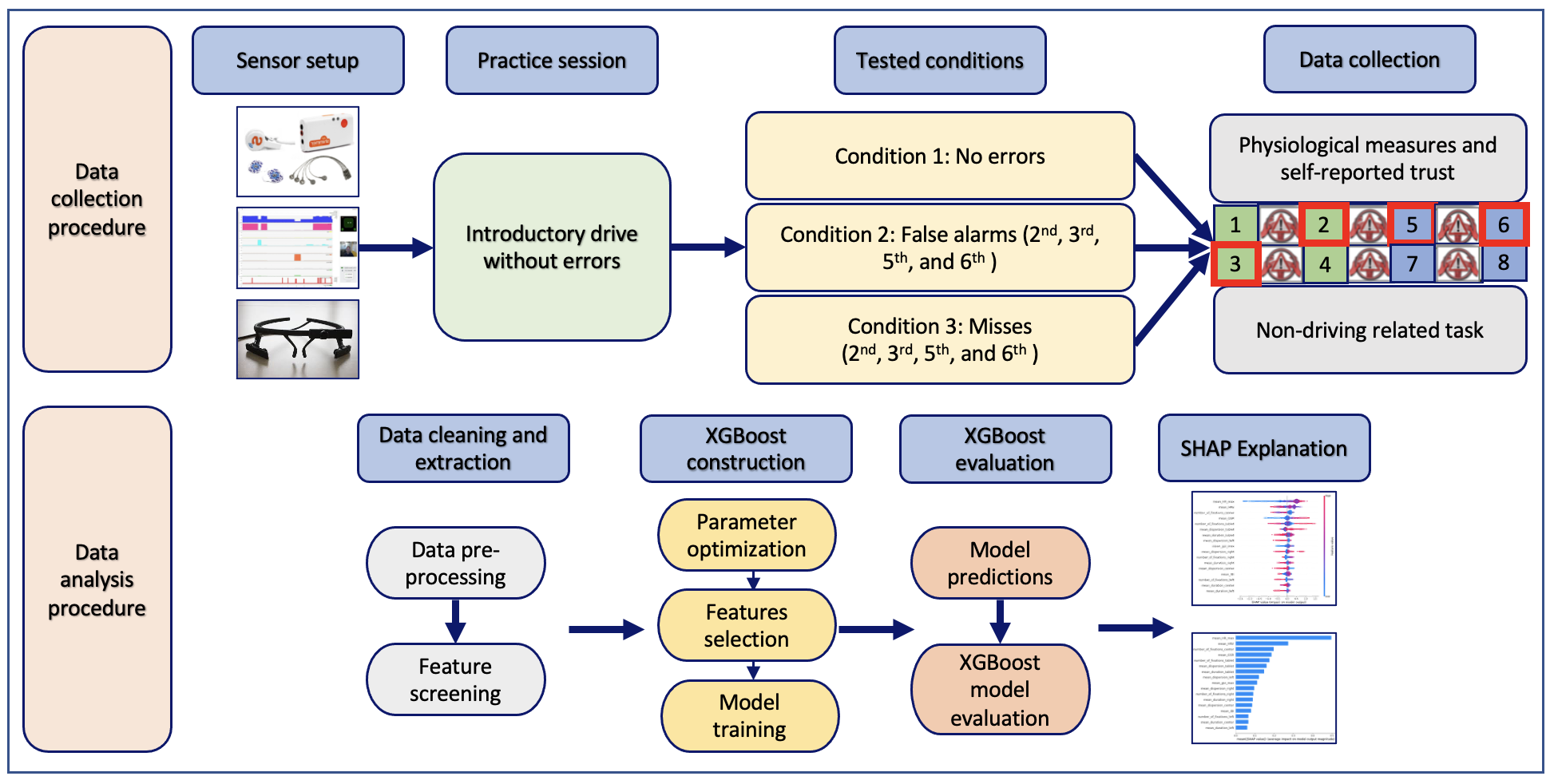
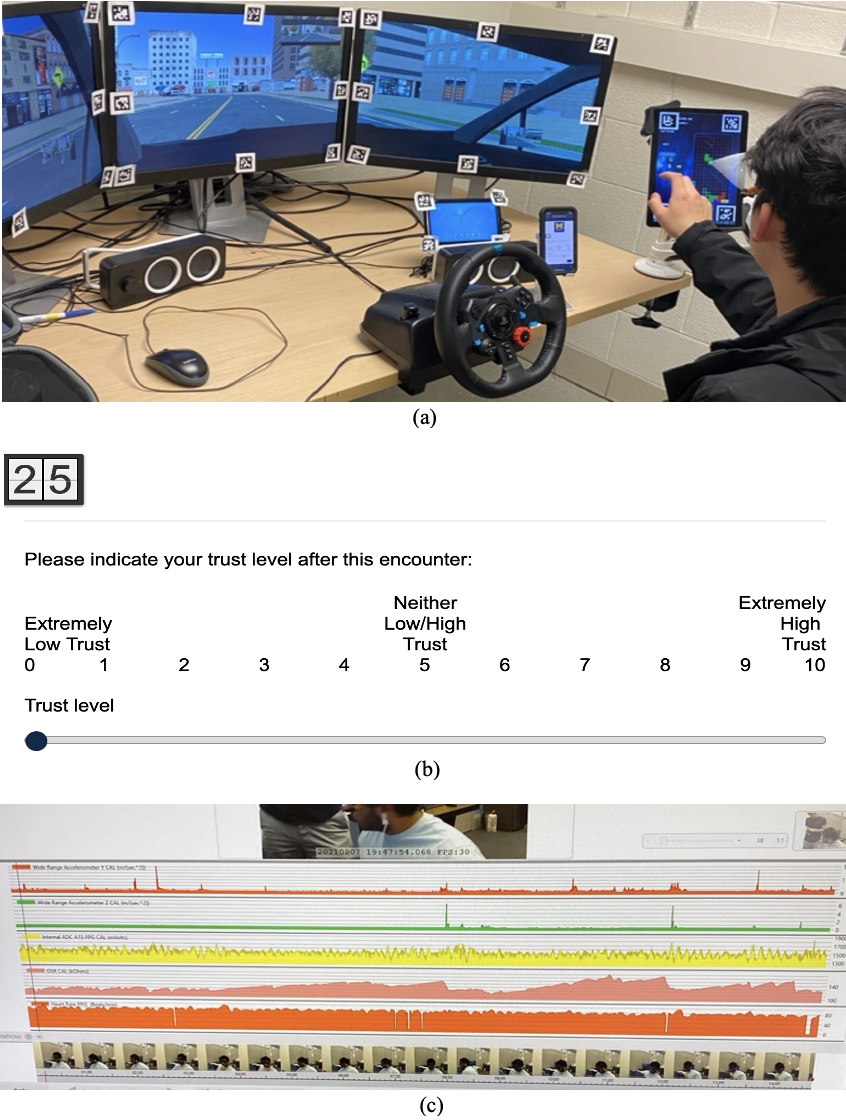
- 3つの条件(コントロール、誤報、見逃し)を含む8回の運転継承要求(TORs)を伴う、59名の参加者を対象としたドライブシミュレータ研究を実施した。
- 電気皮膚反応(GSR)、心拍(HR)インデックス、および中央ディスプレイおよびタブレットへの注視回数と注視時間などの眼球追跡指標を含む生理的データを収集した。
- 生理的および眼球追跡データから前処理と特徴抽出を行い、mean_GSR、mean_HRV、number_of_fixations_center、mean_duration_tabletなどを算出した。
- 行動的および生理的パターンに基づくラベル付き信頼状態を用いて、XGBoost、ランダムフォレスト、ロジスティック回帰、SVM、ナイーブベイズの5つの機械学習モデルを訓練した。
- リアルタイムでの動的運転相互作用中の信頼レベル予測を可能にするため、時間窓アプローチを採用した。
- F1スコアと特徴の重要度分析に基づき、XGBoostを最適モデルとして選定した。
実験結果
リサーチクエスチョン
- RQ1生理的指標は、条件付き自動運転における動的信頼をリアルタイムで信頼性高く予測できるか?
- RQ2誤報と見逃しの異なるシステム障害は、信頼ダイナミクスと生理的反応にどのように影響するか?
- RQ3リアルタイムの生理的データを用いた信頼予測において、どの機械学習モデルが最も優れた性能を示すか?
- RQ4具体的にどの生理的および眼球追跡特徴がドライバーの信頼に最も予測力を持つか?
主な発見
- XGBoostモデルは、リアルタイム信頼予測において89.1%のF1スコアを達成し、他のモデルを上回った。
- コントロール、誤報、見逃しの各条件下で、信頼状態を分類する際の正答率は81.6%であった。
- 最も予測力の高かった特徴は、mean_HR_max、mean_HRV、number_of_fixations_center、mean_GSR、number_of_fixations_tablet、mean_dispersion_tablet、mean_duration_tabletであった。
- mean_HRVの上昇は、特に信頼度が低い状況(見逃し)において、警戒状態の向上とより良い認知的準備状態に関連していた。
- mean_GSRの上昇は、信頼度の上昇と関連しており、特に制御に参加する状況でのアーザルの増加が要因と考えられ、一部の先行研究とは矛盾する結果であった。
- 中央ディスプレイおよびタブレットへの注視回数と注視時間といった眼球追跡特徴が、顕著な予測要因であった。これは、システムインターフェースへの注意の集中を示している。
より良い研究を、今すぐ始めましょう
論文の読解から最終レビューまで、研究時間を劇的に削減しましょう。
クレジットカード登録不要
このレビューはAIが作成し、人間の編集者が確認しました。