
[論文レビュー] REBELS-IFU: Dust Build-up in Massive Galaxies at Redshift 7
この論文は、JWST/NIRSpec 金属量と ALMA の塵・ガス測定を用いて、z~6.5–7.7 の 12 個の REBELS 惑星系における塵・ガス・金属含有量を分析し、早期宇宙における塵-ガス、塵-金属、塵-星質量関係を制約する。
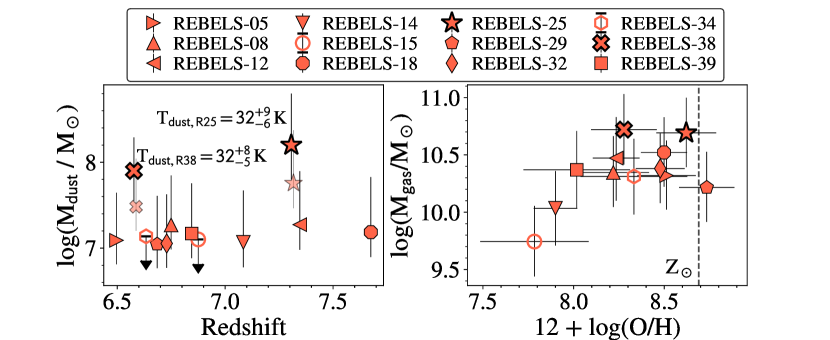
In recent years, observations with the JWST have started to map out the rapid metal enrichment of the early Universe, while (sub)millimeter observations have simultaneously begun to reveal the ubiquity of dust beyond $z\gtrsim6$. However, the pathways that led to the assembly of early dust reservoirs remain poorly quantified, and require pushing our understanding of key scaling relations between dust, gas and metals into the early Universe. We investigate the dust build-up in twelve $6.5 \lesssim z \lesssim 7.7$ galaxies drawn from the REBELS survey that benefit from (i) JWST/NIRSpec strong-line metallicity measurements, (ii) ALMA [CII]-based redshifts and gas masses, and (iii) dust masses from single- or multi-band ALMA continuum observations. Combining these measurements, we investigate the dust-to-gas (DtG), dust-to-metal (DtM), and dust-to-stellar mass (DtS) ratios of our sample as a function of metallicity. While our analysis is limited by systematic uncertainties related to the [CII]-to-H$_2$ conversion factor and dust temperature, we explore a wide range of possible values, and carefully assess their impact on our results. Under a fiducial set of assumptions, we find an average $\log(\mathrm{DtG}) = -3.02 \pm 0.23$, only slightly below that of local metal-rich galaxies. On the other hand, at fixed metallicity our average $\log(\mathrm{DtS}) = -2.15 \pm 0.42$ is significantly larger than that of low-redshift galaxies. Finally, through a comparison to various theoretical models of high-redshift dust production, we find that assembling the dust reservoirs in massive galaxies at $z\approx7$ likely requires the combination of rapid supernova enrichment and efficient ISM dust growth.
研究の動機と目的
- 6 以上の宇宙年齢の巨大銀河の塵・ガス・金属含有量を、JWST/NIRSpec と ALMA データの共同利用で定量化する。
- 塵-ガス、塵-金属、塵-星質量のスケーリング関係を、金属量の関数として検討する。
- 初期の塵蓄積 reservoir を生み出す過程における SN 富化と ISM 塵成長の役割を評価する。
- 妥当なパラメータ範囲全体で、[C II]-to-H2 変換や塵温度を含む体系的不確かさを評価する。
提案手法
- ALMA の [C II]-ベースのガス質量と連続波長観測から得られる塵質量を組み合わせて DtG、DtM、DtS 比を導出する。
- Zanella et al. (2018) の [C II]-to-H2 校正を用いて、[C II] 光度から分子ガス質量を推定する。
- JWST/NIRSpec の強線診断(R23、O32、R3 が適用可能な場合)からの金属量を採用し、他の較正値と照合する。
- fiducial な仮定の下で塵-ガス、塵-金属、塵-星質量比を計算し、広い範囲の塵温度やその他の不確かパラメータを探索する。
- 初期の銀河において分子ガスを主成分と仮定し(HI は無視できる程度)、塵成長モデルへの影響を検討する。
実験結果
リサーチクエスチョン
- RQ1z~6.5–7.7 の銀河における観測 DtG、DtM、DtS 比はどの程度で、ガス相金属量とどうスケールするのか。
- RQ2迅速な SN 富化と ISM 塵成長が、大質量の初期銀河における推定塵蓄積量を説明しうるか。
- RQ3[C II]-to-H2 変換、塵温度、塵特性に関する仮定が、推定塵スケーリング関係にどのように影響するか。
- RQ4観測された塵と金属含有量は、高赤像域での塵生成理論モデルのうちどのモデルを支持するか。
主な発見
- 平均 DtG は log(DtG) ≈ -3.02、分散約 0.23 dex、局所の金属豊富銀河よりやや低い。
- 金属量を固定した場合の平均 DtS は log(DtS) ≈ -2.15、分散約 0.42 dex、典型的な低赤方偏移銀河より高い。
- DtM と DtS の関係は、z~7 系において金属含有量に対して塵質量が substantial であることを示唆し、塵処理が効率的であることを示唆する。
- 結果は [C II]-to-H2 変換と仮定した塵温度に敏感であり、影響を定量化するための広範なパラメータ探索が実施された。
- 理論モデルとの比較は、観測された塵蓄積を z~7 まで構築するには、迅速な SN 富化と効率的な ISM 塵成長の組み合わせが必要であることを示唆する。
![Figure 2: The effect of the adopted $\alpha_{\text{[C\,{\sc ii}]{}}}$ and $T_{\mathrm{dust}}$ on the inferred dust-to-gas ratio of a hypothetical galaxy at the median redshift ( $z=6.8$ ) and [C ii ] luminosity [ $\log(L_{\text{[C\,{\sc ii}]{}}}/L_{\odot})=8.9$ ] of our sample. The thickest contour](https://ar5iv.labs.arxiv.org/html/2501.10508/assets/x2.png)
より良い研究を、今すぐ始めましょう
論文設計から論文執筆まで、研究時間を劇的に削減しましょう。
クレジットカード登録不要
このレビューはAIが作成し、人間の編集者が確認しました。